
Vuélvete ilimitado con Magzter GOLD
Obtenga acceso ilimitado a más de 9000 revistas, periódicos e historias Premium por solo
Cracking the World's Most Famous Code
Scientific American
|January 2026
Solving the CIA's Kryptos puzzle took three parts math and one part sleuthing
-
THE 35-YEAR-OLD SAGA OF KRYPTOS, an enigmatic sculpture containing four encrypted messages outside the headquarters of the U.S. Central Intelligence Agency, recently took a bizarre twist. Cryptographers had broken the first three passages in the 1990s, just a few years after artist Jim Sanborn erected the copper structure. But the fourth, known as K4, remained a 97-character fortress—that is, until last September, when journalists Jarett Kobek and Richard Byrne discovered the answer in the Smithsonian archives.
How does one crack the world’s most famous code? The breakthroughs on Kryptos provide a guided tour of the cat-and-mouse game played by code makers and code breakers that has defined information security for millennia.
The core challenge of cryptography is to deliver a secret message securely in the presence of eavesdroppers. The strategy always involves the same ingredients: The message, called the plaintext, gets distorted (the encryption) so that anybody who intercepts it sees only garbled gibberish (the ciphertext). Ideally, only those with a secret key can decrypt it. If you share your secret key with the intended recipient and nobody else, then you can, in theory, communicate with them in code. Cryptography underlies everyday financial transactions and online communication, not just spy messages.
To understand Kryptos
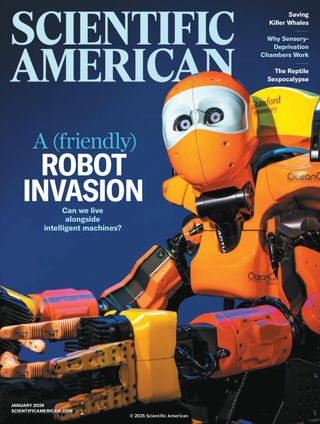

Esta historia es de la edición January 2026 de Scientific American.
Suscríbete a Magzter GOLD para acceder a miles de historias premium seleccionadas y a más de 9000 revistas y periódicos.
¿Ya eres suscriptor? Iniciar sesión
MÁS HISTORIAS DE Scientific American

Scientific American
Probiotic Hope and Hype
Despite their popularity, supplements with billions of \"good\" microbes help only a few illnesses, research shows

3 mins
January 2026

Scientific American
Mondays Really Are More Stressful
The start of the workweek can be a biologically measurable stressor, with consequences for long-term health that can stretch into retirement
4 mins
January 2026
Scientific American
Tiny Display
An e-paper breakthrough brings extremely high-resolution color
2 mins
January 2026
Scientific American
Fine-Feathered Snack
A bat's tracker documents a dramatic midair hunt
2 mins
January 2026

Scientific American
OUR ROBOTIC PICTURE
Will mechanical helpers ever be commonplace at home, at work and beyond?
11 mins
January 2026

Scientific American
"Use Your Words" Can Be Good for Kids' Health
Writing or expressing feelings can help adults mentally and physically. Kids are no different
5 mins
January 2026

Scientific American
Distant Diplomacy
Unrelated species “talk” and understand one another to avoid threats
2 mins
January 2026
Scientific American
Behind the Nobel
A 2025 winner reflects on the mysterious T cells that won him the prize
5 mins
January 2026
Scientific American
A Suite of Killers
Heart ailments, kidney diseases and type 2 diabetes actually may be part of just one condition. It's called CKM syndrome
10 mins
January 2026
Scientific American
Static Launch
Tiny worms leap toward their fruit fly hosts with an electric “tractor beam”
3 mins
January 2026
Listen
Translate
Change font size