Intentar ORO - Gratis
A New View of CO2
Scientific American
|December 2025
The most important and most misunderstood molecule on Earth
WHEN WE TALK ABOUT CARBON DIOXIDE, the narrative is almost always that of a modern-day morality play. We hear about gigatons of CO₂ emitted, about rising global temperatures and about the dire, unheeded warnings of climate scientists. In these tales, CO₂ often seems less like a mute, inert molecule and more like a supervillain—a malevolent force that has been plotting for centuries to wreak havoc on our planet and ruin our lives.
But according to science journalist Peter Brannen, that dismal view is far too narrow. In his latest book, The Story of CO₂ Is the Story of Everything (Ecco, 2025), he reframes our understanding of what may be the most vilified and misunderstood molecule on Earth.
Inspired and informed by conversations with leading planetary scientists, Brannen's central argument is that CO₂ is not merely an industrial pollutant but a key player in the four-billion-year-old drama of life on Earth. It is the molecule that built our planet, forming the global carbon cycle that has regulated climate, shaped geology and powered evolution for eons. He shows how the ebb and flow of atmospheric CO₂ across Earth's vast history has played a role in practically everything under the sun—from the primordial origins of life to the development of human civilization and our global economic system. Brannen makes the case that to understand CO₂, from the ancient past to the present day, is to understand the very fabric of our world.
SCIENTIFIC AMERICAN spoke with Brannen about what's in his new book, how he came to see a simple gas as a character in a planetary epic, and what the long history of CO₂ can tell us about our precarious present moment—and our uncertain future.
An edited transcript of the interview follows.
How did this book come to be?
That's always a great way to start. My previous book,
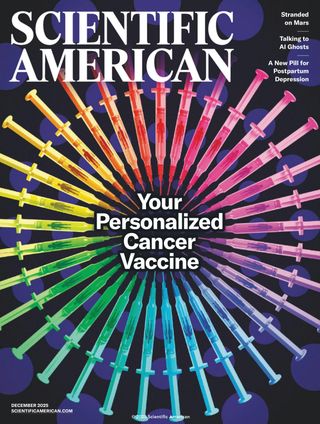

Esta historia es de la edición December 2025 de Scientific American.
Suscríbete a Magzter GOLD para acceder a miles de historias premium seleccionadas y a más de 9000 revistas y periódicos.
¿Ya eres suscriptor? Iniciar sesión
MÁS HISTORIAS DE Scientific American

Scientific American
Probiotic Hope and Hype
Despite their popularity, supplements with billions of \"good\" microbes help only a few illnesses, research shows

3 mins
January 2026

Scientific American
Mondays Really Are More Stressful
The start of the workweek can be a biologically measurable stressor, with consequences for long-term health that can stretch into retirement
4 mins
January 2026
Scientific American
Tiny Display
An e-paper breakthrough brings extremely high-resolution color
2 mins
January 2026

Scientific American
Fine-Feathered Snack
A bat's tracker documents a dramatic midair hunt
2 mins
January 2026

Scientific American
OUR ROBOTIC PICTURE
Will mechanical helpers ever be commonplace at home, at work and beyond?
11 mins
January 2026

Scientific American
"Use Your Words" Can Be Good for Kids' Health
Writing or expressing feelings can help adults mentally and physically. Kids are no different
5 mins
January 2026

Scientific American
Distant Diplomacy
Unrelated species “talk” and understand one another to avoid threats
2 mins
January 2026
Scientific American
Behind the Nobel
A 2025 winner reflects on the mysterious T cells that won him the prize
5 mins
January 2026

Scientific American
A Suite of Killers
Heart ailments, kidney diseases and type 2 diabetes actually may be part of just one condition. It's called CKM syndrome
10 mins
January 2026
Scientific American
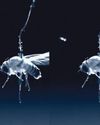
Static Launch
Tiny worms leap toward their fruit fly hosts with an electric “tractor beam”
3 mins
January 2026
Listen
Translate
Change font size