
Vuélvete ilimitado con Magzter GOLD
Obtenga acceso ilimitado a más de 9000 revistas, periódicos e historias Premium por solo
Intentar ORO - Gratis
TRUMP'S TARIFF FRENZY
Down To Earth
|April 16, 2025
India should be most concerned about 'reciprocal tariffs' as Donald Trump seeks to pry open the country's agricultural markets for US' agri-business companies
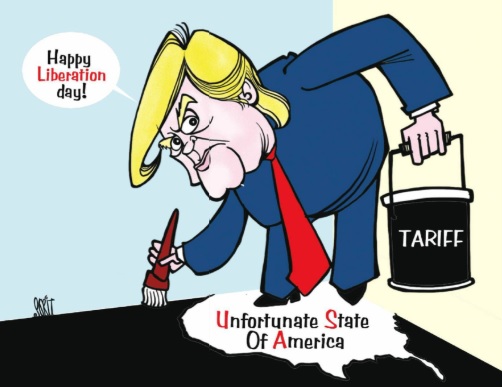
THE EXTRAORDINARY step that US President Donald Trump has taken on April 2 by imposing “reciprocal tariffs”, which he described as the “declaration of economic independence”, has thrown the global economy in the throes of severe uncertainties that have never been seen since the Great Depression during the 1930s. Trump unveiled the “reciprocal tariffs” through the Executive Order, “Regulating Imports with a Reciprocal Tariff to Rectify Trade Practices that Contribute to Large and Persistent Annual United States Goods Trade Deficits”. As many as 57 countries were targeted through the imposition of “reciprocal tariffs”, ranging from 11 per cent to 49 per cent, which were to be introduced on April 9. But a few days earlier, on April 5, an additional ad valorem duty of 10 per cent was imposed on all imports from all trading partners. The “reciprocal tariff” on India was 26 per cent, implying that all exports to its largest export market are facing 36 per cent tariffs. These are sufficiently steep to seriously impinge on export prospects of several key industries for whom the US is a major market.
India’s South Asian neighbours have been slapped “reciprocal tariffs” that are much higher. Sri Lanka faces the highest “reciprocal tariff” of 44 per cent (54 per cent overall), while for Bangladesh and Pakistan the overall tariff burden would be 47 per cent and 40 per cent respectively.


Esta historia es de la edición April 16, 2025 de Down To Earth.
Suscríbete a Magzter GOLD para acceder a miles de historias premium seleccionadas y a más de 9000 revistas y periódicos.
¿Ya eres suscriptor? Iniciar sesión
MÁS HISTORIAS DE Down To Earth

Down To Earth
Bitter pill
THE WEB SERIES PHARMA EXPOSES HARSH TRUTHS OF THE PHARMACEUTICAL INDUSTRY, WHERE PROFIT OFTEN BECOMES MORE IMPORTANT THAN HUMAN HEALTH

3 mins
January 16, 2026
Down To Earth
CHAOS IN-DEFINITION
The Aravallis are perhaps India's most litigated hill range. More than 4,000 court cases have failed to arrest their destruction. The latest dispute concerns a narrow legal definition of this geological antiquity, much of which has been obliterated by mining and urban sprawl. While the Supreme Court has stayed its own judgement accepting that definition, it must see the underlying reality and help reconcile development and national security with conservation.
19 mins
January 16, 2026
Down To Earth
BITS: INDIA
Indore has recorded 16 deaths and more than 1,600 hospitalisations between December 24 and January 6.
1 min
January 16, 2026

Down To Earth
GUARANTEE EXPIRES
India's rural employment guarantee law is replaced with a centrally controlled, budget-capped scheme. Is this an attack on the right to work?
3 mins
January 16, 2026

Down To Earth
BLOOM OR BANE
Surge of vibrant pink water lilies in Kuttanad, Kerala, provides socio-economic benefits, but the plant's ecological impacts must be understood
4 mins
January 16, 2026
Down To Earth
INVISIBLE EMPLOYER
Field and academic evidence shows sharp falls in casual agricultural employment at places where groundwater access declines
3 mins
January 16, 2026

Down To Earth
Schemed for erasure
Does the VB-G RAMG Act address structural weaknesses long observed in MGNREGA's implementation?
10 mins
January 16, 2026

Down To Earth
School of change
An open school in Panagar, Madhya Pradesh, aims to protect children of tribal settlements from falling into the trap of addiction
2 mins
January 16, 2026

Down To Earth
PULSE OF RESILIENCE
As a climate-ready crop, cowpea shows potential for widespread use in India
3 mins
January 16, 2026
Down To Earth
BITS GLOBAL
Britain recorded its hottest and sunniest year ever in 2025, the country's meteorological office said on January 2.
1 min
January 16, 2026
Listen
Translate
Change font size