Intentar ORO - Gratis
Revival of a tradition
Down To Earth
|April 16, 2023
Rajasthan communities restore pastureland to ease impacts of fodder crisis in livestock farming

AT A time when dairy farmers across the country are struggling to keep their businesses afloat in the face of steady inflation in fodder prices and severe shortage in fodder availability, animal husbandry continues to be a profitable proposition in the semi-arid region of Rajasthan's Udaipur and Bhilwara districts.
"Till 10 years ago, we too used to struggle for arranging feed for our animals," says 50-year-old Sarsi Bai, from Boojh village in Udaipur district. Though arranging fodder and different forage crops for their livestock has been a way of life for the residents of the semi-arid village, fodder availability had gradually reduced with population growth and fragmentation of landholding. In the 2010s, the situation became so dire that most households had to buy fodder from a private beed (pasture) some 7 km away; price of the fodder depended on the beed owner's will. In 2016, Boojh residents got in touch with the Foundation for Ecological Security (FES), a non-profit that works with communities across the country on ecological restoration. This marked a turnaround for not only the households of Boojh, but also several other villages in the region.
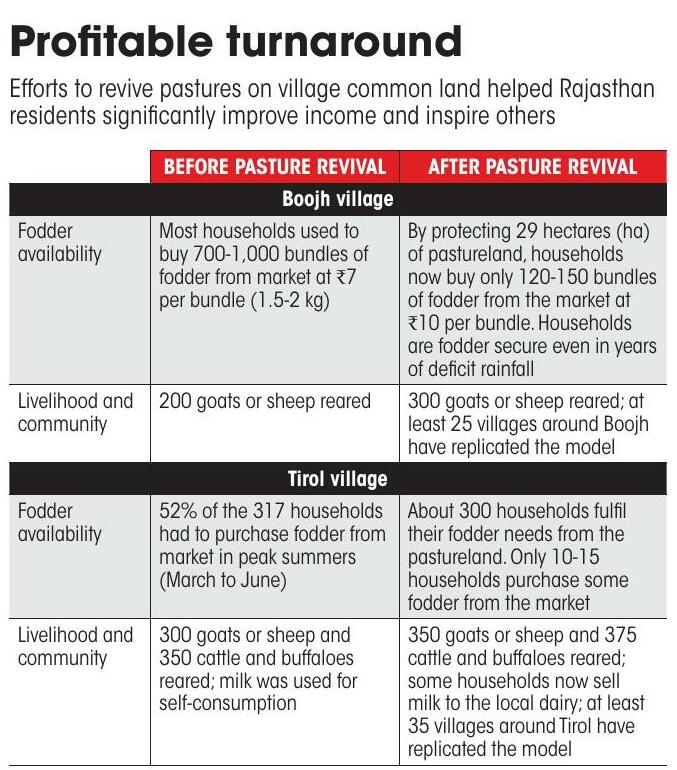
"FES researchers told us that we can overcome the fodder crisis by reviving and managing the shamlat or village common land," recalls Deepak Shrimali, a resident. There are three pastures, spanning 45 hectares (ha), which Boojh residents shared with neighbouring villages. Soon, almost all the households in the village came together to set up a "pasture development and management committee", and named it after the local deity Bhujeshwar Mahadev. The committee decided to revive one of the three pastures. FES prepared a revival plan for the 15 ha patch and offered guidance to the committee from time to time.


Esta historia es de la edición April 16, 2023 de Down To Earth.
Suscríbete a Magzter GOLD para acceder a miles de historias premium seleccionadas y a más de 9000 revistas y periódicos.
¿Ya eres suscriptor? Iniciar sesión
MÁS HISTORIAS DE Down To Earth

Down To Earth
THE GREAT PIVOT
China's moves to transition to clean energy offer critical lessons to India

4 mins
March 01, 2026

Down To Earth
COAL V CORRIDOR
A proposal to mine coal along a corridor that links two tiger reserves in central India is a step away from getting final clearance. The move could affect movement and genetic diversity of tiger populations in the region
8 mins
March 01, 2026

Down To Earth
India's challenging AI predicament
Hobbled by lack of innovation and AI skills in its crucial technology sector, India is focusing on a ruinous plan to host data centres
4 mins
March 01, 2026
Down To Earth
China to implement zero tariffs across Africa
CHINA ON February 14 announced that it will implement zero tariffs for imports from all the 53 African nations it has diplomatic relations with, starting from May 1.
1 min
March 01, 2026
Down To Earth
Poverty, sans the threshold
MEASUREMENT OF poverty is a fundamental exercise, needed to direct development programmes.
2 mins
March 01, 2026

Down To Earth
A bridge across forever
For two decades, a Chhattisgarh village remains stuck in a loop of building temporary river crossings to access markets and sell forest produce
4 mins
March 01, 2026
Down To Earth
Liveable cities need a new model
CRY FOR my Delhi. This is my city—my family records many generations who have lived here.
3 mins
March 01, 2026

Down To Earth
Real impacts of the changing seasons
This refers to the article \"1,500 days, and an alarm for new climate\" (1-15 December, 2025).
1 mins
March 01, 2026

Down To Earth
‘It’s a systematic effort by US to dismantle climate policy’
The US, the world's largest historical emitter of greenhouse gases, has overturned its “endangerment finding”, the legal foundation for regulating emissions under the Clean Air Act since 2009.
4 mins
March 01, 2026
Down To Earth
Amazon turned carbon source in 2023 drought
EXTREME DROUGHT and a prolonged heatwave in 2023 pushed parts of the Amazon rainforest from acting as a carbon sink to becoming a carbon source for three months, according to a February 13 study published in the journal AGU Advances of the American Geophysical Union.
1 min
March 01, 2026
Translate
Change font size