Intentar ORO - Gratis
KILL TO CONSERVE
Down To Earth
|August 01, 2022
Sustainable use of wildlife is the best approach to conservation in the long run. This is the latest scientific assessment by the Intergovernmental Science-Policy Platform on Biodiversity and Ecosystem Services (IPBES). Optimal exploitation of wild flora and fauna will ensure that livelihood and dietary needs of humans are met without threatening survival of the species. But do countries have the capacity to ensure sustainable use, and to make sure the benefits reach local communities? An analysis by SHUCHITA JHA, HIMANSHU NITNAWARE and VIBHA VARSHNEY in New Delhi with ABSALOM SHIGWEDHA in Namibia, CYRIL ZENDA in Zimbabwe, PETER ELIAS in Tanzania and CHRISTOPHE HITAYEZU in Rwanda
-

After four years, when the intergovernmental body IPBES released the summary of its much-awaited "Assessment Report on the Sustainable Use of Wild Species" on July 8, many knew that it would provoke animal rights groups.
Adopted at the ninth plenary session of IPBES or the Intergovernmental Science-Policy Platform on Biodiversity and Ecosystem Services in Bonn, Germany, the summary has been prepared by nearly 300 social and natural scientists from across the world who examined 6,200 scientific studies and repositories of indigenous knowledge. It is the most detailed scientific summary, to date, on the benefits of wild species and lists pathways for using them sustainably.
Suggesting greater integration of species conservation and food security, the summary states that billions of people worldwide rely on some 50,000 wild species for food, energy, medicine and income. Roughly, 33,000 of the species are plants and fungi; 7,500 are fish and aquatic invertebrates; and 9,000 are amphibians, insects, reptiles, birds and mammals. Of these, more than 10,000 species are used directly for human food. Sustainable use of the wild species is, therefore, fundamental to maintaining biodiversity and ecosystem functions in the long term, while achieving food security and improving nutrition across the globe. About 70 per cent of the world's poor directly depend on wild species for survival. In many cases, wild species are symbols of cultural identities.
The report states that sustainable use of wild species would bolster the UN's Sustainable Development Goals (SDGs). It can help achieve 80 per cent of the SDG1 and SDG2 goals each that aim at eradicating poverty and hunger. This is apart from contributing to the achievement of 15 other SDGS that include ensuring good health and well-being; reducing inequality; providing access to affordable clean energy; and promoting economic growth.
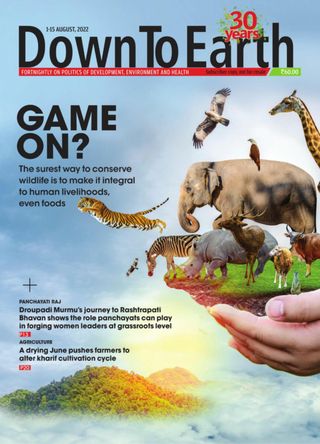

Esta historia es de la edición August 01, 2022 de Down To Earth.
Suscríbete a Magzter GOLD para acceder a miles de historias premium seleccionadas y a más de 9000 revistas y periódicos.
¿Ya eres suscriptor? Iniciar sesión
MÁS HISTORIAS DE Down To Earth

Down To Earth
THE GREAT PIVOT
China's moves to transition to clean energy offer critical lessons to India

4 mins
March 01, 2026

Down To Earth
COAL V CORRIDOR
A proposal to mine coal along a corridor that links two tiger reserves in central India is a step away from getting final clearance. The move could affect movement and genetic diversity of tiger populations in the region
8 mins
March 01, 2026

Down To Earth
India's challenging AI predicament
Hobbled by lack of innovation and AI skills in its crucial technology sector, India is focusing on a ruinous plan to host data centres
4 mins
March 01, 2026
Down To Earth
China to implement zero tariffs across Africa
CHINA ON February 14 announced that it will implement zero tariffs for imports from all the 53 African nations it has diplomatic relations with, starting from May 1.
1 min
March 01, 2026
Down To Earth
Poverty, sans the threshold
MEASUREMENT OF poverty is a fundamental exercise, needed to direct development programmes.
2 mins
March 01, 2026

Down To Earth
A bridge across forever
For two decades, a Chhattisgarh village remains stuck in a loop of building temporary river crossings to access markets and sell forest produce
4 mins
March 01, 2026
Down To Earth
Liveable cities need a new model
CRY FOR my Delhi. This is my city—my family records many generations who have lived here.
3 mins
March 01, 2026
Down To Earth
Real impacts of the changing seasons
This refers to the article \"1,500 days, and an alarm for new climate\" (1-15 December, 2025).
1 mins
March 01, 2026

Down To Earth
‘It’s a systematic effort by US to dismantle climate policy’
The US, the world's largest historical emitter of greenhouse gases, has overturned its “endangerment finding”, the legal foundation for regulating emissions under the Clean Air Act since 2009.
4 mins
March 01, 2026
Down To Earth
Amazon turned carbon source in 2023 drought
EXTREME DROUGHT and a prolonged heatwave in 2023 pushed parts of the Amazon rainforest from acting as a carbon sink to becoming a carbon source for three months, according to a February 13 study published in the journal AGU Advances of the American Geophysical Union.
1 min
March 01, 2026
Translate
Change font size