Intentar ORO - Gratis
BUILT TO BINGE
Down To Earth
|October 16, 2025
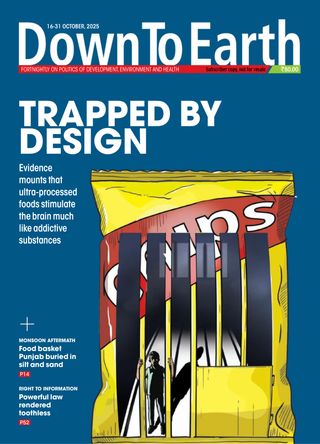
Over the past few decades, food companies have exploited basic human instincts to peddle ultra-processed products. Engineered to hijack the brain's reward system, these foods are silently fuelling a new addiction epidemic, and driving rising rates of obesity and chronic diseases. Urgent policy action is needed to reclaim control over our food environment.

THE WORLD has long known how cigarettes hijack the brain. Light one, inhale, and the nicotine hit is instant. Within seconds, the chemical acts on the brain to induce a pleasurable sensation—some report euphoria or heightened alertness; others, a sense of calm or satisfaction. Over time, the brain begins to crave this effect, leading to nicotine dependence. And despite the well-documented health risks, many users struggle to kick the habit.
Now replace the cigarette with a packet of chips or cookies. You open it, reach for one, and within seconds, your hand is back in the packet—much like the iconic tag line of Pringles’ stackable chips: “Once you pop, you can’t stop.” The craving is rarely driven by hunger. A growing body of research suggests that the brain demands more of these ultra-processed foods (UPFS) much like in the way it may crave for nicotine and other addictive substances.
Nearly 300 studies across 36 countries document that processed junk foods cause patterns of intake typical of drug addiction, write a group of scientists from the US in Nature Medicine on July 25. The article “Now is the time to recognize and respond to addiction to ultra-processed foods”, argues that certain foods can trigger addictive behaviour consistent with substance-use disorders. This is accepted by many addiction scientists and supported by evidence of neurobiological overlap with the brain circuits and molecular targets implicated in “classical” drug addictions. One meta-analysis from 2022, for example, estimates the global prevalence of addiction to UPFS at 14-20 per cent—equivalent to that of alcohol-use disorders.
Yet addiction to food is not formally recognised by medical classification systems, including the internationally accepted Diagnostic and Statistical Manual of Mental Disorders. This oversight, warns the Nature Medicine article, carries significant public health consequences.

Esta historia es de la edición October 16, 2025 de Down To Earth.
Suscríbete a Magzter GOLD para acceder a miles de historias premium seleccionadas y a más de 9000 revistas y periódicos.
¿Ya eres suscriptor? Iniciar sesión
MÁS HISTORIAS DE Down To Earth

Down To Earth
THE GREAT PIVOT
China's moves to transition to clean energy offer critical lessons to India

4 mins
March 01, 2026

Down To Earth
COAL V CORRIDOR
A proposal to mine coal along a corridor that links two tiger reserves in central India is a step away from getting final clearance. The move could affect movement and genetic diversity of tiger populations in the region
8 mins
March 01, 2026

Down To Earth
India's challenging AI predicament
Hobbled by lack of innovation and AI skills in its crucial technology sector, India is focusing on a ruinous plan to host data centres
4 mins
March 01, 2026
Down To Earth
China to implement zero tariffs across Africa
CHINA ON February 14 announced that it will implement zero tariffs for imports from all the 53 African nations it has diplomatic relations with, starting from May 1.
1 min
March 01, 2026
Down To Earth
Poverty, sans the threshold
MEASUREMENT OF poverty is a fundamental exercise, needed to direct development programmes.
2 mins
March 01, 2026

Down To Earth
A bridge across forever
For two decades, a Chhattisgarh village remains stuck in a loop of building temporary river crossings to access markets and sell forest produce
4 mins
March 01, 2026
Down To Earth
Liveable cities need a new model
CRY FOR my Delhi. This is my city—my family records many generations who have lived here.
3 mins
March 01, 2026

Down To Earth
Real impacts of the changing seasons
This refers to the article \"1,500 days, and an alarm for new climate\" (1-15 December, 2025).
1 mins
March 01, 2026

Down To Earth
‘It’s a systematic effort by US to dismantle climate policy’
The US, the world's largest historical emitter of greenhouse gases, has overturned its “endangerment finding”, the legal foundation for regulating emissions under the Clean Air Act since 2009.
4 mins
March 01, 2026
Down To Earth
Amazon turned carbon source in 2023 drought
EXTREME DROUGHT and a prolonged heatwave in 2023 pushed parts of the Amazon rainforest from acting as a carbon sink to becoming a carbon source for three months, according to a February 13 study published in the journal AGU Advances of the American Geophysical Union.
1 min
March 01, 2026
Listen
Translate
Change font size