Intentar ORO - Gratis
THE BIG THREE
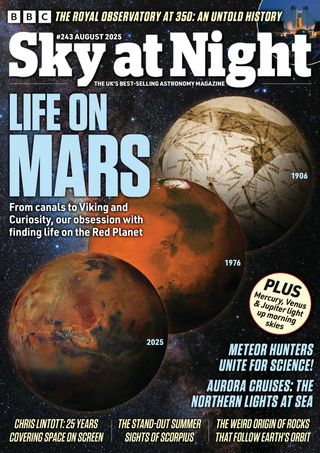
BBC Sky at Night Magazine
|August 2025
The top sights to observe or image this month
-
Mercury, Venus and Jupiter
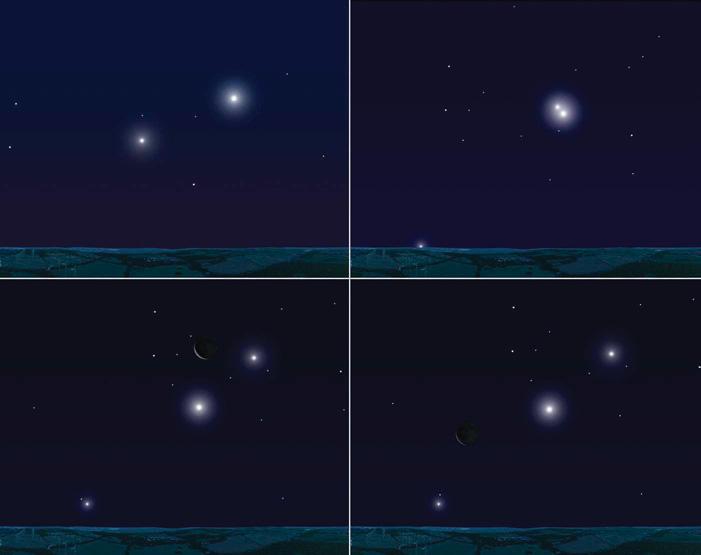
BEST TIME TO SEE: From 03:30 BST (02:30 UT) all month. Closest approach on 12 August
Venus is the brightest planet that can be seen from Earth. At its peak brightness, when 22% illuminated, Venus approaches mag. -5 – that's so bright that it can cast shadows, if conditions allow. Jupiter is bright too, able to reach mag. -2.94 under optimum conditions (coincidentally, that's the same maximum brightness as Mars). Mercury isn't far behind, able to attain a peak magnitude of -2.48.
Of course, catching all four near one another at peak brightness can't actually happen, as Jupiter and Mars need to be opposite the Sun, a position that Mercury and Venus can never attain. That's not to say that a meeting between some of these worlds isn't impressive – and this month, you'll have a chance to take a look and see for yourself. On 1 August, it's just mag. -3.9 Venus and mag. -1.8 Jupiter that appear together in the dawn twilight. They appear a little under 11° apart on this date, both being above the horizon just after 03:00 BST (02:00 UT), but you'll need to give them a bit more time to get to a decent altitude for viewing, say from around 04:00 BST (03:00 UT).
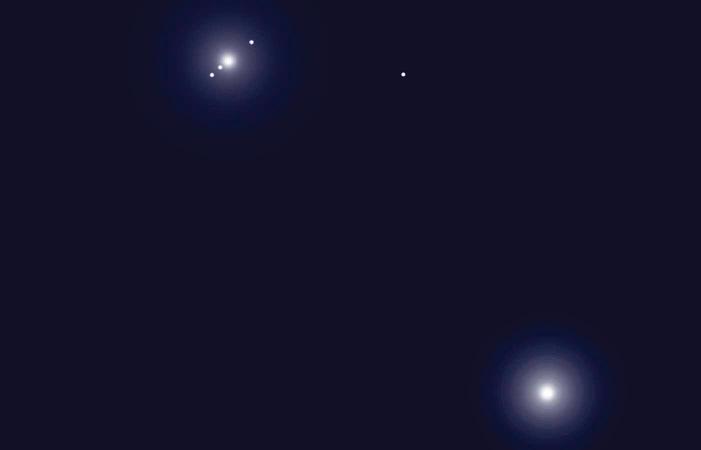
Over the course of the following mornings, the apparent gap between them closes due to Venus making a dash to the east, running under the stars that form the Gemini twin Castor's foot. Catch Venus early enough on 2 August, when the sky is still dark, and you might be able to see it 2.3° south of the open cluster M35. Binoculars will give the best view of this meeting.

Esta historia es de la edición August 2025 de BBC Sky at Night Magazine.
Suscríbete a Magzter GOLD para acceder a miles de historias premium seleccionadas y a más de 9000 revistas y periódicos.
¿Ya eres suscriptor? Iniciar sesión
MÁS HISTORIAS DE BBC Sky at Night Magazine

BBC Sky at Night Magazine
Crush: Close Encounters with Gravity
Gravity is something that we're all innately familiar with. It keeps our feet on the ground, fights against a rocket trying to leave Earth and governs the movement of the planets and stars.

1 mins
April 2026
BBC Sky at Night Magazine
Exploring the Universe
There's no shortage of children's books about astronomy.
2 mins
April 2026
BBC Sky at Night Magazine
Make your Milky Way images pop
Simple, free processing techniques using FastStone Image Viewer
3 mins
April 2026
BBC Sky at Night Magazine
Nightfaring: In Search of the Disappearing Darkness
This book is a manifesto for dark skies, written as a travel memoir.
1 mins
April 2026
BBC Sky at Night Magazine
Flying saucers- The making of a modern myth
Our obsession with UFOs goes back further than you might think. Robert Pateman traces how early science fiction, dubious sightings and an alien-mad media led to the 1950s saucer fever
9 mins
April 2026
BBC Sky at Night Magazine
STAR OF THE MONTH
Alphecca, the brightest jewel in the Crown
1 min
April 2026
BBC Sky at Night Magazine
How to use a planisphere
Navigate the sky with the original stargazer's tool. No batteries, apps or Wi-Fi required!
3 mins
April 2026
BBC Sky at Night Magazine
Why rockets don't launch straight up
For a rocket to get its payload into space, it has to follow a curved path. But what would happen if it didn't?
2 mins
April 2026
BBC Sky at Night Magazine
Q&A WITH A DARK MATTER SPECIALIST
Dark matter makes up 27 per cent of all matter in the Universe. So why is it so hard to find? Meet one of the people making a map that leads us to it
3 mins
April 2026

BBC Sky at Night Magazine
Why I want to put a hotel on the Moon
Bored of the beach? Sick of city breaks? Step this way. Space entrepreneur Skyler Chan explains how he'll build a holiday destination on the Moon by 2030
2 mins
April 2026
Listen
Translate
Change font size