
Vuélvete ilimitado con Magzter GOLD
Obtenga acceso ilimitado a más de 9000 revistas, periódicos e historias Premium por solo
Intentar ORO - Gratis
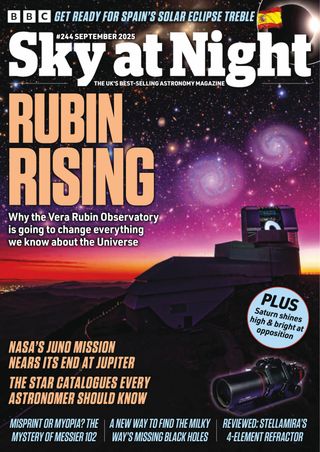
Stella Mira 86mm ED f/7 quadruplet refractor
BBC Sky at Night Magazine
|September 2025
Pin-sharp stars, rock-solid build and easy imaging - we're impressed
Earlier this year, First Light Optics announced a new addition to its in-house brand of telescopes, the StellaMira range.
The 86mm f/7 quadruplet refractor is the first four-element telescope in the collection, with two extra-low-dispersion (ED) elements and a builtin flattener which promises a perfectly flat field of view, from corner to corner. It provides 602mm of focal length, which is perfect for a wide variety of popular targets, and despite the rapidly disappearing darkness of our spring skies we were excited to make the most of every clear moment to try it out.
The telescope is provided in a sturdy aluminium carry case, with a fitted foam insert to protect the refractor and its accessories. Out of the box, the quality of the build and all of the fittings is immediately obvious. The tube feels very solid without being heavy, while other elements are CNC machined, with no plastic in sight. There's an integrated, retractable aluminium dew shield that extends with a twist motion, which we knew we would welcome in the humid evenings. We were also pleasantly surprised to see a Losmandy dovetail.
As is usual with First Light Optics's own-brand telescopes, the StellaMira 86mm ED quadruplet comes with lots of small extras as standard. Apart from the carry case, these include not one but two finder shoes, M54 and M48 adaptors, and a carrying handle on top which doubles as a finderscope clamp. Even though this telescope is marketed as primarily for imaging, there's a 2-inch-to-1.25-inch adaptor at the back that could take a diagonal and eyepieces for visual observation.
Getting started

Esta historia es de la edición September 2025 de BBC Sky at Night Magazine.
Suscríbete a Magzter GOLD para acceder a miles de historias premium seleccionadas y a más de 9000 revistas y periódicos.
¿Ya eres suscriptor? Iniciar sesión
MÁS HISTORIAS DE BBC Sky at Night Magazine

BBC Sky at Night Magazine
Q&A WITH A STAR DIMMING EXPERT
Extraordinary flickering in a distant star has led astronomers to the wreckage of two planets colliding. We meet one of the team behind the rare discovery

3 mins
June 2026
BBC Sky at Night Magazine
Don't let stars overpower your images
How to use Siril freeware to turn down the stars and turn up delicate details
3 mins
June 2026
BBC Sky at Night Magazine
Chasing UFOs on the web
Robert Pateman investigates how the internet has changed the way we view and report on UFO sightings
6 mins
June 2026

BBC Sky at Night Magazine
Under southern SKIES Stargazing in Australia's Warrumbungles
Ten years after Australia gained its first International Dark Sky Park, Yvette Cook finds out exactly why Warrumbungle National Park is a world-class astrotourism destination
7 mins
June 2026
BBC Sky at Night Magazine
Pick the perfect eyepiece
How to choose the right match for your target, telescope and sky conditions
3 mins
June 2026
BBC Sky at Night Magazine
What's really at the heart of our GALAXY?
Colin Stuart investigates the radical claim that our Milky Way's central supermassive black hole may not exist after all
7 mins
June 2026
BBC Sky at Night Magazine
New moons found around Jupiter and Saturn
And we think we know why Jupiter has more big moons than its neighbour
1 min
June 2026

BBC Sky at Night Magazine
A new way to find advanced alien life
Model could find patterns across multiple planets that reveal life - whatever form it takes
1 mins
June 2026
BBC Sky at Night Magazine
Star-forming region captured in amazing clarity
Piercing the dust clouds allows astronomers to see little-known, youthful massive stars
1 min
June 2026
BBC Sky at Night Magazine
RVO Horizon 102 tabletop Dobsonian
An affordable, easy, carry-anywhere telescope that makes learning the sky a pleasure
4 mins
June 2026
Listen
Translate
Change font size