Intentar ORO - Gratis
Mastering flats
BBC Sky at Night Magazine
|September 2023
Adding DSLR flat frames to your workflow to improve your deep-sky images
-

Getting the most out of our deep-sky data is a constant learning process. Not only do we need to master the complexities of capturing the data in the first place, but the art of postprocessing is just as important. Between the data capture and processing stages lie calibration frames. They are integral as they allow us to overcome some of the limitations in our imaging setups, such as sensor noise, dusty lenses and vignetting. Reducing noise and vignette allows us to stretch our data further.
The two most common types of calibration frame are 'dark' and 'flat' frames. While dark frames reduce the noise in an image, flat frames help subtract anomalies in the image train, such as dust bunnies and vignette. Vignette presents as dark edges in the field of view (FOV) or an uneven field illumination, and can be due to lens/mirror design or something interfering with the light path in the image train.
It's good practice to add calibration frames to all astro images. First, we'll explain how to take these using a DSLR and then we'll explore how flat frames improve an image of the Sadr (IC 1318) and Crescent Nebula (NGC 6888) region of Cygnus.

Esta historia es de la edición September 2023 de BBC Sky at Night Magazine.
Suscríbete a Magzter GOLD para acceder a miles de historias premium seleccionadas y a más de 9000 revistas y periódicos.
¿Ya eres suscriptor? Iniciar sesión
MÁS HISTORIAS DE BBC Sky at Night Magazine
BBC Sky at Night Magazine
The Giant Leap: Why Space is the Next Frontier in the Evolution of Life
“Earth is the cradle of humanity, but one cannot live in the cradle forever,” wrote Konstantin Tsiolkovsky in 1911.

1 mins
February 2026
BBC Sky at Night Magazine
Tele Vue Nagler Type-7 series eyepieces
These premium optics were inspired by Apollo - and deliver a giant leap to your views
4 mins
February 2026
BBC Sky at Night Magazine
Once Upon a Time in Space
While the Space Race of the Cold War years was ultimately a geopolitical contest between the USA and the Soviet Union, the rivalry sparked rapid innovation and inspired multiple generations to look skyward.
1 mins
February 2026
BBC Sky at Night Magazine
The Multiverse: When One Universe Isn't Enough
The concept of a 'multiverse' – the idea that our Universe may be just one of many – is widespread in science fiction and a common thread of online discussions.
1 mins
February 2026
BBC Sky at Night Magazine
Q&A WITH A GAMMA RAY SPECIALIST
In 2025, astronomers detected a blast from space that lasted seven hours. Now they're uncovering the strange processes behind the exceptional outburst
3 mins
February 2026
BBC Sky at Night Magazine
Astronomy Photographer of the Year
The world-leading astrophotography competition returns. Could your image take the top prize of £10,000?
2 mins
February 2026
BBC Sky at Night Magazine
MOONWATCH
February's top lunar feature to observe
2 mins
February 2026
BBC Sky at Night Magazine
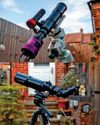
NOVAStar Scarlet A62Q 62mm f/8.4 quadruplet achromatic refractor
Well-built and capable, this beginner scope punches well above its bargain price
4 mins
February 2026
BBC Sky at Night Magazine
STAR OF THE MONTH
Rasalas, Leo the Lion's metal-rich crown
1 min
February 2026
BBC Sky at Night Magazine
Comet 24P/Schaumasse
Having reached perihelion on 8 January, comet 24P/ Schaumasse is now fading. Starting the month at a small-telescope-friendly mag. +10.5, it dims throughout February to below 12th magnitude.
1 min
February 2026
Translate
Change font size