
Vuélvete ilimitado con Magzter GOLD
Obtenga acceso ilimitado a más de 9000 revistas, periódicos e historias Premium por solo
Yogic Lifestyle & Well-being
Heartfulness eMagazine
|June 2023
EDDIE STERN has been practicing and studying yoga since he was fifteen, and was drawn by India and the yogic life. Here he explains the science of yoga, and how the practices affect both physical and mental well-being.
-

What Is Yoga?
There are many definitions of yoga. I am partial to Patanjali’s definition, “chitta vritti nirodhah.” Then yoga is like an equation: yoga = nirodhah, the stilling or mastery of the vrittis, which are the fluctuations and movements or activities in the chitta, which is the field of mind, thought, consciousness.
And key to Patanjali’s definition is the idea that yoga is an umbrella term for different things we can do to achieve nirodhah. It’s not just one thing. We can use asanas, pranayama, mantra, service, bhakti, and other different modalities.
From a scientific view, yoga is a systematic multi-modality intervention of practices that influence our anatomical body and physiological systems, balance and calm our emotional and mental states, increase discernment (buddhi), and increase devotion, gratitude and awe. These last three have been scientifically shown to have a multitude of benefits on cardiovascular health, and the way we relate to the world, and also provide conceptualizations of transcendental principles. For example, there are meditations on tanmantras, panmantras, and pancha mahabhutas that expand or dissolve our sense of separateness from the rest of the world, and allow us to integrate ourselves in different ways.
Scientific research
About 12 years ago, a researcher approached me and asked if I could design a yoga protocol to help with pre-hypertensive conditions in African Americans. I’d never done anything like that and I didn’t have a college degree. After high school, I went straight to India and started learning yoga. I learned everything from Mother India.
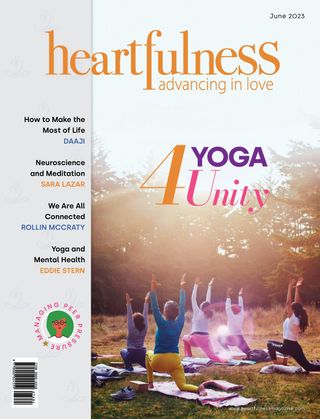

Esta historia es de la edición June 2023 de Heartfulness eMagazine.
Suscríbete a Magzter GOLD para acceder a miles de historias premium seleccionadas y a más de 9000 revistas y periódicos.
¿Ya eres suscriptor? Iniciar sesión
MÁS HISTORIAS DE Heartfulness eMagazine

Heartfulness eMagazine
A Touch of Heaven
Irish singer and teacher, EILISH BUTLER, combines the mystical chant of Saint Hildegard von Bingen (1098-1176) with the evolutionary path of Uncovering the Voice, satisfying her passion for mystical spirituality and music.

2 mins
November 2025

Heartfulness eMagazine
FROM INNER STILLNESS TO OUTER AGENCY:
How Heartfulness Builds an Internal Locus of Control and Workplace Success
3 mins
November 2025

Heartfulness eMagazine
Virtual Intelligence
Author and cultural commentator CHARLES EISENSTEIN extends last month's argument about virtual substitutes hollowing out reality-this time to Al's imitation of intimacy-and points to what only embodied relationships can restore.
10 mins
November 2025

Heartfulness eMagazine
Grace Is the Creative Spark
Do you sometimes feel that life is blessed and things are unfolding effortlessly, without force or struggle? Some people say it is because of “grace” or “God’s grace.
5 mins
November 2025

Heartfulness eMagazine
Zuri's Guiding Light
A luminous fable from LIAA KUMAR on self-trust, belonging, and inner guidance.
3 mins
November 2025

Heartfulness eMagazine
I AM
In a quiet meditation on desire, stillness, and the witnessing Self, JARNA KHIMANI traces the shift from seeking to being.
3 mins
November 2025

Heartfulness eMagazine
Courage: From Relief to Presence
JASON NUTTING on why relief is temporary-and how courage, rooted in the heart, endures.
3 mins
November 2025

Heartfulness eMagazine
Embracing The Value Within
DR. ROXANNE M. ST. CLAIR on seeing the value in you—and in others—and making it a daily practice.
4 mins
November 2025
Heartfulness eMagazine
Gratitude's Gift
A Creston woman recently recounted her experience in a checkout line.
2 mins
November 2025

Heartfulness eMagazine
HAPPINESS and Gut Health
Q: How does gut health influence mental well-being, and can practices like meditation actively support a healthier digestive system? The gut is often called the second brain because it has over 500 million neurons that constantly talk to the brain through the vagus nerve.
2 mins
November 2025
Translate
Change font size