Intentar ORO - Gratis
The Devil's Tree
Heartfulness eMagazine
|January 2025
DR V. RAMAKANTHA, retired forest officer, who lived, raised a family, and worked in forests for most of his adult life, returns to our pages in 2025 to share his vast knowledge of medicinal plants, and the fascinating stories associated with them. In his signature style, this month he weaves together science, folklore, and traditional knowledge to tell the story of the Devil's Tree, Saptaparni.
-
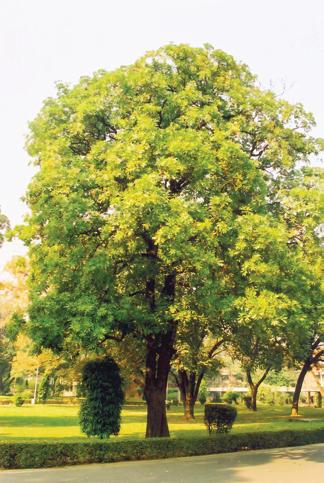
Saptaparni is a large evergreen tree growing up to 120 feet. Palakkad, a town and district in the Indian state of Kerala, is believed to have been named after these trees—“pala” refers to Saptaparni and “kaadu” to forests. Saptaparni is also known as yakshi-paalya, meaning Devil’s Tree. Yaksha and Yakshi are nature spirits, generally considered benevolent celestial beings who visit Earth, but they also have a darker form of grotesque and terrible entities that can appear before people as the most beautiful and enchanting ladies. In many parts of South India, a Yakshi is believed to make a home in a Saptaparni tree. If any male villager gradually loses weight and health, an affair with a Yakshi becomes the first suspicion in the minds of the elders.
 A cautionary tale
According to folklore, a Brahmin had gone to a distant village on work. He was late returning, and the golden rays of the sun started disappearing from the horizon. Being far from home, and being afraid of the impending dark, he quickened his step. Then, to his surprise, he saw a maiden of extraordinary beauty wearing a white sari, her long hair adorned with the sweet-smelling flowers of Saptaparni.
To his greater surprise, she approached him and in a sweet voice told him that she was late returning from her companion's home. As she was afraid of the dark, she pleaded with the Brahmin to accompany her home, just a short distance away.


Esta historia es de la edición January 2025 de Heartfulness eMagazine.
Suscríbete a Magzter GOLD para acceder a miles de historias premium seleccionadas y a más de 9000 revistas y periódicos.
¿Ya eres suscriptor? Iniciar sesión
MÁS HISTORIAS DE Heartfulness eMagazine

Heartfulness eMagazine
A Touch of Heaven
Irish singer and teacher, EILISH BUTLER, combines the mystical chant of Saint Hildegard von Bingen (1098-1176) with the evolutionary path of Uncovering the Voice, satisfying her passion for mystical spirituality and music.

2 mins
November 2025

Heartfulness eMagazine
FROM INNER STILLNESS TO OUTER AGENCY:
How Heartfulness Builds an Internal Locus of Control and Workplace Success
3 mins
November 2025

Heartfulness eMagazine
Virtual Intelligence
Author and cultural commentator CHARLES EISENSTEIN extends last month's argument about virtual substitutes hollowing out reality-this time to Al's imitation of intimacy-and points to what only embodied relationships can restore.
10 mins
November 2025

Heartfulness eMagazine
Grace Is the Creative Spark
Do you sometimes feel that life is blessed and things are unfolding effortlessly, without force or struggle? Some people say it is because of “grace” or “God’s grace.
5 mins
November 2025

Heartfulness eMagazine
Zuri's Guiding Light
A luminous fable from LIAA KUMAR on self-trust, belonging, and inner guidance.
3 mins
November 2025

Heartfulness eMagazine
I AM
In a quiet meditation on desire, stillness, and the witnessing Self, JARNA KHIMANI traces the shift from seeking to being.
3 mins
November 2025

Heartfulness eMagazine
Courage: From Relief to Presence
JASON NUTTING on why relief is temporary-and how courage, rooted in the heart, endures.
3 mins
November 2025

Heartfulness eMagazine
Embracing The Value Within
DR. ROXANNE M. ST. CLAIR on seeing the value in you—and in others—and making it a daily practice.
4 mins
November 2025
Heartfulness eMagazine
Gratitude's Gift
A Creston woman recently recounted her experience in a checkout line.
2 mins
November 2025

Heartfulness eMagazine
HAPPINESS and Gut Health
Q: How does gut health influence mental well-being, and can practices like meditation actively support a healthier digestive system? The gut is often called the second brain because it has over 500 million neurons that constantly talk to the brain through the vagus nerve.
2 mins
November 2025
Listen
Translate
Change font size