
Vuélvete ilimitado con Magzter GOLD
Obtenga acceso ilimitado a más de 9000 revistas, periódicos e historias Premium por solo
How to Protect Yourself from EMR
Heartfulness eMagazine
|April 2023
Last month, TERRAN DAILY explained how electromagnetic pollution can negatively impact us all. Here, she explores some practical measures we can all take to protect our families from its adverse effects.

Sources of exposure to artificial electromagnetic radiation (EMR)
Problematic electromagnetic radiation in our homes can have many sources, and some are unexpected. Nick Pineault, in his very readable The Non-Tinfoil Guide to EMFs, talks about four types of electromagnetic frequencies (EMFs) that have been linked to adverse health: radio frequencies and microwaves (RF), electric fields (EF), magnetic fields (MF), and dirty electricity (DE).
Most of us think of harmful or potentially harmful EMFs as radio frequencies from cell phones, Wi-fi, etc., but the other three also have negative effects on our health and well-being. In fact, well-known building biologist Oram Miller holds that magnetic frequencies are the most harmful, suppressing the immune system and increasing the risk of cancer. Magnetic frequencies and radio frequencies reduce melatonin production and disrupt our cells’ calcium channels, leading to the same negative effects.
Electric fields are the most common in our homes, but have not been the subject of much research. Dirty electricity can be a big problem for attention and behavior in children, and also appears to be a factor in several chronic diseases like diabetes and multiple sclerosis. Let us take a closer look at each of these.
1. Radio frequencies and microwaves
RFs are generated by smartphones, tablets, Wi-fi, Bluetooth, baby monitors, cordless phones, wireless electric meters (smart meters), microwaves, and cellular phone networks (4G and 5G). Quite a lot of research has been done on RFs and their links to brain tumors and other cancers, depression, insomnia, decreased fertility, impaired fetal development, and behavior and learning problems in children.
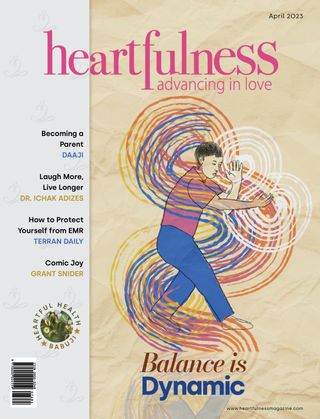

Esta historia es de la edición April 2023 de Heartfulness eMagazine.
Suscríbete a Magzter GOLD para acceder a miles de historias premium seleccionadas y a más de 9000 revistas y periódicos.
¿Ya eres suscriptor? Iniciar sesión
MÁS HISTORIAS DE Heartfulness eMagazine

Heartfulness eMagazine
A Touch of Heaven
Irish singer and teacher, EILISH BUTLER, combines the mystical chant of Saint Hildegard von Bingen (1098-1176) with the evolutionary path of Uncovering the Voice, satisfying her passion for mystical spirituality and music.

2 mins
November 2025

Heartfulness eMagazine
FROM INNER STILLNESS TO OUTER AGENCY:
How Heartfulness Builds an Internal Locus of Control and Workplace Success
3 mins
November 2025

Heartfulness eMagazine
Virtual Intelligence
Author and cultural commentator CHARLES EISENSTEIN extends last month's argument about virtual substitutes hollowing out reality-this time to Al's imitation of intimacy-and points to what only embodied relationships can restore.
10 mins
November 2025

Heartfulness eMagazine
Grace Is the Creative Spark
Do you sometimes feel that life is blessed and things are unfolding effortlessly, without force or struggle? Some people say it is because of “grace” or “God’s grace.
5 mins
November 2025
Heartfulness eMagazine
Zuri's Guiding Light
A luminous fable from LIAA KUMAR on self-trust, belonging, and inner guidance.
3 mins
November 2025

Heartfulness eMagazine
I AM
In a quiet meditation on desire, stillness, and the witnessing Self, JARNA KHIMANI traces the shift from seeking to being.
3 mins
November 2025

Heartfulness eMagazine
Courage: From Relief to Presence
JASON NUTTING on why relief is temporary-and how courage, rooted in the heart, endures.
3 mins
November 2025

Heartfulness eMagazine
Embracing The Value Within
DR. ROXANNE M. ST. CLAIR on seeing the value in you—and in others—and making it a daily practice.
4 mins
November 2025
Heartfulness eMagazine
Gratitude's Gift
A Creston woman recently recounted her experience in a checkout line.
2 mins
November 2025

Heartfulness eMagazine
HAPPINESS and Gut Health
Q: How does gut health influence mental well-being, and can practices like meditation actively support a healthier digestive system? The gut is often called the second brain because it has over 500 million neurons that constantly talk to the brain through the vagus nerve.
2 mins
November 2025
Translate
Change font size