Intentar ORO - Gratis
FEAR EFFECT
Edge UK
|Christmas 2025
From Crow Country to Resident Evil 9, horror games are still in their ascendancy. But what are the tricks behind making players scared? And can the popularity last?
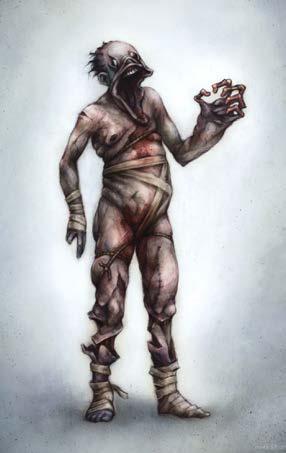
Thomas Grip, co-founder of Frictional Games and the designer behind genre icons such as Penumbra, Amnesia and Soma, has a peculiar piece of advice for horror game creators: make it boring. “It’s critical it’s not too engaging,” he says, “because then it’s like playing Tetris while you’re in the spooky mansion. The ghost is standing behind you, but you don’t notice because you’re too involved in the game of Tetris. You kind of want gameplay that is dull, repetitive or simplistic.”
Brian Clarke, creator of 2022’s The Mortuary Assistant, and now the in-development Paranormal Activity game, has a similar ethos. Explaining the tactics for building an effective scare, he says the goal is to focus the player on something innocuous and then suddenly break the silence. “The key is that the player has something to do that distracts them from the elephant in the room,” Clarke explains. “’I know there’s something creepy in here – but I have to make sure that this swipe-card reader works’. The horror is almost secondary to the menial task.”
This approach characterises a certain type of horror game. Think of Slender, where all you do is walk through a (very plain) forest and pick up eight pieces of paper. The Five Nights At Freddy’s series, especially the earlier games, is similarly routine: check the cameras, monitor the power supply and, if you need to, shut the doors. If survival horror dominated the ’90s, then this subgenre, which DreadXP head of operations Henry Hoare calls “blue-collar horror”, is one of the biggest today. “The player develops expectations in their mind,” Hoare says, referencing other examples such as Lethal Company and Repo, “and then you can subvert those expectations.”
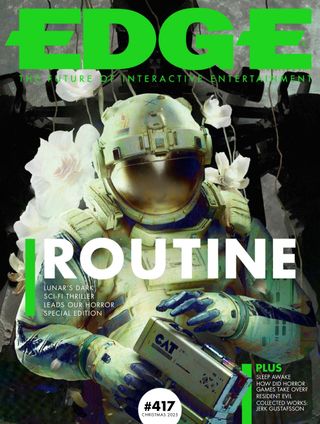

Esta historia es de la edición Christmas 2025 de Edge UK.
Suscríbete a Magzter GOLD para acceder a miles de historias premium seleccionadas y a más de 9000 revistas y periódicos.
¿Ya eres suscriptor? Iniciar sesión
MÁS HISTORIAS DE Edge UK

Edge UK
IMITATION GAME
This AI thinks she's a person. Do you choose to kill her dream?

7 mins
July 2026
Edge UK
Mouse: PI For Hire
Look at the bottom third of the screen, in almost any given frame of Mouse: PI For Hire, and you'll find developer Fumi Games wearing its influences on its sleeve — or rather, what extends from them.
4 mins
July 2026

Edge UK
Will: Follow The Light
There is a big difference between not being able to solve a puzzle and not being able to understand what a puzzle is asking you to do.
4 mins
July 2026

Edge UK
Dosa Divas
Isn't this precisely the passionless enshittification of cookery the game's heroes are meant to be resisting?
4 mins
July 2026

Edge UK
AN AUDIENCE WITH... JENOVA CHEN
The designer synonymous with games as art on 20 years of Thatgamecompany
13 mins
July 2026

Edge UK
Tomodachi Life: Living The Dream
Shigeru Miyamoto, Donald Trump and Ganondorf walk into an ice-cream parlour. No, that’s not the setup to a joke, but a regular Tuesday afternoon in Tomodachi Life.
4 mins
July 2026
Edge UK
Pragmata
It's somewhat ironic, given the game's subject matter, that the AI of its would-be Terminators is severely limited
7 mins
July 2026

Edge UK
Replaced
Replaced's opening 30 minutes show enormous promise. You play as Reach, an advanced, coldly rational artificial intelligence accidentally implanted into the body and brain of its human creator.
4 mins
July 2026

Edge UK
Mixtape
Even as it feels increasingly like a relic, the concept of the mixtape endures.
4 mins
July 2026

Edge UK
D-TOPIA
A perfect world? Just don't forget to smile
3 mins
July 2026
Listen
Translate
Change font size