Intentar ORO - Gratis
Why do children bully? And what can parents DO ABOUT IT?
ParentsWorld India
|April 2025
Bullying is unfortunately a common problem in Australian schools, with surveys suggesting one in five teenagers are bullied.
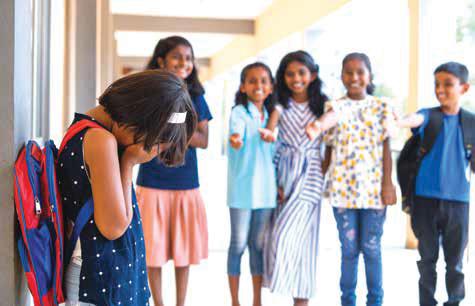
While schools are responsible for ensuring a safe environment, parents are likely to be distressed and unsure about what to do if their child is being bullied.
What exactly is bullying? And how can you help your child if you are concerned?
What is bullying?
Bullying is not just kids being thoughtless or a bit mean. It is not a single act, a mistake, or a mutual disagreement.
Bullying is a repeated act of aggression intended to cause harm. It can be physical (harming the person or their belongings), verbal (written and spoken words that cause harm), or social (isolating someone, harming their social standing, or sharing private information).
It is not a “normal” childhood experience. It is targeted and has long-lasting and serious effects for the victim.
These effects include reduced engagement in education and loneliness at school, loss of self-esteem, psychological distress, depressive symptoms, problems with sleep, suicide and suicidal ideation, non-suicidal self-injury and substance abuse.
Bullying can be overt and hidden
Bullying can be overt with observable actions like kicking or name-calling.
Or it can be covert, which is hidden and can include whispering, exclusion, and rumours. While females and males are equally likely to have experienced bullying and are equally likely to bully, males are more likely to engage in overt physical bullying, while females are more likely to engage in covert bullying through social or cyber behaviour.
A 2019 Mission Australia survey found 21 percent of young people aged 15-19 reported bullying in the past 12 months. Of those who had been bullied, nearly 80 percent said the bullying happened in school.
More than 70 percent said the bullying is verbal, 61 percent said it's social, 36.5 percent said it is cyberbulling and about 20 percent said it is physical.

Esta historia es de la edición April 2025 de ParentsWorld India.
Suscríbete a Magzter GOLD para acceder a miles de historias premium seleccionadas y a más de 9000 revistas y periódicos.
¿Ya eres suscriptor? Iniciar sesión
MÁS HISTORIAS DE ParentsWorld India

ParentsWorld India
Switching from carb-heavy to BALANCED DIETS
As awareness about lifestyle diseases such as diabetes and obesity grows, the nutritional and health value of carb-heavy diets is being re-examined with medical experts calling for adoption of balanced, protein-rich diets, especially for children

3 mins
November 2025

ParentsWorld India
Preparing children FOR PUBERTY
Puberty is the biological process of physical maturation, with the typical onset age ranging between 8-13 years for girls and 9-14 years for boys.
3 mins
November 2025

ParentsWorld India
Ways to strengthen FAMILY BONDING
We lead such busy lives that there's hardly any time for emotional bonding. The children are caught up with school and homework, while we're tied to our office routines. How can we build and strengthen family bonding?
3 mins
November 2025

ParentsWorld India
Breastfeeding BASICS
Breastfeeding is ideal for child and parent health but challenging for most families a pediatrician explains how to find support
5 mins
November 2025
ParentsWorld India
The art of contrast WITH PARADOX
This well-known Shakespeare quotation justifies Hamlet's cruel actions because ultimately, they will serve a kinder purpose.
2 mins
November 2025

ParentsWorld India
Use colours wisely to enhance children's EMOTIONAL WELL-BEING
Colours are not merely about decoration and aesthetics; they are infused with emotional and psychological weight. Thoughtfully chosen colour schemes promote positive emotional, behavioral and cognitive outcomes in children
3 mins
November 2025

ParentsWorld India
Heart to HEART
Children need good role models to emulate and inspire them to achieve greatness.
3 mins
November 2025
ParentsWorld India
Fuelling Curiosity, Shaping Champions
Education isn't just about lessons and grades—it's about discovering who we are and what we can become.
2 mins
November 2025

ParentsWorld India
Soaring demand for COMMERCIAL PILOTS
According to aviation experts, there's a requirement of 35,000-40,000 new pilots over the next decade, with over 7,000 required in 2026 alone
3 mins
November 2025

ParentsWorld India
Helping children RESPECT INDIAN CULTURE
PW invited parents of Scindia Kanya Vidyalaya, Gwalior - India's #1 girls boarding school to share how they ensure their children respect Indian culture and traditions
2 mins
November 2025
Listen
Translate
Change font size