
Vuélvete ilimitado con Magzter GOLD
Obtenga acceso ilimitado a más de 9000 revistas, periódicos e historias Premium por solo
Intentar ORO - Gratis
NUS researchers shed light on local mangrove crab's electric blue strip
The Straits Times
|June 16, 2025
Light-focusing band believed to be first such external structure used by animals for signalling
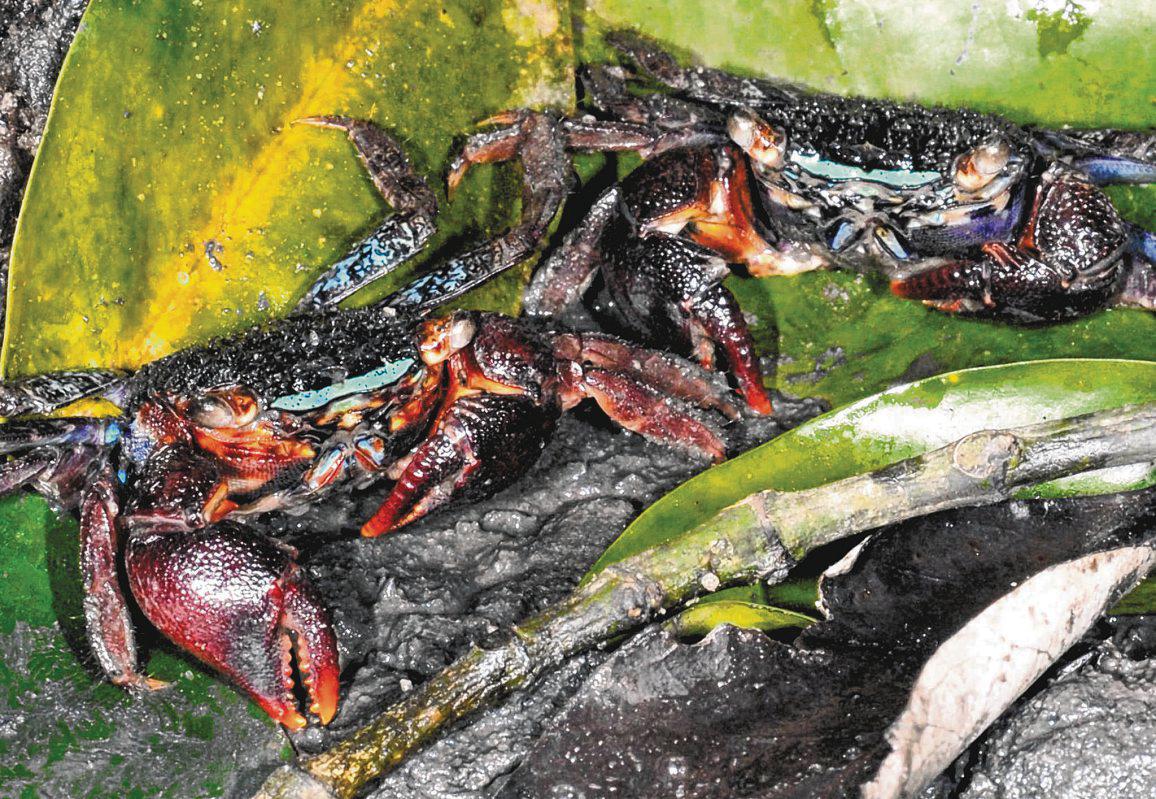
A black mangrove crab peers from a muddy bed of fallen leaves in Mandai Kechil, its striking cyan "monobrow" set in an alien-like glare.
The piercing blue strip on the face-banded crab (Parasesarma eumolpe) is neither bioluminescent—it does not glow in the dark—nor iridescent, meaning that its colours do not shift at different angles.
Instead, researchers here have discovered, it is the band's concave shape that focuses reflected light to enhance brightness, much like the reflective surface behind the bulb in car headlights.
What is more, no matter what angle the source light comes from, the crab's band reflects light most intensely at the eye level of other face-banded crabs to optimise signalling, or conveying information about itself.
The face-banded crab—a small freshwater crustacean with a shell typically between 2.5cm and 4cm wide commonly found in Singapore, Malaysia, Indonesia, Thailand and China—has been the focus of over a decade of research by scientists from NUS.
NUS researchers Peter Todd and Jan Chan, from the university's Department of Biological Sciences, believe this is the first known example of such light-focusing external structures used for signalling in animals.
Their new study, co-authored with four other researchers from the department, details the band's structure that they term "nature's headlamps"—finally shedding light on the mystery behind its luminance and brightness.
Similar reflective features have previously only been documented in the eyes of animals, like dogs, cats and crocodiles, but these enhance vision in the dark and are not used for signalling.
"It is exciting that such a structure has evolved to enhance signalling in these crabs but has not been described previously," said Associate Professor Todd.

Esta historia es de la edición June 16, 2025 de The Straits Times.
Suscríbete a Magzter GOLD para acceder a miles de historias premium seleccionadas y a más de 9000 revistas y periódicos.
¿Ya eres suscriptor? Iniciar sesión
MÁS HISTORIAS DE The Straits Times
The Straits Times
Xi-Putin summit a nod to China's superpower status
Russia is happy to play junior partner partly because it needs this relationship but also because it accepts the new world order.

6 mins
May 22, 2026

The Straits Times
'ENHANCING' THE EPL EXPERIENCE
EPL’s new streaming service and StarHub’s offering complement each other: Telco’s V-P
3 mins
May 22, 2026
The Straits Times
Jobs • What fresh graduates need to stay ahead: Experts
As artificial intelligence tools automate entry-level roles, companies here are now hiring fresh graduates with at least two years of work experience, said experts.
1 min
May 22, 2026

The Straits Times
A CASE FOR LUXURY
Known for its iconic aluminium suitcases, German luxury luggage maker Rimowa now has a made-to-measure service exclusive to its flagship store in Cologne
7 mins
May 22, 2026
The Straits Times
Teo Siong Seng, the shipping scion accused of fixing container prices
Mr Teo Siong Seng, a towering figure in Singapore's maritime and business landscapes for decades, is at the centre of an investigation by the United States Department of Justice.
2 mins
May 22, 2026
The Straits Times
NDP 2026: Bigger venue, new songs, but no Red Lions, mobile column
About 42,000 people will be able to catch the National Day Parade (NDP) in 2026 as it returns to the National Stadium after 10 years.
3 mins
May 22, 2026
The Straits Times
Samsung chip employees to get $432,000 average bonus under strike deal
Samsung Electronics semiconductor employees are expected to receive average bonuses worth 509 million won (S$432,000) in 2026, a company official said on May 21, under a tentative deal between management and labour unions to avert a strike.
2 mins
May 22, 2026

The Straits Times
AFRICAN TEAMS NOW HAVE BELIEF
Morocco reaching 2022 World Cup semi has given continent confidence, says CAF boss
3 mins
May 22, 2026
The Straits Times
SHEESH IS RARING TO GO TO WAR
Rising 10YO out to exact revenge on War Code in KL on May 24
3 mins
May 22, 2026
The Straits Times
Tourists adjust plans ahead of changes in Thai visa rules
Plan to shorten visa-free stays follows recent high-profile arrests of foreigners
3 mins
May 22, 2026
Listen
Translate
Change font size