Intentar ORO - Gratis
The Frozen Zoo How scientists are putting disappearing species on ice
The Guardian Weekly
|March 15, 2024
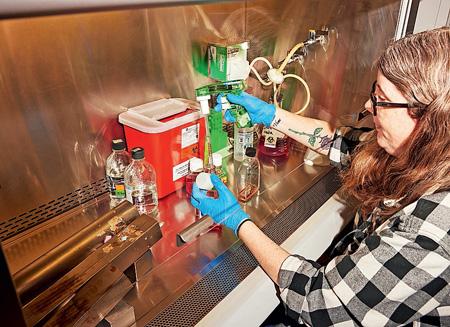
Ina California laboratory, four women do the painstaking work of preserving cells amid agrowing extinction crisis

In a basement laboratory abutting a 730-hectare wildlife park in San Diego, California, Marlys Houck looks up to see a uniformed man holding a blue insulated lunch bag filled with small pieces of eyes, trachea, feet and feathers.
"Ah," she says, softly. "Here are today's samples."
The bag contains small bits of soft tissue from animals who have died of natural causes at the zoo. Today's samples include a leaf frog and a starling.
The man holding the bag is James Boggeln, a volunteer with the zoo, who hands it to Houck, the curator of this laboratory, known as the "Frozen Zoo". She and her team will start turning these bits of tissue into a bank of research and conservation for the future. They will put the tissue into flasks where enzymes digest them, then the lab members will slowly incubate them over a month - growing an abundance of cells that can be frozen and reanimated for future use.
At nearly 50 years old, the Frozen Zoo holds the world's oldest, largest and most diverse repository of living cell cultures more than 11,000 samples that represent 1,300 different species and subspecies, including three extinct species and more that are very close to extinction.
Today the Frozen Zoo is operated by an all-female team of four, who watch over a vast collection of hand-marked vials with labels such as "giraffe", "rhino" and "armadillo", all stored in massive circular tanks filled with liquid nitrogen. In a world suffering from a climate and biodiversity crisis, putting species on ice offers one way to be hopeful about the future.


Esta historia es de la edición March 15, 2024 de The Guardian Weekly.
Suscríbete a Magzter GOLD para acceder a miles de historias premium seleccionadas y a más de 9000 revistas y periódicos.
¿Ya eres suscriptor? Iniciar sesión
MÁS HISTORIAS DE The Guardian Weekly

The Guardian Weekly
I love when my enemies hate, me
Every day, Hasan Piker broadcasts a marathon Twitch stream, airing his views to 3 million followers. It has led to him becoming one of the biggest voices on the US left. But Piker's online fame has drawn vitriol towards him in real life

10 mins
January 02, 2026
The Guardian Weekly
Baseinstinct Why did Trump order airstrikes on Nigeria?
Claims that Christians face religious persecution overseas have become a major motivating force for Trump's base.
2 mins
January 02, 2026
The Guardian Weekly
Florence's outcasts A vivid and absorbing history of one of the first orphanages in Europe
Joseph Luzzi, a professor at Bard College in New York, is a Dante scholar whose books argue for the relevance of the Italian art and literature of the late middle ages and Renaissance to our own times.
1 mins
January 02, 2026

The Guardian Weekly
Need cheering up after a terrible year? I have just the story for you
Perhaps you are searching for reasons to be cheerful at the end of a particularly dispiriting year and the start of a new one that may well offer more of the same? In that case, read on.
4 mins
January 02, 2026
The Guardian Weekly
N347 Vegetable udon curry
You could also serve this with rice, but if you do, use only half the quantity of dashi, because this curry is made slightly soupier to go with the noodles.
1 mins
January 02, 2026
The Guardian Weekly
Warbling free The app that can tell birds by their songs
When Natasha Walter first became curious about the birds around her, she recorded their songs on her phone and arduously tried to match each song with online recordings.
2 mins
January 02, 2026
The Guardian Weekly
A soundtrack to all of humanity
The Nazis adopted Ode to Joy. Happy Birthday hides a tale of greed. And Putin has turned Shostakovich's Leningrad symphony into a call to arms. Is this the fate of musical utopias?
4 mins
January 02, 2026

The Guardian Weekly
Brigitte Bardot 1934 -2025
France's most sensational cultural export, who on screen epitomised youth, sex and modernity until politics and her campaigns for animal rights took over
3 mins
January 02, 2026

The Guardian Weekly
Who owns space? As the race starts to exploit the cosmos for commercial gains, we must act to preserve it for all humanity
If there is one thing we can rely on in this world, it is human hubris, and space and astronomy are no exception.
3 mins
January 02, 2026
The Guardian Weekly
Food for thought A personally inflected history of psychiatric ideas with flashes of anarchic humour
In 1973, US psychologist David Rosenhan published the results of an experiment.
3 mins
January 02, 2026
Listen
Translate
Change font size