
Vuélvete ilimitado con Magzter GOLD
Obtenga acceso ilimitado a más de 9000 revistas, periódicos e historias Premium por solo
Intentar ORO - Gratis
Spilling the tea: What should we grow, in this era of oversupply?
Hindustan Times Jammu
|October 05, 2025
Steamy Secrets
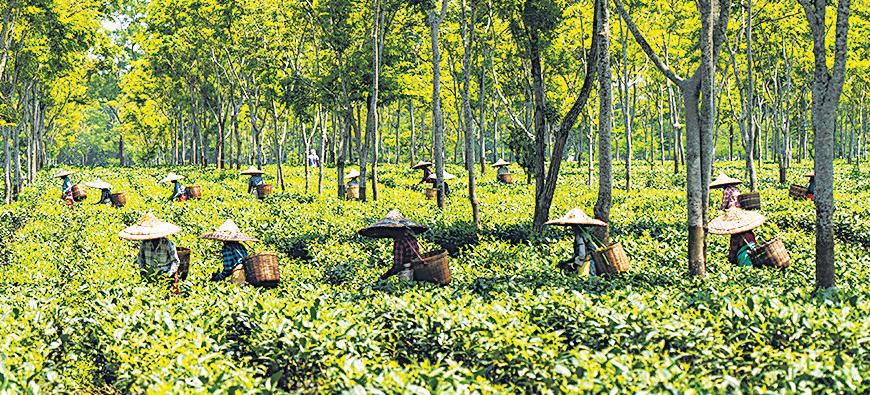
Reality #1: A global superpower is fuming over a trade deficit and scrambling to even the scales.
Reality #2: It is also trying to steal trade secrets from the other country.
Reality #3: An opioid epidemic is raging.
This isn’t America-and-China today; it’s actually Britain-and-China, in the 18th and 19th centuries. And the object at the heart of it all: Tea.
When Catherine of Braganza wed Charles II in 1662, she introduced tea into the English court. What started as a royal indulgence soon cascaded through aristocratic households. Caffeine colonised England in different ways. Coffee, as we saw in an earlier column, was consumed in coffee houses, sparking intellectual debate among men, but tea... tea was feminine, consumed in a leisurely upper-class ritual.
By 1706, Thomas Twining had bought Tom’s Coffee House in London and started selling readymade tea alongside coffee, and then tea leaves to upper-class households. Meanwhile, the British East India Company (EIC), reeling from the 1720 ban on textile imports, stepped up imports of commodities such as raw cotton, sugar and tea. (Incidentally, Indian sugar was the world’s first fair-trade product, marketed as such because it was produced without slave labour.)
High taxes and the EIC monopoly kept tea prices so high that this fomented colonial resentment, which erupted as the Boston Tea Party, when American revolutionaries boarded British ships in the Boston Harbor in 1773 and dumped 342 chests of tea into the sea. It was a protest against high taxes set by a parliament that contained no representation from the colonies.
A few years later, Britain finally slashed taxes, turning tea into a staple. The English love of this beverage, however, led to a massive drain of silver to China, which was then the world’s sole supplier. To address this, EIC used two approaches.


Esta historia es de la edición October 05, 2025 de Hindustan Times Jammu.
Suscríbete a Magzter GOLD para acceder a miles de historias premium seleccionadas y a más de 9000 revistas y periódicos.
¿Ya eres suscriptor? Iniciar sesión
MÁS HISTORIAS DE Hindustan Times Jammu
Hindustan Times Jammu
Developed India rests on the youth's well-being
Picture an India where young innovators from small towns are building companies with global customers, where daughters from villages are standing on national and international sporting podiums, and where students from Tier-II and Tier-III cities are presenting ideas on platforms that connect them directly with policymakers, industry leaders and investors.

4 mins
June 18, 2026
Hindustan Times Jammu
Preparing for a poor monsoon
Pragmatic prudence rather than alarmism should dictate the policy response
2 mins
June 18, 2026
Hindustan Times Jammu
AI's real test: Reducing pendency of court cases
The Supreme Court's draft AI Regulations go well beyond existing precedents from other countries. But a few critical areas still need addressing
4 mins
June 18, 2026
Hindustan Times Jammu
Justice depends on human wisdom, not AI
The Indian legal profession is facing an uncomfortable reality it can no longer ignore. A significant number of those practising law may not be qualified to do so.
3 mins
June 18, 2026
Hindustan Times Jammu
Land degradation can't be the price India pays
Every summer, as temperatures soar above 40°C across India, attention turns to heatwaves, dry spells, water shortages, and power cuts.
3 mins
June 17, 2026
Hindustan Times Jammu
Managing our cities better
NCR and other cities must adopt a public good approach to urban spaces, instead of the existing practice of regulatory capture and failure
1 mins
June 17, 2026

Hindustan Times Jammu
JSW Realty seeks $169 mn loan from Tata Capital
JSW Realty, the real estate arm of Indian conglomerate JSW Group, is in advanced talks to raise a ₹1,400 crore ($169 million) loan from shadow lender Tata Capital Ltd., according to people familiar with the matter.
1 min
June 17, 2026

Hindustan Times Jammu
What next as US sun dims in West Asia?
Efforts in West Asia modelled on the 1975 Helsinki Conference could address the deep sense of insecurity in the region
3 mins
June 17, 2026
Hindustan Times Jammu
An Indian formula for African food security
In Luweero, 70 kilometres north of Kampala, Uganda, coffee farmer Gaddafi Nassour has doubled his income in a few years.
3 mins
June 17, 2026

Hindustan Times Jammu
Clean energy allows India to withstand risks
The global energy crisis following the Strait of Hormuz blockade and India’s large crude oil import bill shows why clean energy is not merely a climate obligation but a core energy security strategy
4 mins
June 16, 2026
Listen
Translate
Change font size