Intentar ORO - Gratis
Stepping Stone Deal?
Business Standard
|August 20, 2025
A carefully balanced pact with the UK could set the tone and template for India's future free-trade agreements
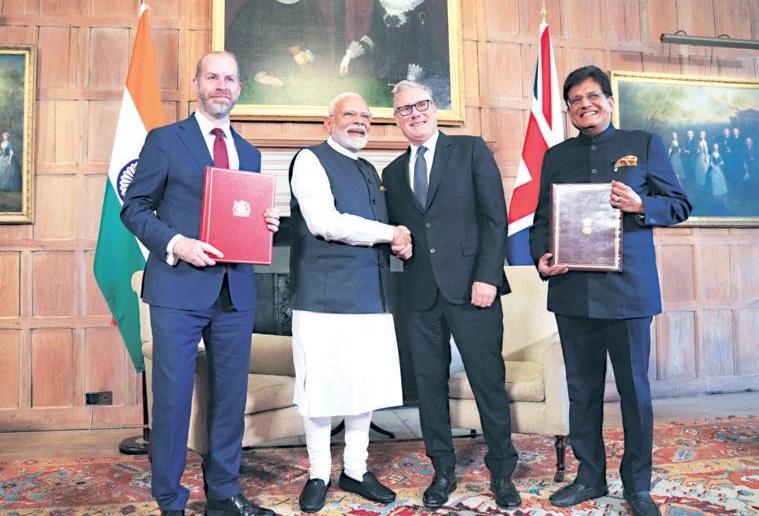
The recently signed trade pact with the United Kingdom (UK) will act as a crucial "stepping stone" and a benchmark for the "high-quality" agreements India intends to pursue, Commerce and Industry Minister Piyush Goyal has said. Calling it a "win-win" for both nations, Goyal argued that the deal would also enhance India's credibility in the global trade arena.
The India-UK Comprehensive Economic and Trade Agreement (CETA), signed on July 24 after three-and-a-half years of negotiations, signals that India is ready to face competition and shed its reputation as a high-tariff economy—a "tariff king," as the United States (US) has often labeled it. The pact will cut India's applied trade-weighted average tariff on goods imports from the UK from 15 per cent to 3 per cent.
Balancing red lines Experts point out that the deal was possible only because both sides respected each other's sensitivities and regulatory autonomy.
For the first time, India agreed to reduce tariffs on automobiles, albeit in a phased manner. The sector had been one of the most contentious points in negotiations. Indian negotiators eventually crafted a compromise: small cars remain protected, while larger vehicles face gradual tariff reductions, opening the segment to greater competition.
Alcoholic beverages, another sticking point, saw a similar approach. India agreed to phased duty cuts on whisky, brandy, rum, vodka, tequila, and ciders.
Agriculture, however, remained largely off the table. Dairy products, cereals such as wheat, rice, maize, and millets, and key edible oils and oilseeds were excluded from tariff cuts. On the UK side, sensitive items such as milled rice, sugar, pork, chicken, and eggs also remained protected.
Mobility, a politically sensitive issue in Britain, was addressed by formalizing existing visa rules for short-term and temporary business travel, offering certainty to businesses without introducing new concessions.

Esta historia es de la edición August 20, 2025 de Business Standard.
Suscríbete a Magzter GOLD para acceder a miles de historias premium seleccionadas y a más de 9000 revistas y periódicos.
¿Ya eres suscriptor? Iniciar sesión
MÁS HISTORIAS DE Business Standard
Business Standard
Tariff cuts in FTAs likely to cost India ₹1 trillion in FY27
India’s customs duty forgone on account of preferential tariff reductions under free-trade agreements (FTAs) signed so far may cross ₹1 trillion in 2026-27 (FY27), according to the Budget documents.

2 mins
February 16, 2026
Business Standard
India will transit from global back office to strategic AI partner: Vaishnaw
Indian consumers are one of the largest users of AI.
2 mins
February 16, 2026

Business Standard
Addressing nutrition along with hunger
Are modern high-yielding varieties of grains less nutri- tive than traditional desi crops? This is a common per- ception that seems largely, albeit not wholly, well founded.
3 mins
February 16, 2026
Business Standard
BPCL unfazed by geopolitics, to buy crude on techno-commercial merit
State-run Bharat Petroleum Corporation (BPCL) will source crude oil purely on ‘techno-commercial’ considerations amid evolving geopolitical dynamics, Chairman and Managing Director Sanjay Khanna told Shubhangi Mathur in an in-person interaction.
2 mins
February 16, 2026
Business Standard
'Don't see major impact of proposed mis-selling norms'
Following Axis Max Life Insurance’s Q3FY26 earnings, Sumit Madan, managing director (MD) and chief executive officer (CEO) of the company, spoke to Aathira Varier and Subrata Panda in a video interview about the Reserve Bank of India’s (RBI's) proposed guidelines on mis-selling and their likely impact on the company and the sector, the firm’s business plans going forward, and the status of its reverse merger with Max Financial Services, among other issues. Edited excerpts:
3 mins
February 16, 2026
Business Standard
How Vietnam shaped the civil rights movement
‘The New York Times war correspondent David Halberstam caught the pulse of his era when he observed, in 1964, that there were parallels between America’s misbegotten adventure in Vietnam and the struggle for civil rights in the murderous, Klan-infested state of Mississippi.
3 mins
February 16, 2026
Business Standard
OMCs, banks drove India Inc's steepest profit rise in 8 qtrs
Corporate earnings in October-December 2025 (Q3FY26) were better than expected owing to a surge in the profits of public-sector oil-marketing companies (OMCs), banks, non-bank lenders, and firms in the business of metals and mining.
3 mins
February 16, 2026

Business Standard
SGB issue: Why tax certainty matters
Imagine a cricket Test match where the host prepares two pitches — a green top for fast bowlers and a dry track for spinners.
3 mins
February 16, 2026
Business Standard
MFs double down on private banks
Mutual funds (MFs) stepped up buying in private-sector bank stocks amid January's market turbulence, deploying significant capital into the segment.
1 min
February 16, 2026
Business Standard
SC remarks may help strengthen Rera, real estate industry
The Supreme Court’s (SC’s) recent remarks on the Real Estate Regulatory Authority (Rera) are expected to impact the real estate sector by shifting the focus from the strength of the law to the seriousness of its enforcement, experts say.
2 mins
February 16, 2026
Listen
Translate
Change font size