Intentar ORO - Gratis
MAIL BY MULE
The Atlantic
|June 2025
Neither snow nor rain nor 2,000-foot cliffs can stop them.
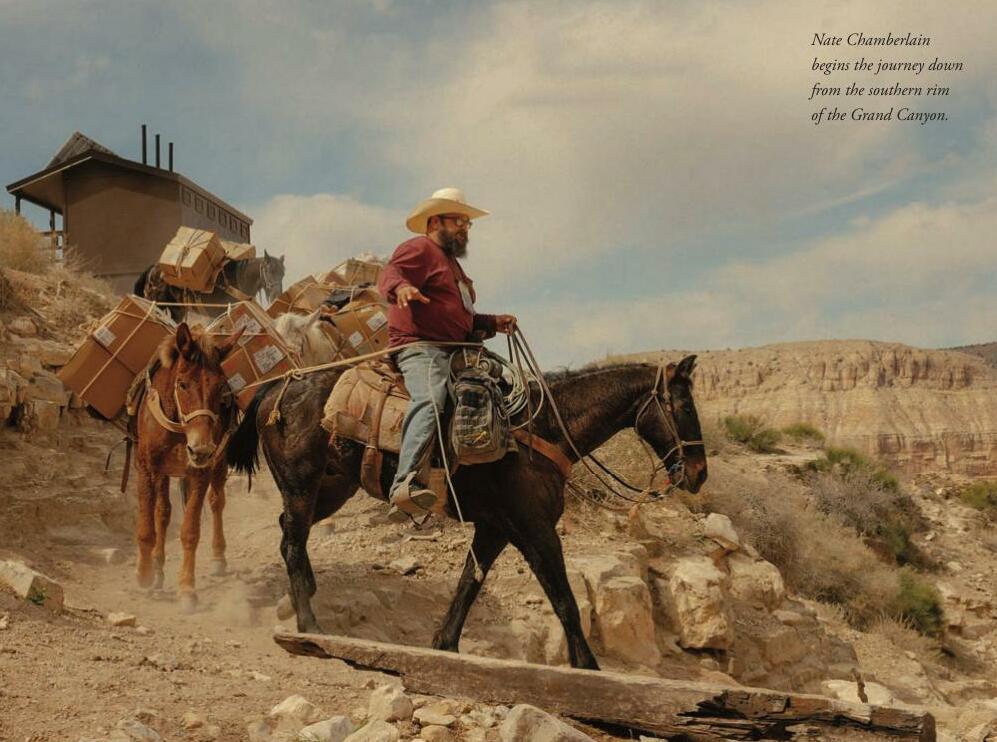
Just after 8 o'clock one spring morning, 2,000 feet below the rim of the Grand Canyon, Nate Chamberlain, wearing chaps and cowboy boots, emerged from the post office in Supai, Arizona, with the last of the morning mail. He tucked a Priority Mail envelope into a plastic U.S. Postal Service crate lashed to one of the six mules waiting outside. Then he climbed into the saddle on the lead mule, gave a kick of his spurs, and set off down the dirt road leading out of the village.
It was the beginning of what may be the country’s most unusual USPS route—the very last to deliver mail by mule. The mule train would travel eight miles along a creek lined with cottonwoods, through a narrow gorge, and up a switchbacking trail carved into the cliffside to reach a hitching post at the top of the canyon, where a sign reads US MAIL DELIVERY ZONE. There, Chamberlain would drop off the outgoing mail with a driver—who would take it another 68 miles to the next post office, in the town of Peach Springs—and pick up the incoming mail to deliver back to the village.
Supai, the only village on the reservation of the Havasupai Tribe, is one of the most remote communities in the country. It is accessible only by foot, and by helicopter when the weather allows. The mule train, which makes the 16-mile, six-hour loop up and down the canyon five days a week, is perhaps the most extreme manifestation of the USPS mandate to “render postal services to all communities.” Mail delivery in Supai involves a feat of logistics, horsemanship, and carefully placed hooves. It is slow and drudging work—starting at 3 a.m., when Chamberlain rises to feed the pack string, and continuing to sundown as fences are fixed and horseshoes are replaced—that belies an era of instant delivery, optimized everything, and “government efficiency.” It also offers a glimpse into what the Postal Service can mean for rural America, at a moment when the agency's future is uncertain.


Esta historia es de la edición June 2025 de The Atlantic.
Suscríbete a Magzter GOLD para acceder a miles de historias premium seleccionadas y a más de 9000 revistas y periódicos.
¿Ya eres suscriptor? Iniciar sesión
MÁS HISTORIAS DE The Atlantic

The Atlantic
How America Celebrated Its 100th Birthday
The Centennial Exhibition of 1876 promised a glorious industrial future. Outside its gates, the country seethed with violence and corruption.

12 mins
June 2026

The Atlantic
THE CLOWN SHOW
The Savannah Bananas are reviving one of the most entertaining—and controversial—teams in Negro Leagues history.
21 mins
June 2026

The Atlantic
The Diva
Denyce Graves is retiring from performing after a career as one of opera's leading women. But there's more work for her to do.
10 mins
June 2026

The Atlantic
Cat Heir
Did Karl Lagerfeld really leave millions to Choupette?
26 mins
June 2026

The Atlantic
The Secret of Elizabeth Strout's Appeal
How she writes best sellers that are also critical darlings
10 mins
June 2026

The Atlantic
THE VENTURE-CAPITAL POPULIST
How David Sacks and the new tech right went full MAGA and captured Washington
32 mins
June 2026

The Atlantic
Glory Days
Heartland rock was shot through with nostalgia— but nostalgia for what?
9 mins
June 2026

The Atlantic
Alien Nation
Why Americans want to believe that the government is hiding the truth about extraterrestrial life
11 mins
June 2026

The Atlantic
Dinah's Hat
On the day Dinah lost her hat, I was sitting on the top step of my just-right Scamp trailer doing a crossword.
24 mins
June 2026

The Atlantic
THE AMERICA I'VE KNOWN
In my 93rd year, it's become ever more clear that patriotism requires sacrifice and collective effort.
7 mins
June 2026
Listen
Translate
Change font size