Intentar ORO - Gratis
The next view into the cosmos
TIME Magazine
|March 24, 2025
The giant, 40-ft. space telescope resting in the airtight, climate-controlled clean room at NASA’s Goddard Space Flight Center in Greenbelt, Md., wants nothing to do with the microscopic dust particles clinging to your clothing.
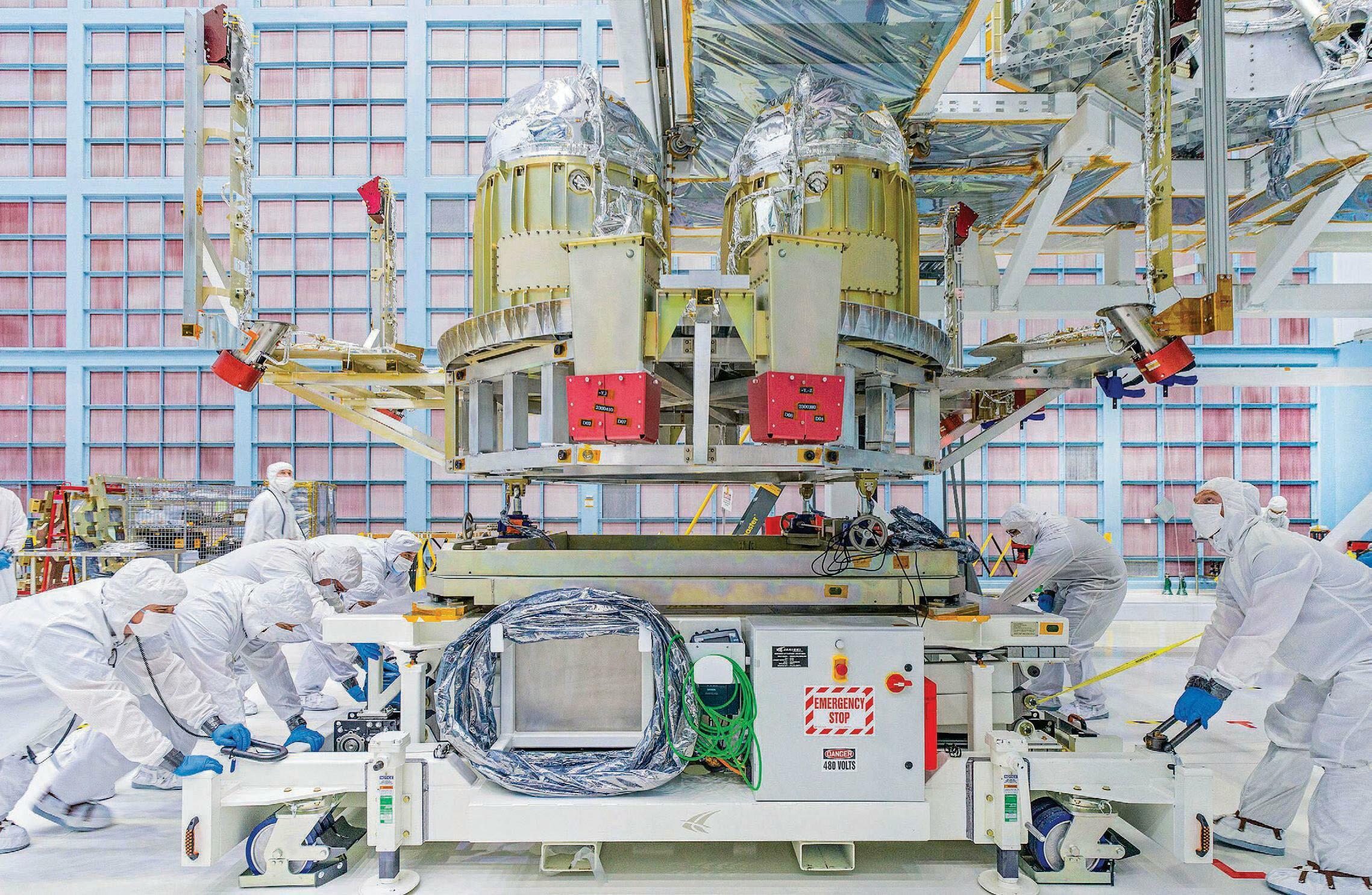
So before you enter the room, you stand in a chamber that blows high-powered, compressed air at you from head to toe, sweeping you clean. Next you dress up in surgical scrubs—booties, head covering, mask, blouse, and pants—and pass through a series of doors that take you into successively more sterile anterooms. Only then, when your dust can pose no danger to the delicate machine in the center of the room, can you join the Nancy Grace Roman Space Telescope on the factory floor. There, technicians are busy completing its assembly in preparation for its launch in May 2027 to a spot in space close to 1 million miles from Earth. From there it may transform our understanding of the cosmos.
“The vast discovery power of this telescope is going to expand our window of knowledge by orders of magnitude,” says Jamie Dunn, the Roman telescope’s project manager. “You’re going to have a tremendous amount of data available to tens of thousands of scientists. It’s just mind-boggling.”
“We [will be able to] move quickly and map out very large areas of the sky,” adds Josh Schlieder, the $4 billion telescope’s wide-field-instrument scientist. “We [will] detect hundreds of millions of galaxies to very high accuracy with very deep imaging.”
The telescope will be able to look at a patch of sky 100 times larger than both the Hubble Space Telescope and the James Webb Space Telescope can. It will be able to peer up to 13.2 billion light-years away, collecting images of the 13.8 billion-year-old universe when it was just 600 million years old. The 18 detectors in its wide-field infrared imaging camera are equipped with 16 million pixels each, providing exquisite image resolution. And its 5.6-ft. (1.7 m) high-gain antenna will be able to send a fire hose of pictures and data back to Earth at unprecedented speed. What’s more, all of this data will be open source—available to the world.


Esta historia es de la edición March 24, 2025 de TIME Magazine.
Suscríbete a Magzter GOLD para acceder a miles de historias premium seleccionadas y a más de 9000 revistas y periódicos.
¿Ya eres suscriptor? Iniciar sesión
Listen
Translate
Change font size