
Vuélvete ilimitado con Magzter GOLD
Obtenga acceso ilimitado a más de 9000 revistas, periódicos e historias Premium por solo
Intentar ORO - Gratis
The Politics of New Castes
Outlook
|April 01, 2024
With the Prime Minister announcing the poor, women, farmers, and the youths as new caste categories, it would be interesting to see its impact on the upcoming General Elections

ON August 7, 1990, Prime Minister V P Singh, while implementing the recommendations of the Mandal Commission—that included giving 27 per cent reservation to the socially and educationally backward classes—said on the floor of the house: “It is a momentous decision of social justice”. Evoking the legacy of Babasaheb Ambedkar, who tirelessly fought for social and political reservation for the Scheduled Castes (SC) and the Scheduled Tribes (ST), Singh added: “The present decisions are along the same lines, and belong to the tradition of this government’s dedication to the cause of SCs, socially and educationally backward classes and other weaker sections.”
Though this declaration did not cause any immediate stir in the North, Singh was aware of the impending tectonic shift in Indian politics. As the Janata Dal’s (JD) two alliance partners—the Bharatiya Janata Party (BJP) and the Left—were not working in a syncretic manner, Singh, analysts say, wanted to strengthen the social alliance of the Ahir-Jat-Gujjar-andRajput (AJGAR) category that catapulted him to power in 1989. And the best way to do this was to implement the Mandal Commission recommendations.
In the following years, the social alliance of the OBCs and the Dalits, especially across Uttar Pradesh and Bihar, not only changed the fate of politics in India—with the exit of the Congress from both states—it also gave birth to the Kamandal politics that the BJP leveraged to consolidate all the Hindu castes.
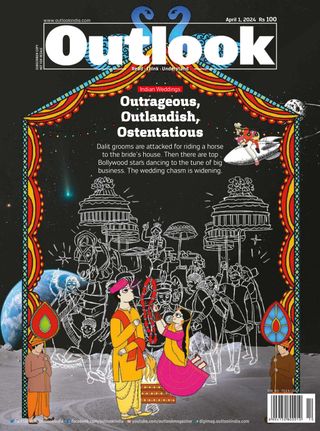

Esta historia es de la edición April 01, 2024 de Outlook.
Suscríbete a Magzter GOLD para acceder a miles de historias premium seleccionadas y a más de 9000 revistas y periódicos.
¿Ya eres suscriptor? Iniciar sesión
MÁS HISTORIAS DE Outlook
Outlook
Goapocalypse
THE mortal remains of an arterial road skims my home on its way to downtown Anjuna, once a quiet beach village 'discovered' by the hippies, explored by backpackers, only to be jackbooted by mass tourism and finally consumed by real estate sharks.

2 mins
January 21, 2026

Outlook
A Country Penned by Writers
TO enter the country of writers, one does not need any visa or passport; one can cross the borders anywhere at any time to land themselves in the country of writers.
8 mins
January 21, 2026

Outlook
Visualising Fictional Landscapes
The moment is suspended in the silence before the first mark is made.
1 mins
January 21, 2026
Outlook
Only the Upper, No Lower Caste in MALGUDI
EVERY English teacher would recognise the pleasures, the guilt and the conflict that is the world of teaching literature in a university.
5 mins
January 21, 2026
Outlook
The Labour of Historical Fiction
I don’t know if I can pinpoint when the idea to write fiction took root in my mind, but five years into working as an oral historian of the 1947 Partition, the landscape of what would become my first novel had grown too insistent to ignore.
6 mins
January 21, 2026

Outlook
Conjuring a Landscape
A novel rarely begins with a plot.
6 mins
January 21, 2026

Outlook
The City that Remembered Us...
IN the After-Nation, the greatest crime was remembering.
1 min
January 21, 2026

Outlook
Imagined Spaces
I was talking with the Kudiyattam artist Kapila Venu recently about the magic of eyes.
5 mins
January 21, 2026

Outlook
Known and Unknown
IN an era where the gaze upon landscape has commodified into picture postcards with pristine beauty—rolling hills, serene rivers, untouched forests—the true essence of the earth demands a radical shift.
2 mins
January 21, 2026

Outlook
A Dot in Soot
A splinter in the mouth. Like a dream. A forgotten dream.
2 mins
January 21, 2026
Listen
Translate
Change font size