
Vuélvete ilimitado con Magzter GOLD
Obtenga acceso ilimitado a más de 9000 revistas, periódicos e historias Premium por solo
Intentar ORO - Gratis
Prescription: Empathy
Outlook
|August 21, 2025
Mental health policy in India must move beyond treatment to include prevention at every level
INDIA'S public health successes like polio, maternal mortality and COVID-19 have followed a similar arc—from a visible threat, to a coordinated response, and measurable reduction. Yet, mental health does not fit this trajectory. Unlike other health emergencies, it does not announce itself with a sudden outbreak, but with quiet signals such as dropping out of school, unexplained fatigue, declining productivity, and suicides relegated to the margins of newspapers. And so, for decades, we have under-invested, under-counted and under-responded to it.
India currently loses about 2,433 years per 100,000 people due to mental illness, measured in Disability-Adjusted Life Years (DALYs), which combine years lived with disability and years lost to early death. With only 56,600 psychiatric beds, 9,000 psychiatrists, and a per capita government spend of just Rs 7.46 on mental hospitals, we are fundamentally unprepared. Such a health system, which is activated only after someone falls severely ill, is inadequate and structurally impossible. In our recent paper, 'Mental Health in India: The Pathway to Zero', we used simulation modelling to examine what it would take to meet the population's mental health needs through treatment alone. To meet the current need, we require nearly 800,000 psychiatric beds, 500,000 psychiatrists, and Rs 20,000 per person annually. By 2040, with the mental health burden projected to rise by 30 per cent, the requirements swell up to over 1,100,000 psychiatric beds, 700,000 psychiatrists and Rs 40,000 per person annually.
These gaps are unbridgeable. No health system can be expected to scale over 20 times its infrastructure, 80 times its workforce, and 5000 times its budget in 15 years. To meet the mental health needs of our population, India must shift from a late-stage, treatment-heavy approach to one that prioritises prevention, early intervention and population-level support.
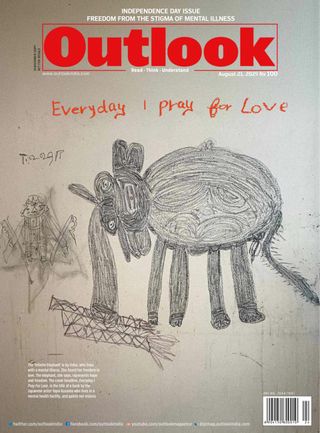

Esta historia es de la edición August 21, 2025 de Outlook.
Suscríbete a Magzter GOLD para acceder a miles de historias premium seleccionadas y a más de 9000 revistas y periódicos.
¿Ya eres suscriptor? Iniciar sesión
MÁS HISTORIAS DE Outlook
Outlook
Turbulence in Tehran
To ignore or lampoon the attempts in Iran against the rule of clerics shrinks the space for the anti-imperialist Left to challenge other political ideologies, such as Hindutva

5 mins
March 21, 2026

Outlook
Not in Our Name
HE should have first corrected his own vices and then given us advice”.
3 mins
March 21, 2026
Outlook
Epic Faux Pas
For Iran, survival is victory. The martyrdom of Khamenei has had a rallying effect, and its strategy is built on domestic civil-military endurance and regional-global deterrence
6 mins
March 21, 2026

Outlook
'Winter Will One Day be Past'
This book is a true testament of friendship and an act of solidarity
4 mins
March 21, 2026
Outlook
‘Nolite Te Bastardes Carborundorum (Don't let the bastards grind you down)
\"There is more than one kind of freedom,\" said Aunt Lydia. \"Freedom to and freedom from.
4 mins
March 21, 2026

Outlook
Zan. Zendegi. Azadi
Are Trump and Netanyahu really interested in liberating Iranian women through this war?
5 mins
March 21, 2026

Outlook
Bruno ki Betiyaan
Whether future regimes sustain, reshape, or compete with Bihar's maternal welfare architecture will determine how deeply Nitish Kumar's political legacy shapes the state's democratic future
4 mins
March 21, 2026

Outlook
Capitalism Redux
The Global South must learn from the West Asian crisis that the persistence of neoliberalism alongside hyper-nationalism leads to brutality and genocidal war
4 mins
March 21, 2026
Outlook
The JNU Files
The immediate backdrop to the recent showdown at Jawaharlal Nehru University lay in earlier tensions
7 mins
March 21, 2026

Outlook
What is Trump's Endgame?
The Iran war looks like a high-stakes attempt by the US and Israel to reshape the balance of power in West Asia
6 mins
March 21, 2026
Listen
Translate
Change font size