Intentar ORO - Gratis
As Goalposts Shift
Outlook
|September 11, 2025
The Opposition accuses the Election Commission of furthering the ruling establishment's political agenda. The ECI dismisses the charges as politically motivated
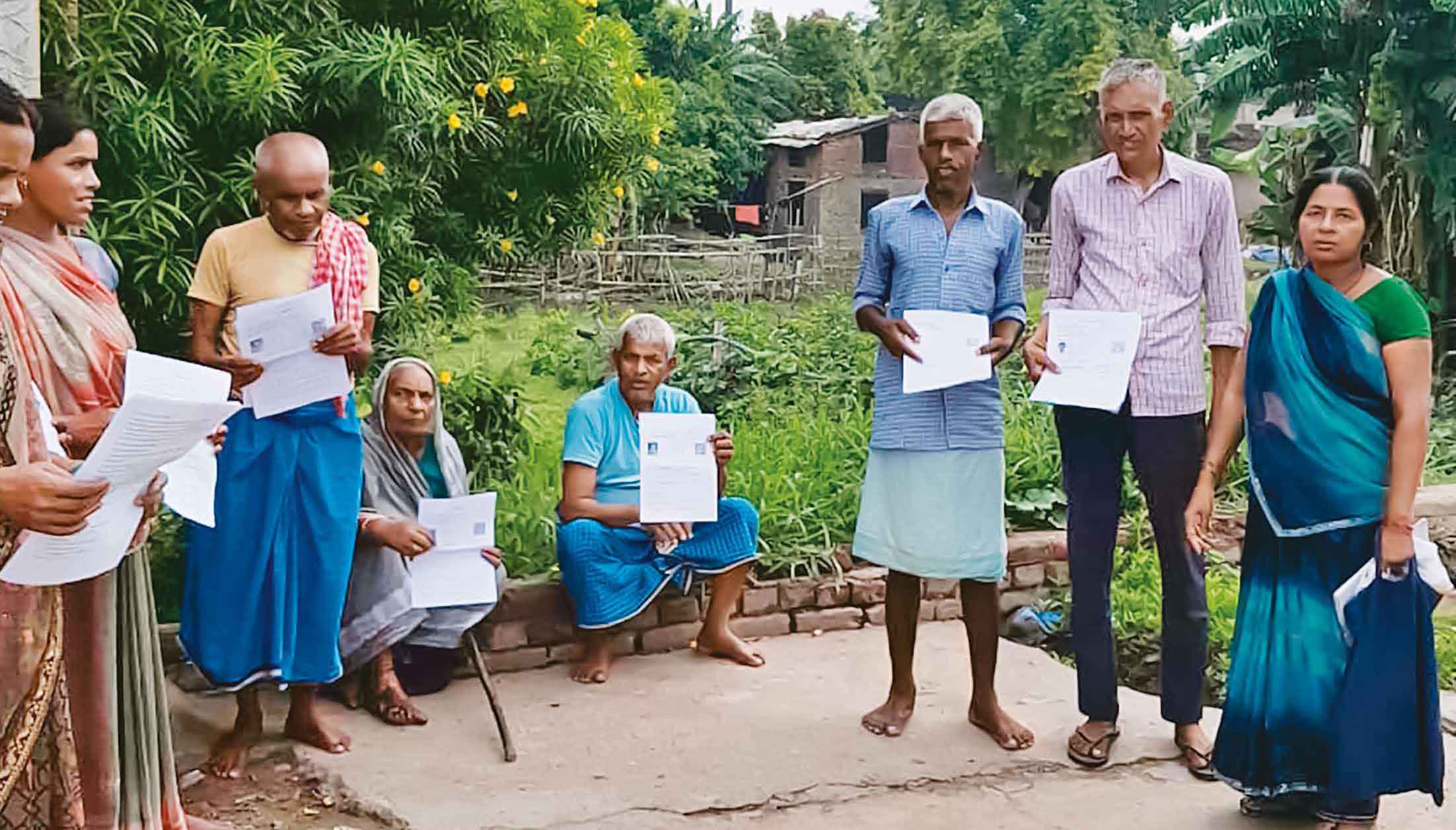
FOR years, among the usual visuals and news reports emerging during election time in India have been that of polling personnel travelling to remote areas—taking country boats to islands, climbing hills, crossing streams and traversing forests. The mission: to ensure even the last person is included in the democratic process.
It is then rather strange that the Supreme Court of India, on July 28, had to remind the Election Commission of India (ECI) that “mass inclusion” and not “en masse exclusion” should be the outcome of the electoral roll revision exercise in the poll-bound state of Bihar.
Three days later, the ECI’s publication of the draft voter list as part of the Special Intensive Revision (SIR) revealed as many as 65 lakh names have been removed from the voter list—setting an example of the removal of the highest number of voters in one go in the history of India’s electoral roll revision.
From making it the poll panel's responsibility to reach out to voters, the ECI appears to have suddenly changed the rules of their engagement. The onus of proving citizenship, an essential part of electoral rights, lies on the electors, and not the ECI, the poll panel told India's top court in July. Even for the large-scale exclusion of 65 lakh names, the ECI tried to pass on the responsibility of correctness of the list to the Booth Level Agents (BLAs) of different political parties, while parties point out that it is the responsibility of the Booth Level Officers (BLOs), who are part of the administration.
What caused the ECI's apparent change of approach—from 'we must reach the last person' to 'aggrieved persons first need to reach us'? The question may have many answers.
While Opposition parties accuse the poll panel of carrying out the political agenda of the ruling establishment, the ECI insists the charges against it are politically motivated.


Esta historia es de la edición September 11, 2025 de Outlook.
Suscríbete a Magzter GOLD para acceder a miles de historias premium seleccionadas y a más de 9000 revistas y periódicos.
¿Ya eres suscriptor? Iniciar sesión
MÁS HISTORIAS DE Outlook

Outlook
The Spectacle of the Woman Accused
Media narratives—especially when women are involved—can end up amplifying suspicion and weaponising gender

7 mins
March 11, 2026

Outlook
The Stink of Epstein
Why are the rich and powerful of the world scared of what lies buried in the Jeffrey Epstein files?
6 mins
March 11, 2026

Outlook
Passing the Watermelon
Narendra Modi's presence in Israel is being read not just as a bilateral engagement, but as an endorsement of Israeli action in Gaza and the West Bank
5 mins
March 11, 2026

Outlook
For Phoolan, Who Wasn't a Devi
“Whether or not it is the Truth is no longer relevant. The point is that it will, (if it hasn’t already) - become the Truth. Phoolan Devi, the woman has ceased to be important. (Yes of course she exists. She has eyes, ears, limbs, hair etc. Even an address now) But she is suffering from a case of Legenditis. She’s only a version of herself. There are other versions of her that are jostling for attention. Particularly Shekhar Kapur’s “Truthful” one, which we are currently being bludgeoned into believing.”–Arundhati Roy in ‘The Great Indian Rape-Trick I’, on the film Bandit Queen by Shekhar Kapur based on Phoolan, whom he never met because he didn’t think he needed to meet her. The film was based on journalist Mala Sen’s book India’s Bandit Queen: The True Story of Phoolan Devi.
5 mins
March 11, 2026

Outlook
The Chic Cartel
Women are not just victims or side characters in recent crime-and-power OTT dramas. They are complex forces-capable of empathy, strategy and ruthlessness-whose narratives demand both recognition and reckoning
5 mins
March 11, 2026

Outlook
The Hierarchy of Sympathy
In crimes against women, justice is shaped not only in courtrooms but in newsrooms where narrative determines whose suffering becomes national conscience and whose fades into procedural silence
5 mins
March 11, 2026

Outlook
Dasyu Sundari
Media accounts simultaneously cast her as victim and avenger, until a life shaped by caste violence and gendered oppression was repackaged into a consumable myth of dishonour and revenge
8 mins
March 11, 2026

Outlook
Prince Pervert
Are rumours of the death of the rule of law vastly exaggerated?
4 mins
March 11, 2026
Outlook
Together, Apart
Poonam Saxena's translations of Mannu Bhandari and Rajendra Yadav's memoirs present a portrait of the trailblazing Hindi writer-couple's marriage and of newly independent India
3 mins
March 11, 2026

Outlook
The Great Indian Rape Trick'
The trope of transforming sexual violence against women into a springboard for rage that can only be channelled through counter-violence has long served as a popular framework in cinema, both globally and in India
6 mins
March 11, 2026
Listen
Translate
Change font size