Intentar ORO - Gratis
Dr.Gindi sculptor, has a philosophical conversation with Richard Baron about sensation, life, infinity and, you guessed it, sculpture.
Philosophy Now
|February/March 2024
Dr. Gindi is one of Switzerland's foremost sculptors, whose work has been exhibited in many countries.
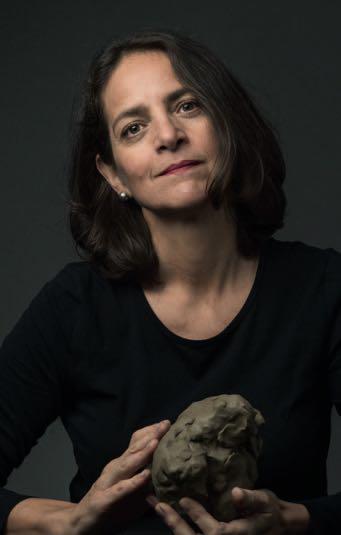
Her bronzes are an invitation to the viewer to rethink their relationship to the world. We see a person, a face, a hand, but we know that there is more to grasp, something that's captured by a tension between what's there in the bronze and what is not there. Through this, Dr. Gindi wants to lead us into an infinite range of possibilities, and thereby make us reflecton the fact that life too is full of possibilities.
Dr. Gindi, your work is characterized by an inquiry into the human condition. As a philosopher-sculptor, you seek to usher us closer to finding our place in the universe. What are we searching for? And why?
There's an awe-inspiring freedom in recognizing the choice to transform what's in front of us. Every individual has the profound opportunity to shape their own journey. In my art, I strive to reflect both the freedom and the responsibility gifted to us: How do we make sense of this momentous choice, the long search, and the sacred journey that we're on? We often believe wholeheartedly that if we achieve something we desire, then something even more significant will come beyond the thing itself. Part of the way we live our lives is striving for these particularities; indeed, it's part of the human condition. But there's also an oftignored part of our existence which exerts a gravitational pull that's just as strong: a desire for belonging, for peace with oneself and one's surroundings, accompanied by the ability to stand at the precipice beholding the big picture.
But to what extent do we have the choice to transform the universe we're thrown into? And how does that search manifest itself in your sculptural work?

Esta historia es de la edición February/March 2024 de Philosophy Now.
Suscríbete a Magzter GOLD para acceder a miles de historias premium seleccionadas y a más de 9000 revistas y periódicos.
¿Ya eres suscriptor? Iniciar sesión
MÁS HISTORIAS DE Philosophy Now

Philosophy Now
Bilbo Theorizes About Wellbeing
Eric Comerford overhears Bilbo and Gandalf discussing happiness.

9 mins
December 2025 / January 2026

Philosophy Now
What Women?
Marcia Yudkin remembers almost choking at Cornell
11 mins
December 2025 / January 2026

Philosophy Now
Islamic Philosophers On Tyranny
Amir Ali Maleki looks at tyranny from an Islamic perspective.
4 mins
December 2025 / January 2026

Philosophy Now
Peter Singer
The controversial Australian philosopher defends the right to choose to die on utilitarian grounds
5 mins
December 2025 / January 2026

Philosophy Now
Another Conversation with Martin Heidegger?
Raymond Tallis talks about communication problems.
7 mins
December 2025 / January 2026

Philosophy Now
Letters
When inspiration strikes, don't bottle it up. Email me at rick.lewis@philosophynow.org Keep them short and keep them coming!
17 mins
December 2025 / January 2026
Philosophy Now
The Philosophy of William Blake
Mark Vernon looks at the imaginative thinking of an imaginative artist.
9 mins
December 2025 / January 2026

Philosophy Now
Philosophical Haiku
Peering through life’s lens God in nature is deduced: The joy of being.
1 mins
December 2025 / January 2026

Philosophy Now
Philosophy Shorts
More songs about Buildings and Food' was the title of a 1978 album by the rock band Talking Heads. It was about all the things rock stars normally don't sing about. Pop songs are usually about variations on the theme of love; tracks like Rose Royce's 1976 hit 'Car Wash' are the exception. Philosophers, likewise, tend to have a narrow focus on epistemology, metaphysics and trifles like the meaning of life. But occasionally great minds stray from their turf and write about other matters, for example buildings (Martin Heidegger), food (Hobbes), tomato juice (Robert Nozick), and the weather (Lucretius and Aristotle). This series of Shorts is about these unfamiliar themes; about the things philosophers also write about.
2 mins
December 2025 / January 2026

Philosophy Now
Hedonic Treadmills in the Vale of Tears
Michael Gracey looks at how philosophers have pursued happiness.
8 mins
December 2025 / January 2026
Listen
Translate
Change font size