Intentar ORO - Gratis
Finishing Secrets FOR FURNITURE-GRADE TRIM
Old House Journal
|January - February 2026
Whether you're staining a door, built-in cabinetry, or any of the millwork in between, follow these steps for a flawless finish.
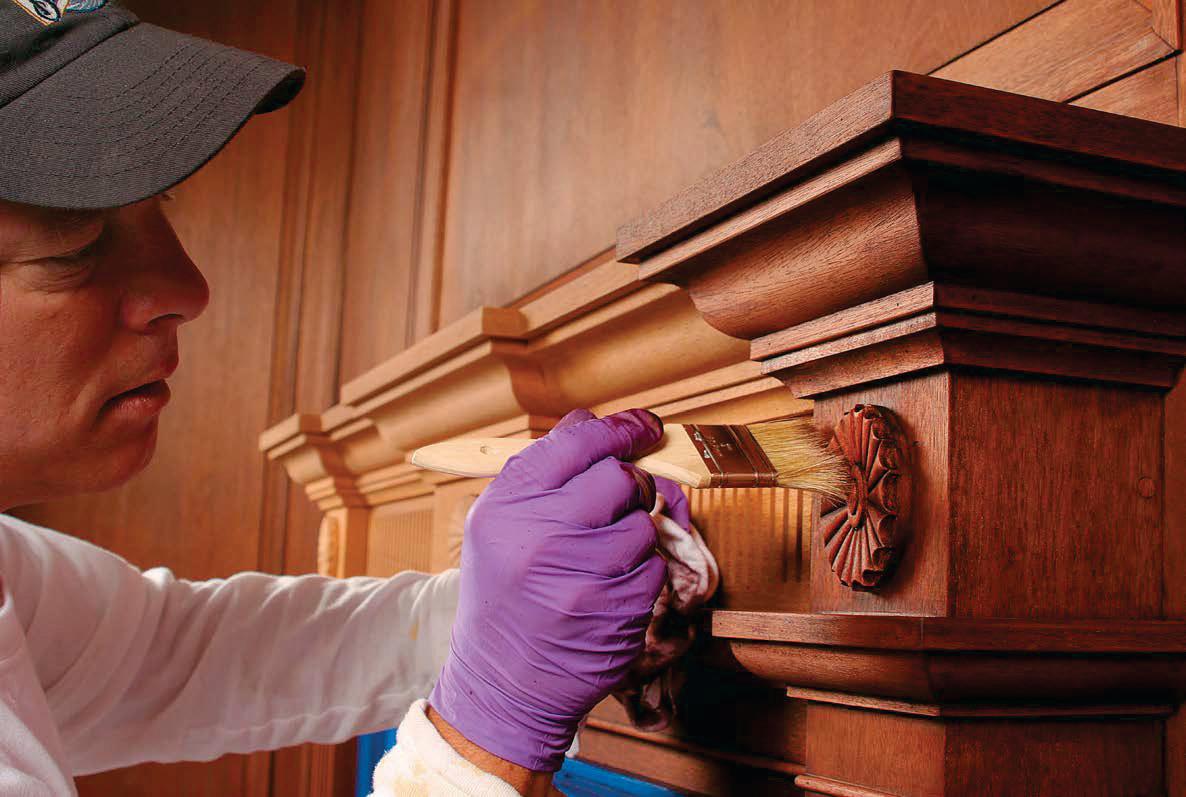
For the past 12 years, I've spent my days as a finish foreman with a company that remodels and restores historic mansions and builds new homes in Newport, R.I. Our carpenters install custom-milled trim, cabinetry, doors, and windows. Then my crew and I go in and finish them. Given all that—and the ocean views—it's a sweet deal.
There's no doubt that the craftsmanship that precedes us sets the stage for us to do our best work. But delivering flawless finishes is no easy task. Staining and clear-coating the mahogany mantelpiece featured here—and the paneled library that it's in—took three of us two weeks to complete. Yes, we were methodical and took great care when applying the stain and the final clear coats. But nothing got more of our attention than the prep we did before popping the lid off the first can of stain.
Sand every inch
On a recent job, someone accidentally dripped water on an oak floor that my crew and I had just prepared for stain. Unfortunately, that someone never told us about it. When we applied the stain, there—in dark splotches—was the evidence. The water had raised the grain, creating an uneven surface. Unlike a layer of paint, which hides the wood, stain highlights it. Unfortunately, stain also highlights watermarks, fingerprints, dried glue, and swirl marks left by power sanders. To get consistent results with stain, you can't just sand the blemishes; you need to sand the entire project evenly.
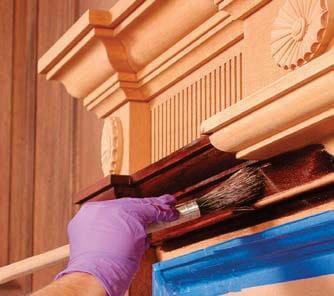 Sanding it all evens the porosity of the wood. When wood is run through a planer or shaper, its outer fibers are compressed, leaving a glazed or glossy appearance. If stain is applied directly over the compressed fibers, it doesn't penetrate as it's meant to. Sanding opens the fibers evenly, allowing stain to soak in.

Esta historia es de la edición January - February 2026 de Old House Journal.
Suscríbete a Magzter GOLD para acceder a miles de historias premium seleccionadas y a más de 9000 revistas y periódicos.
¿Ya eres suscriptor? Iniciar sesión
MÁS HISTORIAS DE Old House Journal

Old House Journal
Un-muddling!
MAKING IT WRIGHT The Ross Home was completed in 1916 as part of a small subdivision called Ravine Bluffs, in Glencoe, Illinois, designed by Frank Lloyd Wright.

1 min
May - June 2026

Old House Journal
Vintage, Retro, Wow
For their own house, this artistic pair created an eclectic farmhouse kitchen.
3 mins
May - June 2026

Old House Journal
New Window in a Brick House
Redundant flashings and attention to detail keep out air and water.
6 mins
May - June 2026

Old House Journal
Interpreting MCM, outdoors
ADOPTING A MID-CENTURY HOUSE, A GARDENER IS INSPIRED BY THE EXPANSIVE VIEWS FROM INSIDE TO CREATE AN INTERPRETIVE LANDSCAPE—THINKING OUTSIDE THE (GLASS) BOX.
4 mins
May - June 2026

Old House Journal
stewards of home PAST & FUTURE
In Milwaukee, a striking limestone Tudor retains its history as it gains luxury and function through a deft renovation.
3 mins
May - June 2026

Old House Journal
Eichlers get an upgrade
Performance improvements for the prized homes of an influential developer who wanted us all to be able to own one.
7 mins
May - June 2026

Old House Journal
Houses Before 1800
These are survivors in styles ancient and vernacular.
1 min
May - June 2026

Old House Journal
Weaving Sidewall Shingle Corners
Some house styles and shingle applications don't rely on corner boards. Here's how to make an attractive, waterproof corner.
2 mins
May - June 2026

Old House Journal
serenity IN A LANDMARK HOUSE
In Berkeley, a preservation-minded couple reinvigorate a picturesque 1914 house designed by famed California architect Julia Morgan.
4 mins
May - June 2026

Old House Journal
SITE-BUILT TRIM RACK
I built this trim rack because I wanted our job sites to be more efficient and organized.
1 min
May - June 2026
Listen
Translate
Change font size