
Vuélvete ilimitado con Magzter GOLD
Obtenga acceso ilimitado a más de 9000 revistas, periódicos e historias Premium por solo
RUBBED RIGHT: Moissanite & Silicon Carbide
Rock&Gem Magazine
|September 2023
When a popular artisan who has worked in lapidary since the 1950s suggests taking a closer look at their "grit of W choice, it's at least worth checking out.

Meet moissanite, also known as silicon carbide, a natural mineral (SiC) so rare that, until the late 1980s, it was believed only found in grains of primitive chondrictic meteorites pre-dating the formation of our own Sun but with a 9.25 Mohs rating, a close contender in hardness to diamond (10).
Now that's interesting.
TURNING UP THE HEAT
The mineral is named after French chemist and 1906 Nobel Prize recipient Ferdinand Frédéric Henri Moissan, one of the original members of the International Atomic Weights Committee and designer of the electric-arc furnace, which could attain temperatures upwards of 3,500°C (or 6,332°F).
Moissan used his furnace to volatilize, or evaporate, substances heretofore regarded as infusible and impossible to melt down. His work preparing new compounds helped lead to the discovery of the highly abrasive carborundum and afforded him the pursuit of his own theory that diamonds could be synthesized by crystallizing carbon under pressure from molten iron.
That's right. Monsieur Moissan is a grandperé of the artificial diamond.
In fact, the chemist misidentified natural moissanite as a diamond in 1893, while examining grains of rock samples from a meteor crater in Canyon Diablo outside of Flagstaff, Arizona. The resulting dent in the Earth, nearly a mile wide and 750 feet deep, according to The Barringer Crater Company, was created when a meteor, estimated at 300,000 tons and traveling 26,000 mph, struck with 150 times the force of the atomic bomb at Hiroshima and blanketed the desert for a mile in every direction with pulverized melted rock mixed with fragments of meteoritic iron.
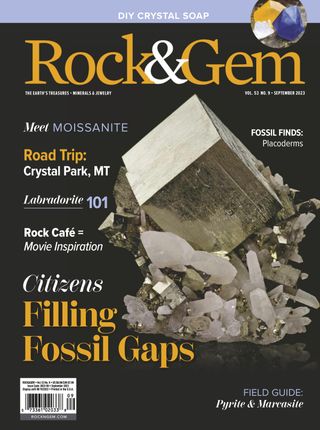

Esta historia es de la edición September 2023 de Rock&Gem Magazine.
Suscríbete a Magzter GOLD para acceder a miles de historias premium seleccionadas y a más de 9000 revistas y periódicos.
¿Ya eres suscriptor? Iniciar sesión
MÁS HISTORIAS DE Rock&Gem Magazine
Rock&Gem Magazine
A New Amber Locality Fills a Gap
A sandstone quarry in central Ecuador has yielded the first significant deposit of Mesozoic amber from South America.

1 min
January / February 2026
Rock&Gem Magazine
Did "Left-Handed" Fish Leave Water Earlier than Thought?
Fossil evidence suggests that fish (or \"fishapods\") dragged themselves onto land during the middle Devonian Period.
1 min
January / February 2026

Rock&Gem Magazine
"Lab Quakes” Produce Surprising Results
When faults let loose and earthquakes result, the main effect we mortals experience is the violent shaking.
1 min
January / February 2026
Rock&Gem Magazine
This Egg is No Spring Chicken
How to date a dino egg
1 min
January / February 2026
Rock&Gem Magazine
Have we Already Mined the Critical Minerals We Need
Then why are we throwing them away?!
1 min
January / February 2026
Rock&Gem Magazine
One Toxic Worm
A critter that creates & tolerates orpiment!
1 min
January / February 2026
Rock&Gem Magazine
ROCK & GEM FIELD GUIDE: Silver
Silver (Ag) is a native element and one of Earth's most prized precious metals.
2 mins
January / February 2026
Rock&Gem Magazine
DINOSAURS OF THE HELL CREEK MUSEUM
In the Badlands of South Dakota, just outside the small town of Belle Fourche—pronounced “Bell Foosh”—a new attraction has taken shape that every dinosaur enthusiast should see. The Dinosaurs of the Hell Creek Museum is part hands-on exhibit, part science center and part active research lab.
3 mins
January / February 2026
Rock&Gem Magazine
The Lost Twins of Kongsberg
A Silver Story Resurfaced
3 mins
January / February 2026
Rock&Gem Magazine
Switzerland's ICE PALACE
Walk Inside a Glacier at The Top of Europe
7 mins
January / February 2026
Translate
Change font size