Intentar ORO - Gratis
Mobile APP Development with React Native
Circuit Cellar
|September 2024
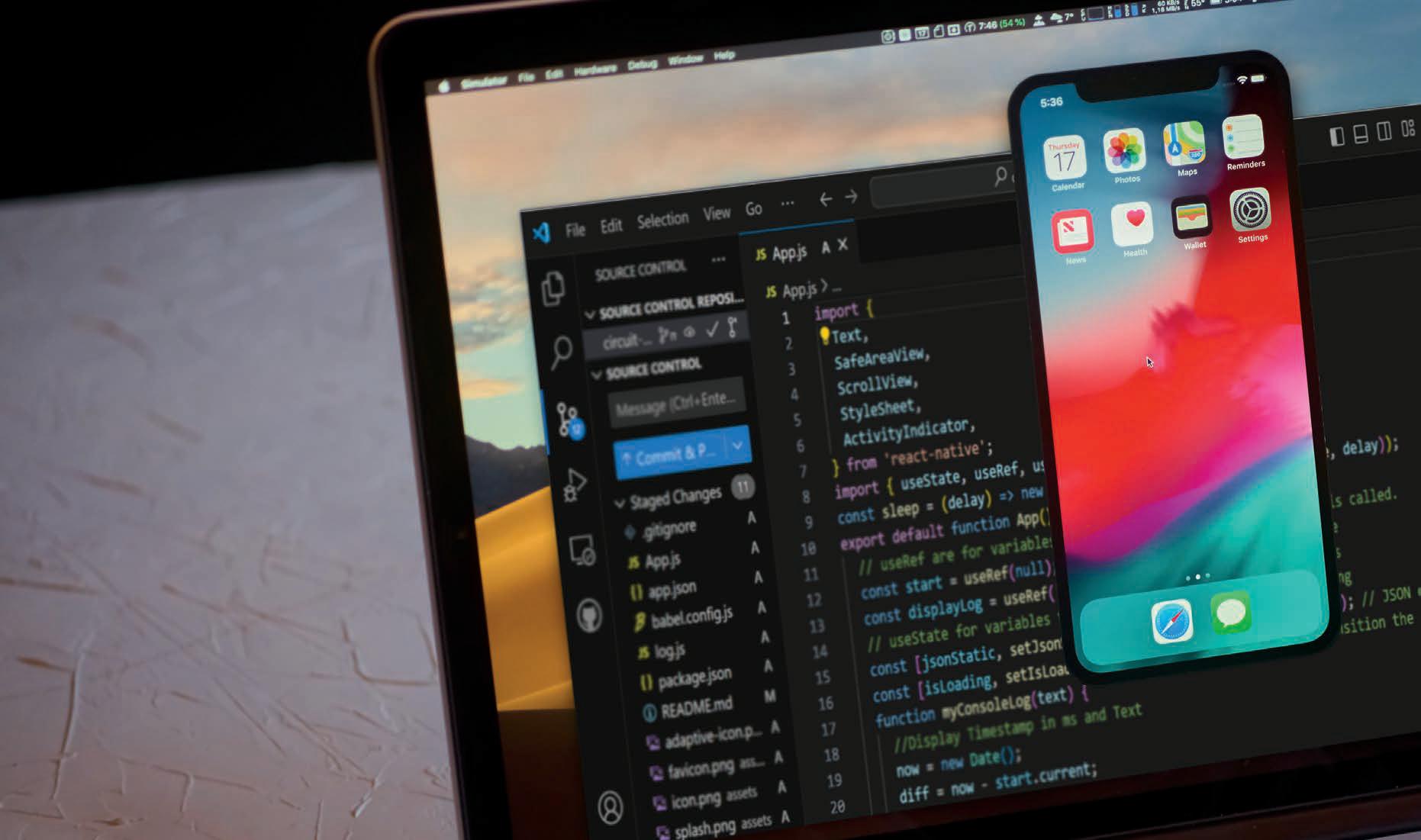
This month, Bob continues his series on mobile app development from an embedded designer's perspective. He programs a React Native app and he offers guidelines for picking a tutorial for React Native. He further explores how it handles concurrency and asynchronous programming. Bob expected a few nuances during the process but to say there were more than a few would be an understatement.
Learning C and the C stdlib library was something I did on my own. Brian Kernighan and Dennis Ritchie's The C Programming Language was something I read while in France on a project in 1981. It was simple, concise and easily digested. Plus, it kept my mind off French baguettes. Reading it did not turn me into a good C programmer, but it laid the foundation. Oh, did I just say that I was a good C programmer. My bad! To show my hubris and shallowness, a short while later a friend asked me to help him debug a C program he had written for the PC. He was brand new to C and I was just "new without the brand" to the language. I confidently told him that, with the debugger, we would find the problem in less than a half hour. Four hours later, I was stumped. The problem was that he allocated very large variables on the stack and blew his default stack away every time he used these variables. But like all stack problems, it was very non-deterministic. The debugger was worthless in debugging that. I had not quite mastered memory allocation.
Now, 45 years later, learning React Native is not done by reading one book. The number of components and the intricacies of JavaScript are significantly more complex than C and its standard library. Add to that the React Native components and I found that I needed a serious course. For example, there are less than 50 functions in most stdlib C libraries. Although there are only 24 core components for React Native, each one is probably 10-20 times more complex than each C library function. Add to that the thousands of community supported components and you will understand the complexity.
TUTORIALS ABOUND

Esta historia es de la edición September 2024 de Circuit Cellar.
Suscríbete a Magzter GOLD para acceder a miles de historias premium seleccionadas y a más de 9000 revistas y periódicos.
¿Ya eres suscriptor? Iniciar sesión
MÁS HISTORIAS DE Circuit Cellar

Circuit Cellar
IDES Converge Toward VS Code
Your Next IDE Might Look Very Familiar

12 mins
April 2026

Circuit Cellar
New KYOCERA AVX Capacitors for Optical Communications
KYOCERA AVX, a leading global manufacturer of advanced electronic components engineered to accelerate technological innovation and build a better future, has expanded its selection of 550/560 Series ultra-broadband capacitors to better satisfy surging cross-market demand for high-speed, high-bandwidth optical communication systems.
2 mins
April 2026

Circuit Cellar
Wireless Convergence Reshaping Autonomous Transportation
The future of transportation will not be defined by a single technology milestone.
4 mins
April 2026

Circuit Cellar
STMicroelectronics' New STM32 Series Redefines Entry-Level Microcontroller Performance and Value for Smart Devices Everywhere
STMicroelectronics (ST), a global semiconductor leader serving customers across the spectrum of electronics applications, has announced a new generation of entry-level microcontrollers (MCUs) to boost the performance of billions of tiny smart devices throughout factories, homes, cities, and infrastructures while meeting cost, size, and power limitations.
1 min
April 2026

Circuit Cellar
Datasheet: Haptic Components Things That Go Buzz in the App
Haptic Devices Bring Physical Feedback to the Human Interface
7 mins
April 2026

Circuit Cellar
Software-Defined Systems
Reshaping the Future of Modern Cars
7 mins
April 2026

Circuit Cellar
Vishay Intertechnology Phototransistor Optocouplers Deliver Accuracy and Energy Efficiency for Industrial Applications
Vishay Intertechnology, Inc. introduced a new series of phototransistor optocouplers that combine a high and linear current transfer ratio (CTR) over temperature with a low forward current of 0.5mA.
1 mins
April 2026

Circuit Cellar
B MCU Real-Time Tracing
How to Trace MCU Code in (Almost) Real Time
13 mins
April 2026

Circuit Cellar
Getting Started with Zephyr RTOS
Sometimes, too much can be just enough. In this article, Jacob shows why learning an RTOS that's more than you need can be just what you need for your growing skillset.
8 mins
April 2026

Circuit Cellar
A Tribute to Robert Tinney
A Captivating Artist in the Early Days of Circuit Cellar
3 mins
April 2026
Listen
Translate
Change font size