
Vuélvete ilimitado con Magzter GOLD
Obtenga acceso ilimitado a más de 9000 revistas, periódicos e historias Premium por solo
Intentar ORO - Gratis
Embedded AI
Circuit Cellar
|October 2025
AI Comes to the Operational Network's Edge

New developments in single-board computers and the chips that power them are bringing the dream of operational artificial intelligence in devices at the network's edge closer to reality than ever before. We're looking at how close we are to widely distributed, on-device intelligence and which trends and developments seem most likely to push us across the goal line.
The integration of Artificial Intelligence (AI) into Internet of Things (IoT) edge devices marks a fundamental shift from centralized cloud computing to distributed intelligence, bringing AI processing closer to data as it's generated and used. This shift, known broadly as Edge AI, is rapidly transforming various industries by enabling devices to process data and make control decisions locally without relying on distant cloud servers or models controlled by third parties.
A SMARTER EDGE
Edge AI is deploying artificial intelligence models directly on edge devices, including sensors, microcontrollers (MCUs), or gateways, enabling them to process data locally. This local processing capability is crucial for enhancing the functionality and efficiency of embedded systems.
The core concepts of Edge AI center on bringing computational power to the network's periphery. This approach offers several significant advantages over traditional client-server or cloud computing. Many of the advantages build on the basic benefits of not shipping data back and forth over long distances, but those benefits show themselves in a number of different ways.
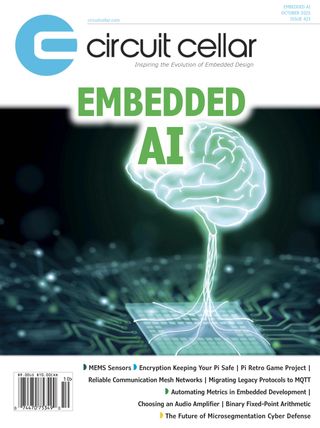

Esta historia es de la edición October 2025 de Circuit Cellar.
Suscríbete a Magzter GOLD para acceder a miles de historias premium seleccionadas y a más de 9000 revistas y periódicos.
¿Ya eres suscriptor? Iniciar sesión
MÁS HISTORIAS DE Circuit Cellar

Circuit Cellar
Sensors: From Canned Tuna to Caviar
In the first installment of a new Circuit Cellar column on sensors, Brian Chee looks at how sensors figure into larger application packages and when can be the perfect solution.

10 mins
February 2026

Circuit Cellar
Bosch Sensortec Launches BMI423 Inertial Measurement Unit
Smart wearables are always on the move-and so is their sensing technology. Bosch Sensortec introduced the BMI423, a new-generation Inertial Measurement Unit (IMU) that combines extended measurement range with low power consumption.
1 mins
February 2026
Circuit Cellar
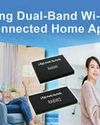
Renesas Releases its First Wi-Fi 6 and Wi-Fi/Bluetooth LE Combo MCUs for IoT and Connected Home Applications
Renesas Electronics Corp., a premier supplier of advanced semiconductor solutions, has introduced the RA6W1 dual-band Wi-Fi 6 wireless microcontroller (MCU), along with the RA6W2 MCU that integrates both Wi-Fi 6 and Bluetooth Low Energy (LE) technologies.
1 mins
February 2026

Circuit Cellar
Airborne Embedded Software: Simplifying Safety and Security
With modern airborne systems no longer isolated computing environments, any vulnerabilities introduced into these increasingly connected devices can quickly become much more than just a cybersecurity issue, but a safety risk no one can afford.
4 mins
February 2026

Circuit Cellar
Wearable LIDAR Spatial Audio Navigator for Visually-Impaired Individuals
Built with a Raspberry Pi Pico, a TF-Luna LiDAR Sensor, and a Hand-Held Potentiometer
13 mins
February 2026

Circuit Cellar
ADRs: The Missing Memory in Embedded Projects
Remembering and communicating why design decisions were made and the reasons behind their particular implementations can be critical when it comes to developing software as a team and maintaing that software in the future. This time Jacob shares his thoughts on and experience with one of the most valuable tools to extend the reach of software development memories.
9 mins
February 2026

Circuit Cellar
Sensors: From Canned Tuna to Caviar
In the first installment of a new Circuit Cellar column on sensors, Brian Chee looks at how sensors figure into larger application packages and when \"just enough sensors\" can be the perfect solution.
10 mins
February 2026
Circuit Cellar
Embedded DSP with the RT1010 MCU
Part 2: Delay, Flanger, IIR, and Overdrive
15 mins
February 2026
Circuit Cellar
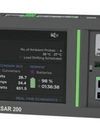
Omnion Power Provides Modular, Scalable DC Power System Monitoring and Control with New Pulsar 200 Controller
Omnion Power is helping to redefine the role of the DC power system controller with its next-generation Pulsar 200 platform.
1 mins
February 2026
Circuit Cellar
Robot Operating System 2 (ROS 2): Core Concepts, Architecture, and Real-World Capabilities
The Robot Operating System 2 (ROS 2) is an open-source, middleware framework that addresses the communication and coordination challenges inherent in modern, distributed robotic systems. In this article, Pedro details how ROS 2's architectural foundations successfully address the core limitations of its predecessor, ROS 1, using real-world scenarios, and steps for setting up the ROS 2 Foxy environment on Ubuntu Linux distro, and cross-platform communication between a host PC and a Raspberry Pi module.
14 mins
February 2026
Listen
Translate
Change font size