Intentar ORO - Gratis
The queen who wouldn't go quietly
BBC History UK
|June 2023
Margaret of Anjou was a foreigner and a woman. Those facts alone should have sunk her bid to regain the English throne for her husband, Henry VI. Yet, writes Joanna Arman, when it came to fighting her family’s corner, Margaret simply didn’t know when she was beaten

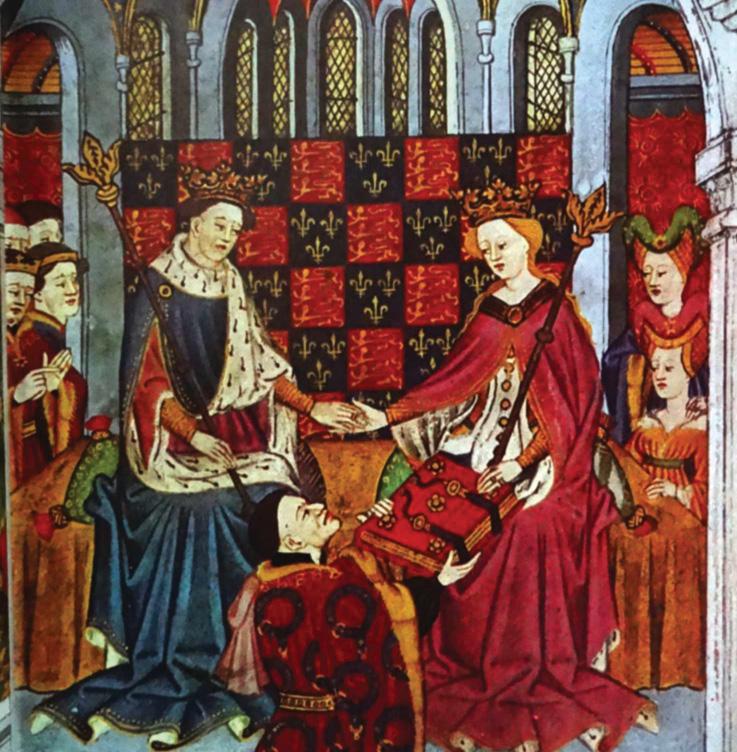
Margaret of Anjou crossed swords with some of 15th-century England’s most formidable warriors. But it was a playwright born eight decades after her death who inflicted the most damage on the queen’s reputation.
When William Shakespeare had Richard, Duke of York describe Margaret as the “She-wolf of France, but worse than wolves of France,” in Henry VI Part III, he helped secure the queen a place in historical infamy. For 500 years, Margaret – wife of Henry VI, and towering figure in the Wars of the Roses – has been labelled an unfaithful wife, a foreign enemy within, a Machiavellian schemer and a bloodthirsty monster who delighted in exacting terrible vengeance on her enemies. Even in modern times, some say Margaret was the inspiration for Game of Thrones’ notoriously manipulative monarch Cersei Lannister.
The truth is, inevitably, far more nuanced – and compelling – than the stereotype. Margaret was neither the unscrupulous ogre of Shakespeare’s portrayal, nor the innocent bystander that some historians have presented in recent years. She was a woman who fought with no little skill and tenacity on behalf of her husband, her son Edward of Westminster – and, of course, herself – in the maelstrom of one of England’s most protracted and vicious civil wars. She suffered setbacks and endured abuse (much of it a result of her gender) that would have broken many of her contemporaries. And yet she so nearly realised her aim of securing her son the English throne. That in itself makes her one of the most fascinating figures of the 15th century.

Esta historia es de la edición June 2023 de BBC History UK.
Suscríbete a Magzter GOLD para acceder a miles de historias premium seleccionadas y a más de 9000 revistas y periódicos.
¿Ya eres suscriptor? Iniciar sesión
MÁS HISTORIAS DE BBC History UK

History Extra
Personal stories
Few shows have enjoyed the longevity of Who Do You Think You Are? and it's easy to understand why it has endured.

1 min
June 2026
History Extra
Tidal change
Southern mythos notwithstanding, there exists no static, exceptional American South.
1 mins
June 2026

History Extra
Marriage story
Emily Howes on her novel about Catherine Dickens' relationship with her famous husband
1 mins
June 2026
History Extra
Sexual her-story
A witty, wide-ranging account of the myths and power structures behind female sexuality impresses SARAH JONES
2 mins
June 2026

History Extra
History man
According to Tom Hanks, during his childhood 'The War' was a recurring topic in the conversations of the adults around him.
1 min
June 2026
History Extra
How to be a master of disguise
10 do's and don'ts when attending a masquerade
2 mins
June 2026
History Extra
Age of indulgence
Our content producer Charlotte Vosper picks episodes of the HistoryExtra podcast about Georgian Britain
1 min
June 2026
History Extra
Gaffer tape
While Bobby Robson and Gareth Southgate both led England to World Cup semi-finals, Alf Ramsey remains the only manager to actually win the trophy.
1 mins
June 2026

History Extra
What's the origin of the Fosbury Flop?
Like the Salchow in ice skating, the Fosbury Flop is a sport technique that immortalises the name of its creator.
1 min
June 2026

History Extra
EXHIBITIONS
In 1776, the United States of America was born - heralded by the Declaration of Independence.
1 min
June 2026
Translate
Change font size