
Vuélvete ilimitado con Magzter GOLD
Obtenga acceso ilimitado a más de 9000 revistas, periódicos e historias Premium por solo
Intentar ORO - Gratis
THE TRIALS OF ED SHEERAN
The New Yorker
|June 05, 2023
Who owns a groove?

One day in 1973, Edward Townsend, a singer-songwriter who’d had a minor hit with the 1958 ballad “For Your Love,” invited a friend, the R. & B. superstar Marvin Gaye, to his home in Los Angeles, to hear some new tunes. Sitting at the piano, Townsend played a four-chord progression in the key of E-f lat major while singing a melody that harked back to his doo-wop days. Townsend, then forty-three, had recently been released from rehab, and the song was a plea to a higher power to help him stay sober. “I’ve been really tryin’ baby, tryin’ to hold back this feeling for so long” was one of the lines.
Gaye, who was suffering from writer’s block after the huge success of “What’s Going On,” for Motown Records, in 1971, heard his friend’s song as a hymn to sex. Together, they created “Let’s Get It On.”
Motown’s music-publishing company, Jobete, took fifty per cent of the song’s copyright. Gaye and Townsend agreed to split their share of the composition’s future earnings. Gaye recorded the song in L.A., in March, 1973, with members of the Funk Brothers, Motown’s house band, who added the wah-wah guitar introduction and the song’s undeniable groove, in which the second and fourth chords are anticipated—slightly in front of the beat. Gaye, in addition to his soaring vocal, played keyboard on the record.
The song, Gaye’s first No. 1, was one of the biggest hits of the year. It became a foundational track in the quiet storm of seventies R. & B. and soul, and has remained an evergreen—a steady earner.
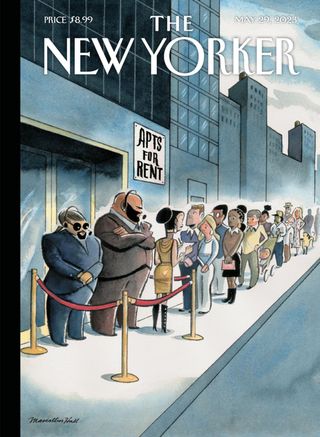

Esta historia es de la edición June 05, 2023 de The New Yorker.
Suscríbete a Magzter GOLD para acceder a miles de historias premium seleccionadas y a más de 9000 revistas y periódicos.
¿Ya eres suscriptor? Iniciar sesión
MÁS HISTORIAS DE The New Yorker

The New Yorker
CONTACT SOLUTIONS
“Disclosure Day.”

6 mins
June 22, 2026

The New Yorker
BAD ROMANCE
When did white-collar work start to look so bleak?
14 mins
June 22, 2026

The New Yorker
MUTTER
I'm waiting for my mother at the airport, holding a strip of cardboard above my head that says \"MUTTER.\"
10 mins
June 22, 2026

The New Yorker
BILLIONS AND BILLIONS
The hedge-fund titan Ken Griffin beats the competition at making money—and spending it.
40 mins
June 22, 2026

The New Yorker
MISERY LOVES COMPANY
The rise of \"Admin Nights\" in pursuit of productivity.
13 mins
June 22, 2026
The New Yorker
MEET RUSS FREUD
It used to be called the Roberts Institute for Living, but everybody knew that it was the insane asylum, and that’s what people called it.
3 mins
June 22, 2026

The New Yorker
UP TO NO GOOD
The hell-raising rocker who conquered country radio.
5 mins
June 22, 2026

The New Yorker
SOUL-SEARCHING
How the American church found its followers.
12 mins
June 22, 2026

The New Yorker
FAREWELL, MY LOVELY
Gustavo Dudamel and James Conlon put down their batons in Los Angeles.
9 mins
June 22, 2026
The New Yorker
ALLIES ON ICE
How the secret plans to take over Greenland have ruptured transatlantic relations.
44 mins
June 22, 2026
Translate
Change font size