Intentar ORO - Gratis
HEAD CASES
The New Yorker
|May 26, 2025
Two productions of Strauss's “Salome,” in New York.
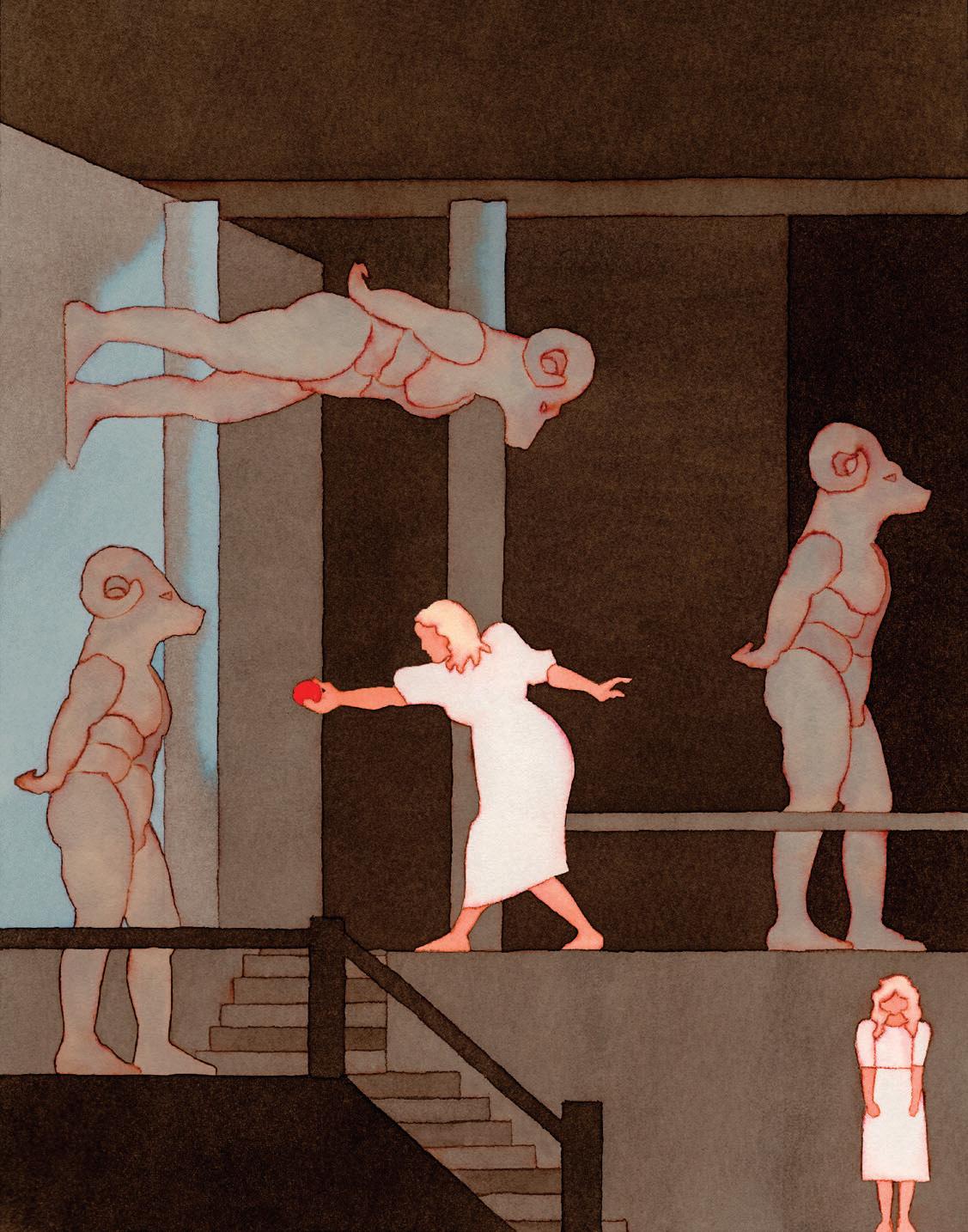
At the Met, decadence is indicated by ersatz-paganistic goings on.
The Biblical figure of Salome, Princess of Judea, who dances before Herod Antipas and demands the head of John the Baptist as a reward, infiltrated late-nineteenth-century culture as an agent of extreme decadence—“the goddess of immortal Hysteria,” as the novelist Joris-Karl Huysmans called her. In Oscar Wilde’s play “Salomé,” written in French in 1892, the princess goes so far as to kiss the prophet’s lifeless lips. In 1905, Richard Strauss used Wilde’s play as the basis for his opera “Salome,” which titillated audiences all over Europe and horrified the board of the Metropolitan Opera. To a degree, the character exemplifies the misogynistic fin-de-siècle trope of women as vampiric beasts. Yet Wilde’s implicit identification with Salome complicates matters. Hedwig Lachmann, the German poet whose incisive translation of “Salomé” became the libretto for Strauss’s opera, saw the princess as an “ethereal being” who feels “alienated from the raw corruption of her surroundings.” The true villain is Herod, who, in his hypocritical mixture of slobbering lust and grandstanding moralism, is a model man of power.
The voluptuous violence of Strauss’s score adds to the richness of the conception. At the turn of the last century, Strauss was experimenting with unprecedented levels of dissonance, and the grinding harmonies of “Salome” threaten to undermine the tonal system, as the young Arnold Schoenberg did not fail to notice. When Herod enters, the music lurches between saccharine waltz episodes and spasms of Expressionistic anarchy—a fracturing of the lingua franca. Salome, in the grisly final scene, reasserts a degree of tonal stability, but dissonant uproar resumes when Herod commands her death. The curtain has gone up on twentieth-century chaos.

Esta historia es de la edición May 26, 2025 de The New Yorker.
Suscríbete a Magzter GOLD para acceder a miles de historias premium seleccionadas y a más de 9000 revistas y periódicos.
¿Ya eres suscriptor? Iniciar sesión
MÁS HISTORIAS DE The New Yorker

The New Yorker
Amanda Petrusich on Katy Grannan's Photograph of Taylor Swift
There’s something uncanny about this still and stunning portrait of a twenty-one-year-old Taylor Swift, shot by Katy Grannan for Lizzie Widdicombe’s Profile of the singer, in 2011.

1 mins
January 12, 2026

The New Yorker
DEAL-BREAKER
Pam is seeing someone, but she’s not talking about it.
19 mins
January 12, 2026
The New Yorker
THE OTHER BOOMERS
Kathryn Bigelow, the director, and Alexandra Bell, the arms-control expert, are both nuclear-attack-submarine literate. Bigelow—whose new Netflix film, “A House of Dynamite,” imagines the U.S. government’s response to an incoming intercontinental ballistic missile (ICBM) eighteen minutes from impact—shot part of her 2002 submarine film, entitled “K-19:
3 mins
January 12, 2026

The New Yorker
THE MUSICAL LIFE BROADWAY BABY
At Joe’s Pizza on Carmine Street, Marc Shaiman, the celebrated composer and lyricist, dropped his slice on the floor. “Ugh, it’s the Shaiman vortex,” he said. “Everything I come near breaks.”
3 mins
January 12, 2026

The New Yorker
NOTORIOUS M.T.G.
Marjorie Taylor Greene and Donald Trump break up over Epstein.
26 mins
January 12, 2026

The New Yorker
YES, AND?
How consent can—and cannot—help us have better sex.
14 mins
January 12, 2026

The New Yorker
LET IT BLEED
When Helen Frankenthaler remade painting.
5 mins
January 12, 2026

The New Yorker
THE AMERICAN POPE
How the Chicago-born Robert Prevost became Leo XIV.
32 mins
January 12, 2026

The New Yorker
DEPT. OF RECYCLING SWIPE OUT
In 1994, when the MetroCard made Its 22, many straphangers were reluctant to say farewell to the subway token. Across the city, commuters struggled to master \"the swipe.
2 mins
January 12, 2026
The New Yorker
THE TALK OF THE TOWN
Easily missed on the back side of the November ballots that brought Zohran Mamdani to Gracie Mansion was a proposal for a new map of New York City.
4 mins
January 12, 2026
Listen
Translate
Change font size