
Vuélvete ilimitado con Magzter GOLD
Obtenga acceso ilimitado a más de 9000 revistas, periódicos e historias Premium por solo
Intentar ORO - Gratis
A Change (of Scenery) Would Do You Good
Writer’s Digest
|July/August 2025
How to vary your setting to your story’s advantage.

Savvy writers know a novel’s setting is more than just a backdrop, a time and place to ground and frame your plot and characters. A well-chosen, well-crafted setting can enhance your story's mood, set the tone, serve as a metaphor for the theme, provide interesting plot possibilities, and much more.
But it’s a tall order for one setting to carry an entire novel. In real life, if we spend too long stuck at home, we get cabin fever. If we go too long without a vacation, we get restless and stir crazy, growing bored with the same old, same old.
So it is with our readers. You could set your novel in the most aspirational place in the world, but if you show only one view of it, eventually, we'll feel as if we're watching a stage play where the set never changes. When a scene starts to feel stale—even though the script and players onstage are solid—it’s time to cue the orchestra's interlude, pull the curtain, and bring your stage crew out of the wings to work some magic that will get your audience to sit up and pay attention.
Here are five ways to vary your setting to your story's advantage.
1. Build contrasting settings into your story’s structure.
A story that pairs vastly different settings can be especially effective in historical fiction (often when modern-day characters are uncovering the mystery of something that happened long ago) and suspense (especially when the story unfolds through multiple points of view).
My latest novel,
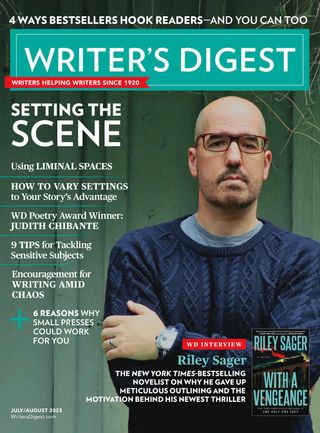

Esta historia es de la edición July/August 2025 de Writer’s Digest.
Suscríbete a Magzter GOLD para acceder a miles de historias premium seleccionadas y a más de 9000 revistas y periódicos.
¿Ya eres suscriptor? Iniciar sesión
MÁS HISTORIAS DE Writer’s Digest

Writer’s Digest
Fate and Prophesy
Defying destiny may be just as hazardous as succumbing to it.”

5 mins
May / June 2026

Writer’s Digest
How to Pitch in Person Without Losing the Plot
Conference-ready tips to make sure your story stands out.
5 mins
May / June 2026
Writer’s Digest
How to Handle Money as a Writer
That is, in case you actually make any ...
8 mins
May / June 2026

Writer’s Digest
Dress Your Manuscript for the Job You Want It to Have
Dress Your Manuscript for the Job You Want It to Have How often have you heard the adage “dress for the job you want”? Probably often enough that it’s a cliché.
5 mins
May / June 2026

Writer’s Digest
Mike Chen
The award-winning science-fiction author discusses the importance of fandom, writing for IP giants like Star Wars, and tackling his biggest project yet: a space opera.
13 mins
May / June 2026
Writer’s Digest
Outlaw Openers
There was a time when starting a sentence with And, But, or So felt like breaking the law.
2 mins
May / June 2026

Writer’s Digest
Collaborate to Create
Why co-authoring nonfiction is a pro strategy worth considering.
7 mins
May / June 2026
Writer’s Digest
The Life-Changing Magic of Tidying Up Your Writing Portfolio
Creating an organized online home for your nonfiction writing samples gives you a strategic advantage.
5 mins
May / June 2026
Writer’s Digest
20 Elevator Pitches for Recently Published Books
One of the most important professional skills an author can develop is the ability to craft an enticing elevator pitch for their book.
5 mins
May / June 2026
Writer’s Digest
On Writing & Newsroom Autobiography
Today, the rise of 24-hour cable news has dramatically reshaped how we consume information.
2 mins
May / June 2026
Listen
Translate
Change font size