
Vuélvete ilimitado con Magzter GOLD
Obtenga acceso ilimitado a más de 9000 revistas, periódicos e historias Premium por solo
Intentar ORO - Gratis
Maize silage for effective dairy cow nutrition
Stockfarm
|December 2025
Silage is preserved forage produced through fermentation under anaerobic (oxygen-free) conditions. Maize silage is produced by harvesting the entire maize plant at a specific growth stage using a silage harvester, finely chopping it, and storing it in airtight bunkers or silos. Here, lactic acid bacteria ferment plant sugars into organic acids, effectively preserving the forage while maintaining most of its nutritional value.
Maize silage is unique in that it provides energy (from starch in the grain) and digestible fibre (from the plant's leaves and stems). This combination supplies fermentable carbohydrates to rumen microbes, making maize silage a well-balanced roughage source for dairy cows.
Key considerations
Cultivar selection: High-quality silage starts with selecting a suitable maize cultivar. Choose high-yielding hybrids with proven silage performance, or those with a high starch content for greater energy value. Disease-resistant cultivars help minimise crop losses, while some varieties remain green for longer and maintain better leaf quality at maturity. For the best results, select cultivars that are well-adapted to the region's climate and growing conditions.
Optimal planting practices: Plant maize at the recommended density and row spacing suited to local soil type, moisture availability, and climate conditions, whether under dryland or irrigation systems.
Balanced fertilisation that includes especially nitrogen, phosphorus, and potassium is essential for achieving high biomass yields and quality. Regularly test soil pH and correct it before planting. Maize performs best in soils with a pH between 6 and 7,2 (pH water). A balanced pH boosts nutrient availability, particularly nitrogen, phosphorus, calcium, and magnesium, ensuring efficient uptake by plant roots.
Optimal harvest time: Harvest timing is the most critical decision in silage production. The ideal stage is when maize kernels are between the half and three- quarter milk line. A dry matter (DM) content of around 35% is ideal; the DM content should increase by roughly 0,5%/day. Harvesting too early leads to low starch levels and nutrient leaching, whereas harvesting too late causes poor compaction, slow fermentation, and reduced digestibility.
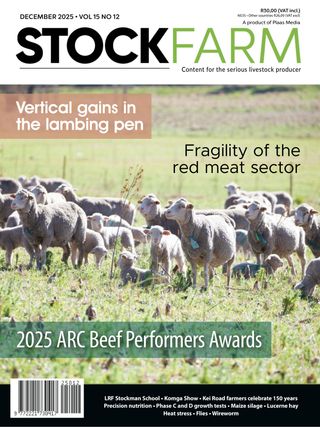

Esta historia es de la edición December 2025 de Stockfarm.
Suscríbete a Magzter GOLD para acceder a miles de historias premium seleccionadas y a más de 9000 revistas y periódicos.
¿Ya eres suscriptor? Iniciar sesión
MÁS HISTORIAS DE Stockfarm

Stockfarm
World School Milk Day: A national celebration of dairy
The Department of Basic Education (DBE), in partnership with Milk SA's Consumer Education Project (CEP), marked the national celebration of World School Milk Day (WSMD) at Mandlomsobo Primary School in Bronkhorstspruit on 26 September.

2 mins
January 2026

Stockfarm
A breed that you like will work with you
Data can't fix what selection broke, and your grandpa knew it.
4 mins
January 2026
Stockfarm
2025 Santam Agriculture Silage Competition: Wet conditions, winning silage
Plaas Media's twelfth Santam Agriculture National Silage Competition once again showcased impressive expertise among its participants.
4 mins
January 2026
Stockfarm
Unravelling the regulations for dairy and imitation dairy products
Regulation R1510 of 22 November 2019, which governs dairy and imitation dairy products, recently took centre stage during a webinar hosted by the Dairy Standard Agency (DSA). Thabang Rampa, manager of regulatory affairs at the DSA, provided a technical interpretation of key sections of the regulation, aimed at improving industry's understanding of the prescribed minimum compositional and labelling requirements.
3 mins
January 2026

Stockfarm
2025 ARC National Master Dairyman Awards: Top dairy farmers honoured
The Agricultural Research Council (ARC) announced the winners of its 2025 National Master Dairyman Awards during a ceremony held in November at Lanzerac Estate in Stellenbosch.
2 mins
January 2026
Stockfarm
Abattoirs: The hidden pulse of meat safety
In conversations regarding the meat supply chain, the first and final links tend to take prominence, while the work performed by the middlemen often goes unnoticed. Yet every link plays a vital role. The real question is: Do we truly understand the value each link adds? Or has ‘value addition’ become shorthand for 'price addition, leaving producers and consumers feeling the financial strain?
5 mins
January 2026
Stockfarm
Silage equipment you can't do without
Silage is an invaluable resource on many livestock farms but producing it is not always simple or cheap.
3 mins
January 2026
Stockfarm
The value of a vaccination programme for cattle
Vaccination is essential for any cattle operation, especially given the increasing risk of disease outbreaks. According to Dr Paul Reynolds, a veterinarian at the Warden and Vrede Animal Hospitals, vaccines are never developed arbitrarily. Each exists because a specific disease threat warranted it.
4 mins
January 2026
Stockfarm
Silage competition winners: Key success factors
The Santam Agriculture National Silage Competition once again delivered impressive results, maintaining its high standards and enthusiastic participation. This year’s judging spanned six key categories: nutrient composition, fermentation quality, aerobic stability, top-layer losses, compaction or density, and visual assessment.
2 mins
January 2026
Stockfarm
Why use a silage inoculant?
Producing high-quality silage is critical for any livestock operation, especially in regions where seasonal forage shortages are common. One of the most effective ways to improve silage fermentation and preservation is with a silage inoculant.
2 mins
January 2026
Listen
Translate
Change font size