Intentar ORO - Gratis
Wet carcass syndrome: a scourge in SA sheep farming
Farmer's Weekly
|September 20, 2024
Wet carcass syndrome continues to take a huge financial toll on South African sheep farmers. Octavia Avesca Spandiel spoke to two experts about the ongoing genetic research aimed at addressing this issue.

Wet carcass syndrome (WCS) is a perplexing condition that significantly impacts the quality of sheep carcasses post-slaughter. The syndrome manifests itself after the slaughtering process, making it difficult to detect and prevent while the animal is alive. This condition poses considerable economic challenges to the sheep farming industry, particularly in South Africa, where it has been a persistent issue since the 19805.
Bhaveni B Kooverjee, a doctoral candidate at the Agricultural Research Council (ARC) researching WCS, and Dr Pranisha Soma, a researcher at the ARC, shed light on this complex syndrome, delving into the clinical signs, potential physiological and biochemical markers, impact on carcass processing, recent research findings and the economic implications of WCS.
"WCS is a condition that is only found in sheep and appears after slaughter. Prior to slaughter, the animal appears normal and unaffected. However, after the 24-hour cooling period, the carcass appears to have a sticky, slimy layer coating the entire outer layer of the carcass," explains Kooverjee. This condition makes the carcasses difficult to handle and its appearance affects its marketability
PHYSIOLOGICAL AND BIOCHEMICAL MARKERS
Detecting WCS before slaughter is a significant challenge. "WCS appears post-slaughter, there are no symptoms prior that we can use as identifying markers to say that this animal will be susceptible to WCS. It appears at the carcass stage," notes Kooverjee. This absence of early markers complicates efforts to manage and prevent the syndrome effectively. The presence of a slimy layer on the carcass significantly hampers processing. "The carcass, as it goes through the processes in the abattoir, becomes very difficult for the abattoir people to cut and clean because it's so slippery. The tools even slip off, posing a challenge for the abattoir workers working on the carcass," explains Kooverjee.
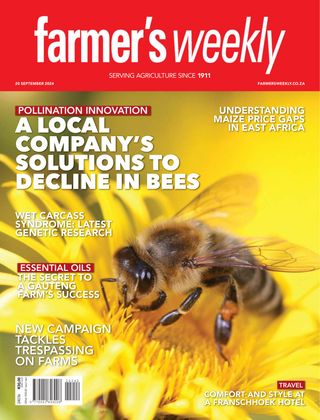

Esta historia es de la edición September 20, 2024 de Farmer's Weekly.
Suscríbete a Magzter GOLD para acceder a miles de historias premium seleccionadas y a más de 9000 revistas y periódicos.
¿Ya eres suscriptor? Iniciar sesión
MÁS HISTORIAS DE Farmer's Weekly

Farmer's Weekly
More about growing vegetable seedlings in trays
By considering various factors and tailoring care to specific vegetable needs, you can produce healthy, robust seedlings ready for transplanting into the garden, writes Shane Brody.

2 mins
March 27 - April 3, 2026

Farmer's Weekly
Prodigy of agriculture and land is now a presidential envoy
Wandile Sihlobo will be armed by state powers to accelerate any decision-making that the Presidency deems crucial to grow the sectors of agriculture and land
2 mins
March 27 - April 3, 2026

Farmer's Weekly
Notes from the Western Cape agricultural roadshow
We spent time last week engaging with agribusinesses and farmers in the Western Cape. The primary agricultural focus of the province is various fruits, citrus, table grapes, wine, wheat, barley, livestock, and aquaculture, among many value chains.
3 mins
March 27 - April 3, 2026

Farmer's Weekly
AGOA's promise fades under new US tariffs
Although the African Growth and Opportunity Act has been extended for another year, new US reciprocal tariffs have largely erased its duty-free benefits. Recent modelling shows sharp declines in African exports to the US, particularly in apparel-dependent economies such as Lesotho and Madagascar.
4 mins
March 27 - April 3, 2026

Farmer's Weekly
Egon Zunckel: a lifetime of learning from the soil
The Zunckel name is synonymous with no-till farming in South Africa. Egon Zunckel, a pioneer in the field and a passionate advocate for soil health, shared with Lindi Botha the lessons he has learnt over the years about building resilient soils and sustainable farming systems.
10 mins
March 27 - April 3, 2026
Farmer's Weekly
Researchers explore new tools to combat herbicide resistance
Research by students from Stellenbosch University aimed at combatting herbicide resistance was highlighted during a recent technical trial information day hosted by the Western Cape Department of Agriculture.
6 mins
March 27 - April 3, 2026

Farmer's Weekly
Lepas leaps into South Africa as the latest Chery-owned brand
Lepas has become Chinese carmaker Chery's latest local subbrand with the introduction of the L4 compact SUV. The Citizen's Charl Bosch reports.
2 mins
March 27 - April 3, 2026

Farmer's Weekly
La Rhone Limousins: a small mixed herd turned renowned stud
The Western Cape is not typically known for cattle farming, particularly in its fruit-growing regions. Yet nestled among the orchards below the mountains of Tulbagh is a Limousin stud that has made a name for itself. AJ du Toit of La Rhone Limousins spoke to Henning Naudé about producing high-quality genetics now found on farms in all nine provinces.
6 mins
March 27 - April 3, 2026
Farmer's Weekly
Nitrogen: no easy fix
Products that claim to herald a nitrogen revolution that will boost global food production are nothing more than snake oil, say scientists.
4 mins
March 27 - April 3, 2026

Farmer's Weekly
Potato soup
Rich, creamy, and indulgent, this soup is the ultimate in comfort food.
1 mins
March 27 - April 3, 2026
Listen
Translate
Change font size