
Vuélvete ilimitado con Magzter GOLD
Obtenga acceso ilimitado a más de 9000 revistas, periódicos e historias Premium por solo
Intentar ORO - Gratis
Is APAC Edging Closer to Clinical Application of Single-cell Tech?
BioSpectrum Asia
|BioSpectrum Asia Oct 2023
Asia Pacific APAC) is expected to be a major contributor to the growth of single cell technology as the market is driven by factors such as the growing demand for personalised medicine, advancements in sequencing technologies, and the increasing use of single cell analysis in drug discovery. While Japan is currently the fastest-growing country in the APAC single-cell analysis market, Singapore, China, and India are showing significant progress in adopting this technology.

A single cell contains multiple omics including genome, epigenome, transcriptome, and others. The completion of the Human Genome Project in 2003 was the beginning of deciphering the biological meaning of the three billion nucleotides in the human genome. Later, a key technological milestone was the release of several massively parallel DNA sequencing (next-generation sequencing) platforms in 2005 and 2007, which allowed for generating sequencing reads of billions of base pairs in a few days at a cost of less than $1,000. Moving on, the single-cell omics sequencing research started in 2009 when the single-cell RNA sequencing (scRNA-seq) assay was described.
In recent years, more and more single-cell technologies have been developed. A vast amount of single-cell omics data has been generated by large projects globally, such as the Human Cell Atlas, the Mouse Cell Atlas, the Mouse RNA Atlas, the Mouse ATAC Atlas, and the Plant Cell Atlas. Based on these single-cell big data, thousands of bioinformatics algorithms for quality control, clustering, cell-type annotation, developmental inference, cell-cell transition, cell-cell interaction, and spatial analysis are developed. Some of the most common single-cell technology methods include Single-cell RNA sequencing (scRNA-seq); Single-cell proteomics; Single-cell epigenomics; Single-cell imaging; and Single-cell electrophysiology.
Notably, the first successful demonstration of single cell RNA sequencing was published in 2009 by a team of researchers at the University of Washington led by Dr Jay Shendure and Dr Cole Trapnell. They used a method called Smart-seq to amplify and sequence the mRNA from individual mouse blastomeres (early-stage embryonic cells) and demonstrated that the technique could be used to profile gene expression in individual cells.
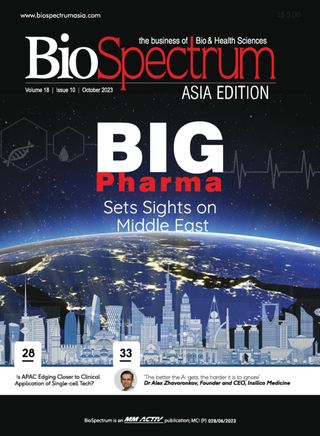

Esta historia es de la edición BioSpectrum Asia Oct 2023 de BioSpectrum Asia.
Suscríbete a Magzter GOLD para acceder a miles de historias premium seleccionadas y a más de 9000 revistas y periódicos.
¿Ya eres suscriptor? Iniciar sesión
MÁS HISTORIAS DE BioSpectrum Asia
BioSpectrum Asia
India–EU FTA Paves Way for Expanded Healthcare Trade
On January 27, 2026, after years of negotiations, India and the European Union announced a landmark Free Trade Agreement.

4 mins
BioSpectrum Asia March 2026
BioSpectrum Asia
PreferCo and Glatt to open CoE for precision fermentation bioprocess scale-up in India
In a major boost to Government of India's BioE3 push, German major Glatt and India-based startup PreferCo have announced the launch of \"PreferCo-Glatt Centre of Excellence (CoE) for Bioprocess Scale-Up\" in Hyderabad's Genome Valley.
1 min
BioSpectrum Asia March 2026

BioSpectrum Asia
Women's Health Surge in APAC
The rising burden of diseases such as ovarian cancer, breast cancer, cervical cancer, infertility, etc. is emerging as the key driver of the women's healthcare market across the globe. While North America led the women healthcare market in 2025, Asia Pacific (APAC) is expected to witness the fastest growth this year onwards. As a result, governments across the APAC region, are recognising the importance of women's health and are launching initiatives, particularly under female leaders, to improve access to healthcare services. Moreover, a number of women-led startups are now developing new solutions to address this growing burden of women-associated diseases in the APAC region. Let's take a closer look.
6 mins
BioSpectrum Asia March 2026

BioSpectrum Asia
Hanchor Bio receives US FDA Orphan Drug Designation for HCB101 in gastric cancer
Taiwan-based biotech startup HanchorBio, Inc. has announced that the US Food and Drug Administration (FDA) has granted Orphan Drug Designation (ODD) to HCB101 for the treatment of gastric cancer.
1 min
BioSpectrum Asia March 2026

BioSpectrum Asia
Daiichi Sankyo names Dr John Tsai as Global Head of R&D
Japan-based Daiichi Sankyo Company has appointed Dr John Tsai to succeed Dr Ken Takeshita, who is stepping down as Global Head of R&D, effective April 1, 2026.
1 min
BioSpectrum Asia March 2026

BioSpectrum Asia
"The global trend is moving beyond centralised hubs toward distributed networks and domestic capability"
King Faisal Specialist Hospital & Research Centre (KFSHRC) and US-based Germfree Laboratories have announced a strategic partnership to develop Saudi Arabia's first fully integrated, modular Advanced Therapy Medicinal Product (ATMP) Manufacturing Campus.
4 mins
BioSpectrum Asia March 2026

BioSpectrum Asia
SEOUL'S RISKY DRUG PRICING RESET
Drug pricing has once again moved to the centre of policy debate in South Korea, with the government recently stepping back from its proposed generic drug pricing reform.
2 mins
BioSpectrum Asia March 2026

BioSpectrum Asia
Takeda and Iambic sign $1.7 B deal to advance AI driven design of small molecules
Iambic, a US-based clinical-stage life science and technology company developing novel medicines using its artificial intelligence (AI)-driven discovery and development platform, has announced a multi-year technology and discovery collaboration agreement with Japan-based Takeda Pharma that will use Iambic's industry leading AI drug discovery models to advance a select set of high-priority small molecule programmes, initially in Takeda's Oncology and Gastrointestinal and Inflammation therapeutic areas.
1 min
BioSpectrum Asia March 2026

BioSpectrum Asia
S.Biomedics announces partnership with Catalent to develop and manufacture TED-A9
US-based Catalent and South Korea-based S.Biomedics have announced a strategic partnership to support the development and manufacturing of TED-A9, S.Biomedics' allogeneic pluripotent stem-cell-derived ventral midbrain-specific dopaminergic precursor cell therapy being developed for the treatment of Parkinson's disease.
1 min
BioSpectrum Asia March 2026
BioSpectrum Asia
China revises drug administration regulations to spur innovation
China has revised regulations concerning drug administration in a bid to promote drug innovation, strengthen management of online sales of medicines and reinforce drug safety supervision.
1 min
BioSpectrum Asia March 2026
Translate
Change font size