
Vuélvete ilimitado con Magzter GOLD
Obtenga acceso ilimitado a más de 9000 revistas, periódicos e historias Premium por solo
Intentar ORO - Gratis
VALUE PUNCH
Motoring World
|March 2026
Cheaper, sharper and smarter than before, the Tata Punch.ev proves that going electric no longer means paying a premium
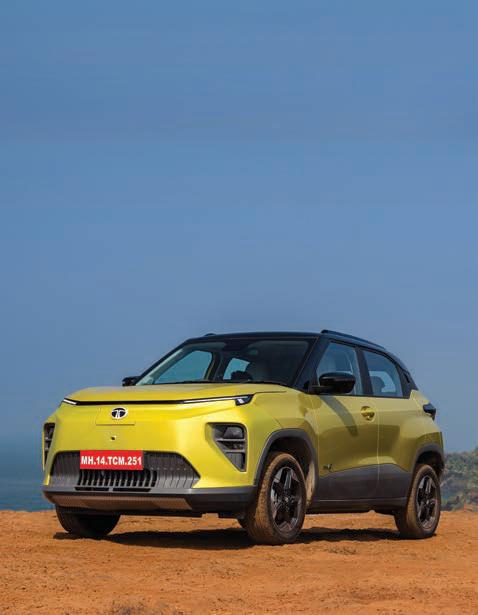
With the ICE Tata Punch still fresh in memory as one of India’s most successful compact SUVs, it was inevitable that attention would shift to its electric sibling.
Tata Motors has been riding the Punch wave for a while now — a car that reshaped the entry SUV segment — and with the updated Punch.ev, the company is clearly sharpening its electric push.
The biggest talking point is the price. At ₹ 9.69 lakh (ex-showroom), the new Punch.ev enters the market aggressively. Add Tata’s Battery-as-a-Service (BaaS) subscription model, which lowers the upfront purchase cost further, and EV ownership suddenly looks far more accessible. In certain configurations, the updated Punch.ev is nearly ₹ 1.5 lakh cheaper than the outgoing version — which naturally raises the question of how Tata has managed such a drop.
The answer lies in smart engineering rather than obvious compromise. Some changes are visible: rear disc brakes have been replaced by drum brakes, and ambient lighting has been removed. On paper, that brake downgrade might raise eyebrows, but in practice EVs rely heavily on regenerative braking. During our drive, there was no noticeable shortfall in stopping power, as regen handles a significant portion of the deceleration before the mechanical brakes even step in.
The larger cost savings come from underneath. Battery cell prices have fallen globally, and Tata has taken advantage of that shift. Interestingly, the battery pack itself hasn’t been downsized. Energy density has improved while the packaging remains largely unchanged, which means better efficiency without sacrificing range.
There’s also a new 6-in-1 integrated controller that combines several high-voltage components into a single unit. This reduces semiconductor usage, simplifies manufacturing and lowers overall system costs while improving efficiency. It’s careful optimisation rather than corner-cutting.


Esta historia es de la edición March 2026 de Motoring World.
Suscríbete a Magzter GOLD para acceder a miles de historias premium seleccionadas y a más de 9000 revistas y periódicos.
¿Ya eres suscriptor? Iniciar sesión
MÁS HISTORIAS DE Motoring World

Motoring World
IT'S IN THE GENES
BMW revives Daytona glory with a wild, modern racing tribute

1 mins
April 2026

Motoring World
CURBSIDE SUSHI
We set out chasing the promise of iftar-kababs sizzling, cutlets calling, and the kind of festive indulgence you plan your evening around.
1 min
April 2026

Motoring World
FALSE PROPHET
It looked promising at first. Did I just spot a unicorn? An AMG E 43 sedan? It can't be.
1 min
April 2026

Motoring World
WATCHFUL EYE
The kind of gadget you forget until you need it
2 mins
April 2026

Motoring World
VISUAL TRICK
Looks can be wildly misleading, and the Ferrari 849 Testarossa proved exactly that to me.
1 min
April 2026

Motoring World
GRACEFUL MISBEHAVIOUR
At first glance, this looks like the exact moment things have gone horribly wrong.
1 min
April 2026

Motoring World
PLAYING POLO
Aside from it being my job to drive modern cars, I actually quite like them.
1 min
April 2026

Motoring World
ULTRA UPGRADE
Samsung's latest flagship has landed, and it means business
1 min
March 2026

Motoring World
FROZEN IN TIME
The time we went to the toughest winter-testing grounds in the world
10 mins
March 2026

Motoring World
INTELLIGENT MOTION
A sophisticated fusion of intelligent technology and effortless agility, engineered to master the relentless rhythm of the modern city
4 mins
March 2026
Listen
Translate
Change font size