Intentar ORO - Gratis
Keeping Things Together
The Country Smallholder
|April 2024
Claire Waring discusses methods of swarm control
-

AIthough this varies over the country, May and June are still the main swarming months, so you need to be ready to take steps to control colonies showing swarm preparations.
Think of the colony as being composed of three parts: the queen, the brood and nurse bees, and the flying bees. All swarm control methods consist of separating one of these from the other two. Like anything else, swarm control is not difficult when you understand the process. However, what you also have to realise is that just doing the separation is not enough. You will also need to intervene at one or two points. This is where you need to remember the development times for the queen and the workers. Whatever steps you take, the individual life cycles will continue.
If you remove the queen, the swarm will not leave the hive. 'Great,' you say. However, there are developing queen cells still in the colony. If you do not reduce these to one after they are sealed, the first virgin queen will emerge and swarm out of the hive, not only with the bees that would have accompanied her if she led an afterswarm, but also all the bees that would have gone with the original queen in the prime swarm. Rather than controlling swarming, you will be in a worse position, having lost even more bees. As the other virgin queens emerge, they are likely to lead out afterswarms so your colony will be depleted even further until the workers 'decide' that enough is enough and kill all but one of the remaining virgins in their cells.
If there is only one sealed cell, the virgin that emerges will not leave with a swarm. When she matures, she will fly out to a drone congregation area to mate and return to head the colony.
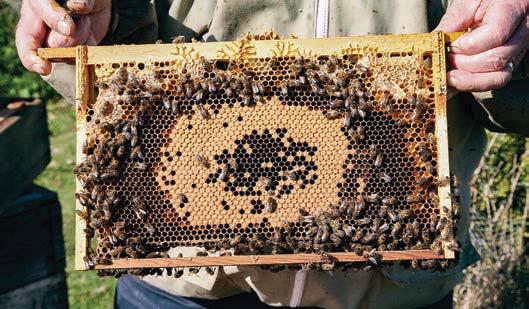
THE NUCLEUS METHOD

Esta historia es de la edición April 2024 de The Country Smallholder.
Suscríbete a Magzter GOLD para acceder a miles de historias premium seleccionadas y a más de 9000 revistas y periódicos.
¿Ya eres suscriptor? Iniciar sesión
MÁS HISTORIAS DE The Country Smallholder
The Country Smallholder
Geese for your garden or orchard
There are many reasons for wanting to keep geese - but there are geese for all reasons. Find out which is the one for you!

3 mins
February 2026

The Country Smallholder
Farming thoughts as the smallholding carries on
Agricultural journalist, and machinery writer Jane Brooks, joins us for her regular look at the world.
4 mins
February 2026
The Country Smallholder
Dutch beauty - the Welsummer, famous for plumage colour and terracotta coloured eggs
Victoria Roberts BVSC MRCVS looks at a breed that has been kept by royalty and finds a suitably regal bird with a fascinating history
3 mins
February 2026
The Country Smallholder
How and why eggs vary in size
Paul Donovan investigates the factors influencing the size of a chicken's egg and finds some surprising influences that cause variations
8 mins
February 2026

The Country Smallholder
Newark hosts 10,000 vintage tractor and heritage machinery enthusiasts
Around 10,000 people turned out to celebrate the history of farm machinery and implements through the ages at this year's Newark Vintage Tractor and Heritage Show, held under bright skies at Newark Showground. The two-day event once again proved why it remains one of the highlights of the vintage calendar, with visitors travelling from across the UK - some from more than 400 miles away - to share in a weekend that mixed nostalgia, engineering excellence and community spirit. Exhibits spanned everything from pre-First World War tractors and classic combines to potato handling equipment, steam engines and restored diggers, with every era of British farming represented. One of the standout attractions was the spectacular Caterpillar display, where 89 exhibits ranging from the smallest crawlers to the largest dozers filled the showground. There was incredible history on the stand, including a Holt 75 manufactured during the First World War and presented in pristine condition. The biggest of all, a mighty D10, towered above the crowd and drew constant attention from visitors.
2 mins
February 2026
The Country Smallholder
Then, Now... and Into the Future
Farming and smallholding practices have altered over the past century or so. Some have been subtle, others less so and many brought about by technology and legislation. In the last of the series, Jeremy Hobson continues to outline just a few of them.
2 mins
February 2026
The Country Smallholder
In the forest garden
Adrian Thomas visits a garden in Somerset that's an inspiring mix of food growing, sustainability and wildlife
4 mins
February 2026

The Country Smallholder
Tis the season for Seville oranges time to make marmalade
Henrietta Balcon looks forward to spring with the breakfast favourite
2 mins
February 2026
The Country Smallholder
Track and Trace
John Sones looks at changes concerning livestock welfare measures and available funding
3 mins
February 2026
The Country Smallholder
Massive win for animal welfare as new vet-backed law set to clamp down on puppy smuggling
After a long and sustained campaign by British Veterinary Association, the Animal Welfare (Import of Dogs, Cats and Ferrets) Bill has received Royal Assent to become law.
2 mins
February 2026
Listen
Translate
Change font size