
Vuélvete ilimitado con Magzter GOLD
Obtenga acceso ilimitado a más de 9000 revistas, periódicos e historias Premium por solo
If You're Not Paranoid, You're Crazy
The Atlantic
|November 2015
As government agencies and tech companies find ever more intrusive ways to influence and probe our thoughts and behavior, one man considers how to stay human in the panopticon.

I knew we’d bought walnuts at the store that week, and I wanted to add some to my oatmeal. I called to my wife and asked her where she’d put them. She was washing her face in the bathroom, running the faucet, and must not have heard me—she didn’t answer. I found the bag of nuts without her help and stirred a handful into my bowl. My phone was charging on the counter. Bored, I picked it up to check the app that wirelessly grabs data from the fitness band I’d started wearing a month earlier. I saw that I’d slept for almost eight hours the night before but had gotten a mere two hours of “deep sleep.” I saw that I’d reached exactly 30 percent of my day’s goal of 13,000 steps. And then I noticed a message in a small window reserved for miscellaneous health tips. “Walnuts,” it read. It told me to eat more walnuts.
It was probably a coincidence, a fluke. Still, it caused me to glance down at my wristband and then at my phone, a brand new model with many unknown, untested capabilities. Had my phone picked up my words through its mic and somehow relayed them to my wristband, which then signaled the app?
The devices spoke to each other behind my back—I’d known they would when I “paired” them—but suddenly I was wary of their relationship. Who else did they talk to, and about what? And what happened to their conversations? Were they temporarily archived, promptly scrubbed, or forever incorporated into the “cloud,” that ghostly entity with the too disarming name?
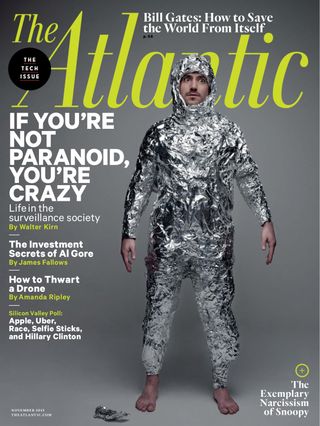

Esta historia es de la edición November 2015 de The Atlantic.
Suscríbete a Magzter GOLD para acceder a miles de historias premium seleccionadas y a más de 9000 revistas y periódicos.
¿Ya eres suscriptor? Iniciar sesión
MÁS HISTORIAS DE The Atlantic

The Atlantic
You Had to Be There
An emerging field of history asks if we can ever really understand how our forebears experienced love, anger, fear, and sorrow.

23 mins
January 2026

The Atlantic
By the Horns
The week before the biggest bullfight of her career, in Cádiz, Spain, this past July, 24-year-old Miriam Cabas posted a carefully produced video on Instagram.
1 mins
January 2026

The Atlantic
The New German War Machine
After World War II, Germany embraced pacifism as a form of atonement. Now the country is arming itself again.
18 mins
January 2026
The Atlantic
The Eloquence
The prime minister was watching a disaster movie when we found him.
4 mins
January 2026

The Atlantic
What's for Dinner, Mom?
The women who want to change the way America eats
12 mins
January 2026

The Atlantic
How Terror Works
A 1947 German novel explores the sometimes corrosive, sometimes energizing nature of fear.
8 mins
January 2026

The Atlantic
Yesterday's Idea of a Modern Man
Sam Shepard, a self-made cowboy, was also a poet of masculine angst.
7 mins
January 2026

The Atlantic
ACCOMMODATION NATION
America's colleges have an extra-time-on-tests problem.
11 mins
January 2026

The Atlantic
Respect the Drummer
A new history of rock, told through its overlooked heroes
5 mins
January 2026

The Atlantic
THE MOST POWERFUL MAN IN SCIENCE
WHY IS ROBERT F. KENNEDY JR. SO CONVINCED HE'S RIGHT?
42 mins
January 2026
Translate
Change font size