
Vuélvete ilimitado con Magzter GOLD
Obtenga acceso ilimitado a más de 9000 revistas, periódicos e historias Premium por solo
Intentar ORO - Gratis
Urban Deserts
Down To Earth
|March 15, 2018
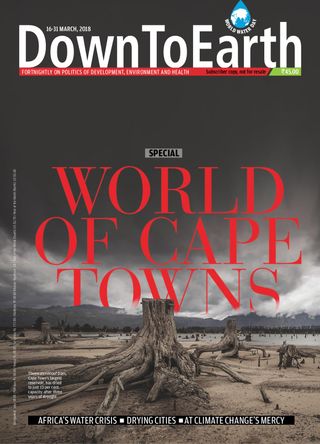
An estimated 400 million people currently live in cities with perennial water shortage. The number is slated to go up to 1 billion by 2050 due to rising urban population and the impact of climate change.
-

THE CRISIS at Cape Town has shown what unplanned urbanisation can do to water availability in the world’s urban centres. Not only are our metropolises headed to a dry future, the scarcity will increase as people are migrating to urban areas at unprecedented rates. About 54 per cent of the world,or 3.9 billion people, live in urban areas and they will grow between 60 and 92 per cent by the end of the century, says a study published in Nature this January. As a result, the urban water demand will increase by 80 per cent by 2050, it adds. Most worryingly, “climate change will alter the timing and distribution of water,” it says.
About 400 million urban dwellers currently face water shortage, states a 2014 study published in Global Environmental Change (see ‘36 per cent cities to face water crisis by 2050’ on p54). This when the average global temperature has not even risen by 1.5°C above pre-industrialisation levels. What will happen when it rises by 2°C? A study, published in Earth System Dynamics in November 2017, has made projections for those scenarios. A 1.5°C rise in the average global temperature will expose 357 million urban dwellers to extreme droughts while the figure for a 2°C rise will be 696 million, it says (see ‘A dry future’ on p55). The number of city dwellers facing water shortage by 2050 could be much higher, about 1 billion, says the Nature study.
These rises in temperature are no longer hypothetical scenarios. A draft report by the Intergovernmental Panel on Climate Change (ipcc) leaked this February warns that the average global temperature is set to rise by 1.5°C by the 2040s. What will happen to our cities?

Esta historia es de la edición March 15, 2018 de Down To Earth.
Suscríbete a Magzter GOLD para acceder a miles de historias premium seleccionadas y a más de 9000 revistas y periódicos.
¿Ya eres suscriptor? Iniciar sesión
MÁS HISTORIAS DE Down To Earth

Down To Earth
THINK TWICE BEFORE FELLING SAL TREES
Many trees considered to be affected by sal borer in the 1990s are still alive today

1 mins
February 16, 2026

Down To Earth
EDGE OF SURVIVAL
Caste divides deny marginalised communities land, resources and essential aid, leaving them more vulnerable to climate disasters
6 mins
February 16, 2026

Down To Earth
A WISH LIST?
Union Budget for 2026-27 conveys the impression of a roll-call of intentions and ambitious proposals, with little detail on their formulation
6 mins
February 16, 2026
Down To Earth
Break down the gender wall
THE RULING National Democratic Alliance (NDA) government has been heavily invested in the goal to make India a developed economy by 2047.
2 mins
February 16, 2026

Down To Earth
MENSTRUAL HEALTH, NOW A FUNDAMENTAL RIGHT
In a landmark judgement, the Supreme Court has recognised menstrual health and hygiene as a fundamental right under Article 21 of the Constitution of India, which guarantees the right to life and dignity.
8 mins
February 16, 2026

Down To Earth
Of devolution and new disasters
The 16th Finance Commission pushes for changes in view of new fiscal and climatic conditions
11 mins
February 16, 2026
Down To Earth
Rising risks of plastics
NEGATIVE IMPACTS on human health due to emissions linked to the plastic lifecycle could double by 2040, according to a study published in The Lancet Planetary Health in January.
1 min
February 16, 2026

Down To Earth
GAP BETWEEN EPIDEMICS NARROWING
A watershed-based and landscape-level approach is needed to address forest degradation
2 mins
February 16, 2026

Down To Earth
WAITING TO STRIKE
Sal heartwood borer is considered the biggest threat to forestry in India, especially to the sal tree, where it lives and breeds.
11 mins
February 16, 2026

Down To Earth
A SPRING DELIGHT
Mustard flowers are not meant only for the eyes. Invite them to your plate once in a while
3 mins
February 16, 2026
Translate
Change font size