Intentar ORO - Gratis
Star Collision
Down To Earth
|November 16, 2018
How scientists solved a centuries-old mystery

ABRIGHT NEW star appeared in the sky in June, 1670. It was seen by the Carthusian monk Père Dom Anthelme in Dijon, France, and astronomer Johannes Hevelius in Gdansk, Poland. Over the next few months, it slowly faded to invisibility. But in March 1671, it reappeared—now even more luminous and among the 100 brightest stars in the sky. Again it faded, and by the end of the summer it was gone. Then in 1672, it put in a third appearance, now only barely visible to the naked eye. After a few months it was gone again and hasn’t been seen since.
This has always seemed to be an odd event. For centuries, astronomers regarded it as the oldest known nova—a type of star explosion. But this explanation became untenable in the 20th century. A nova is a fairly common event, when hydrogen ignites in an otherwise extinct star causing a thermonuclear runaway reaction. Stars can also explode as supernovae, following an implosion of their core. However, we know now that neither would give the kind of repeated appearance seen in this event.
So what was it? Our new research, published in the Monthly Notices of the Royal Astronomical Society, offers a whole new explanation. In 1982, the American astronomer Mike Shara found a nebula—an interstellar cloud of dust, hydrogen, helium and other gases—at the position of the missing star, which had since acquired the name CK Vul in between. This proved that something had indeed happened here. Astronomers later noted that the nebula was expanding, and that the expansion had started around 300 years ago. But the star itself couldn’t be seen.
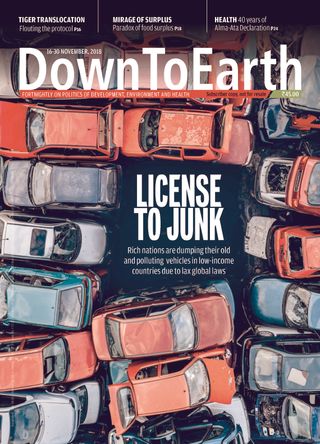

Esta historia es de la edición November 16, 2018 de Down To Earth.
Suscríbete a Magzter GOLD para acceder a miles de historias premium seleccionadas y a más de 9000 revistas y periódicos.
¿Ya eres suscriptor? Iniciar sesión
MÁS HISTORIAS DE Down To Earth
Down To Earth
Popular distrust
THE WORLD seems to be going through a period of stasis despite facing an unfathomable polycrisis.

2 mins
February 01, 2026

Down To Earth
CONSERVE OR PERISH
Periyar Tiger Reserve has rewritten Indian conservation by turning poachers into protectors and conflict into coexistence
5 mins
February 01, 2026

Down To Earth
'Rivers need to run free'
From Tibet to West Bengal, the Brahmaputra is the pulse of communities and ecosystems along its course. But what are the risks the river faces through human interventions, particularly dams, discusses journalist, author and filmmaker SANJOY HAZARIKA in his new book, River Traveller.
4 mins
February 01, 2026
Down To Earth
India is facing up to its innovation lag
There are signs now that India is acknowledging the superior strides made by China in a frontier technology like Al
4 mins
February 01, 2026

Down To Earth
Competing concerns
What are the repercussions of the EU-Mercosur pact that have made European farmers protest against the free trade agreement?
4 mins
February 01, 2026

Down To Earth
From fryer to flight
Sustainable fuel made from used cooking oil can play a pivotal role in helping India achieve its aviation emission reduction goals. Measures to collect this oil must be revamped
4 mins
February 01, 2026
Down To Earth
ACCESS OPEN
An amendment to India's nodal forest conservation law opens up forests across India to commercial exploitation by the paper industry
6 mins
February 01, 2026
Down To Earth
DRINK FROM TAP CAN BE A REALITY
As cities across India struggle to supply safe piped water, Odisha offers a success story
2 mins
February 01, 2026

Down To Earth
GREAT DRYING
The Earth is hotter than at any point in the past 100,000 years, with 2023-25 becoming the warmest three-year period on record and also breaching the 1.5°C threshold for the first time. One fallout is dwindling freshwater.
22 mins
February 01, 2026

Down To Earth
Green redemption
Restoration of grasslands of Kerala's Pampadum Shola National Park, once dominated by invasive Australian wattles, see a return of streams and native species
1 mins
February 01, 2026
Translate
Change font size