Intentar ORO - Gratis
Reign Over Rain
Down To Earth
|January 16, 2019
Rainfall deficit can be a challenge as well as an opportunity. Last year, Dhanbad faced a rainfall deficit of 60 per cent. EKLAVYA PRASAD narrates his personal experience of catching rainwater where it falls in his home, Uttarayan. By constructing rainwater harvesting structures, Uttarayan not only showed the way to address urban water scarcity, it also helped recharge groundwater with 1.06 million litres of rainwater

WHEN I was a child, the dug well in my home, Uttarayan, in Dhanbad, Jharkhand, was the most captivating landscape, especially during the monsoon. During this period, the dug well would be brimming with water. It used to be a mesmerising sight when the dug well would overflow. But for the past two decades, this phenomenon has ceased, and so has the incessant charm of the dug well. While researching, I found that this was not just my home’s story; it was the recurring narrative for the entire Dhanbad city. I also found that the reason for the decline in dug wells as well as groundwater was the domination of tube wells over traditional sources of water. For uninterrupted water supply, residents were extracting groundwater from greater depths.
An interesting development took place in May 2017. The Gang of 20—Future Water Leaders from Carmel School, Dhanbad, under the Participatory Action Research on Urban Groundwater—in collaboration with Megh Pyne Abhiyan, a Delhi-based non-profit working in Bihar and Jharkhand, conducted a survey of 734 households. The survey found that a majority (about 65 per cent) of residents were dependent on groundwater, followed by surface water (31 per cent). The dependence on both sources was 4 per cent.
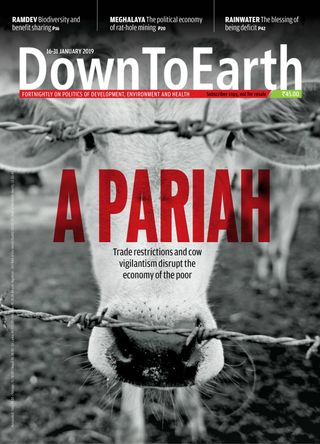

Esta historia es de la edición January 16, 2019 de Down To Earth.
Suscríbete a Magzter GOLD para acceder a miles de historias premium seleccionadas y a más de 9000 revistas y periódicos.
¿Ya eres suscriptor? Iniciar sesión
MÁS HISTORIAS DE Down To Earth
Down To Earth
Popular distrust
THE WORLD seems to be going through a period of stasis despite facing an unfathomable polycrisis.

2 mins
February 01, 2026
Down To Earth
CONSERVE OR PERISH
Periyar Tiger Reserve has rewritten Indian conservation by turning poachers into protectors and conflict into coexistence
5 mins
February 01, 2026

Down To Earth
'Rivers need to run free'
From Tibet to West Bengal, the Brahmaputra is the pulse of communities and ecosystems along its course. But what are the risks the river faces through human interventions, particularly dams, discusses journalist, author and filmmaker SANJOY HAZARIKA in his new book, River Traveller.
4 mins
February 01, 2026

Down To Earth
India is facing up to its innovation lag
There are signs now that India is acknowledging the superior strides made by China in a frontier technology like Al
4 mins
February 01, 2026

Down To Earth
Competing concerns
What are the repercussions of the EU-Mercosur pact that have made European farmers protest against the free trade agreement?
4 mins
February 01, 2026

Down To Earth
From fryer to flight
Sustainable fuel made from used cooking oil can play a pivotal role in helping India achieve its aviation emission reduction goals. Measures to collect this oil must be revamped
4 mins
February 01, 2026

Down To Earth
ACCESS OPEN
An amendment to India's nodal forest conservation law opens up forests across India to commercial exploitation by the paper industry
6 mins
February 01, 2026
Down To Earth
DRINK FROM TAP CAN BE A REALITY
As cities across India struggle to supply safe piped water, Odisha offers a success story
2 mins
February 01, 2026

Down To Earth
GREAT DRYING
The Earth is hotter than at any point in the past 100,000 years, with 2023-25 becoming the warmest three-year period on record and also breaching the 1.5°C threshold for the first time. One fallout is dwindling freshwater.
22 mins
February 01, 2026
Down To Earth
Green redemption
Restoration of grasslands of Kerala's Pampadum Shola National Park, once dominated by invasive Australian wattles, see a return of streams and native species
1 mins
February 01, 2026
Translate
Change font size