
Vuélvete ilimitado con Magzter GOLD
Obtenga acceso ilimitado a más de 9000 revistas, periódicos e historias Premium por solo
Intentar ORO - Gratis
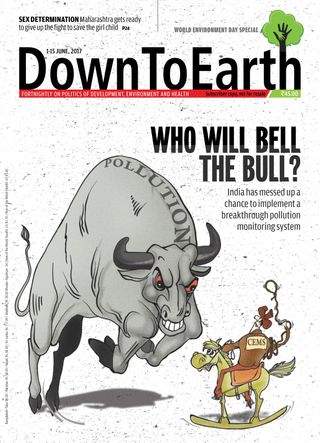
Chop The Dreck Rules
Down To Earth
|June 1, 2017
For farm forestry to grow, regulatory changes are the need of the hour, as this will not only benefit farmers but also help India meet its targets in the Paris climate pact

THE NATIONAL Forest Policy, 1988, brought in a strategic policy change by shifting the focus of forest management—from a “source of revenue” to “forest conservation and enhancement”. This shift led to lower wood supply from forests and encouraged growing trees outside forest areas to meet the rising demand for wood. The massive afforestation drives launched since then have led to a gradual increase in trees outside notified forest areas. The industry has also adapted to these policy changes by establishing a partnership with farmers through farm forestry and is now growing trees for fuelwood, fodder, timber and industrial wood.
To make farm forestry an economically viable proposition, the industry has invested huge resources for the genetic improvement and clonal development of tree species suitable for various purposes. Massive efforts are underway to develop and extend a “package of practices” suitable for growing productive plantations under different agro-ecological regions.
Once the clonal species were planted on the fields, farmers began to realise its economic benefits—there was a 400 per cent increase in productivity as compared to seed-based plantations. This development brought an exponential growth in farm forestry plantations, especially in Andhra Pradesh and Uttar Pradesh. Success of farm forestry plantations has contributed immensely to the increase in trees outside forests (ToF), and according to the State of Forest Report published by the Forest Survey of India, tree cover of over 11,100 km2 was added between 2001 and 2015.
Changing the landscape

Esta historia es de la edición June 1, 2017 de Down To Earth.
Suscríbete a Magzter GOLD para acceder a miles de historias premium seleccionadas y a más de 9000 revistas y periódicos.
¿Ya eres suscriptor? Iniciar sesión
MÁS HISTORIAS DE Down To Earth

Down To Earth
THINK TWICE BEFORE FELLING SAL TREES
Many trees considered to be affected by sal borer in the 1990s are still alive today

1 mins
February 16, 2026

Down To Earth
EDGE OF SURVIVAL
Caste divides deny marginalised communities land, resources and essential aid, leaving them more vulnerable to climate disasters
6 mins
February 16, 2026

Down To Earth
A WISH LIST?
Union Budget for 2026-27 conveys the impression of a roll-call of intentions and ambitious proposals, with little detail on their formulation
6 mins
February 16, 2026
Down To Earth
Break down the gender wall
THE RULING National Democratic Alliance (NDA) government has been heavily invested in the goal to make India a developed economy by 2047.
2 mins
February 16, 2026

Down To Earth
MENSTRUAL HEALTH, NOW A FUNDAMENTAL RIGHT
In a landmark judgement, the Supreme Court has recognised menstrual health and hygiene as a fundamental right under Article 21 of the Constitution of India, which guarantees the right to life and dignity.
8 mins
February 16, 2026

Down To Earth
Of devolution and new disasters
The 16th Finance Commission pushes for changes in view of new fiscal and climatic conditions
11 mins
February 16, 2026
Down To Earth
Rising risks of plastics
NEGATIVE IMPACTS on human health due to emissions linked to the plastic lifecycle could double by 2040, according to a study published in The Lancet Planetary Health in January.
1 min
February 16, 2026

Down To Earth
GAP BETWEEN EPIDEMICS NARROWING
A watershed-based and landscape-level approach is needed to address forest degradation
2 mins
February 16, 2026
Down To Earth
WAITING TO STRIKE
Sal heartwood borer is considered the biggest threat to forestry in India, especially to the sal tree, where it lives and breeds.
11 mins
February 16, 2026
Down To Earth
A SPRING DELIGHT
Mustard flowers are not meant only for the eyes. Invite them to your plate once in a while
3 mins
February 16, 2026
Translate
Change font size