Intentar ORO - Gratis
Snip A Forked Tongue
Outlook
|June 29, 2020
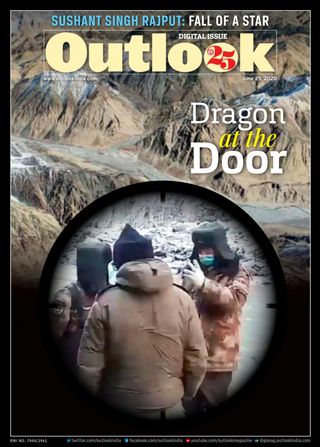
The equal cost imposed on China for its escalation at Galwan should caution it against a further violation of the June 6 agreement. With matching military strength in the area, both sides must ensure peace.

On June 6, 2020, after nearly a month of aggressive and violent face-offs at various points in eastern Ladakh, India, and China had agreed-upon measures to de-escalate the situation and resolve issues. Less than ten days later, on June 15, the most barbaric and violent clash happened in Galwan, bringing the situation back to the brink once again—perhaps more precariously than at any time in the past 45 years.
The landscape in Galwan is tough high-altitude mountainous terrain, and control over the heights overlooking the mountain passes and river valleys determines who dominates the area. This area is strategically important due to the vicinity of the 255 km road running along the Shyok river valley, from Darbuk to the area of Daulat Beg Oldi. The road is well inside Indian territory, but the heights overlooking the Galwan valley give it depth, and also overlook avenues of ingress and egress, to and from into each other’s territory.
India’s ability to build up in the Daulat Beg Oldi area, using this road, is perceived as a threat to the Chinese Aksai Chin area, and the highway linking Tibet to Xinjiang province. To the North, the Daulat Beg Oldi area leads to the Karakoram Pass, and Shaksgam Valley, illegally ceded by Pakistan to China in 1963.
The road from Darbuk to Daulat Beg Oldi has existed for some years now, but it has had problems, with stretches of the road and bridges getting washed away. India’s success in completing a crucial bridge last year, after efforts of almost two decades, seems to have pushed China to the edge.

Esta historia es de la edición June 29, 2020 de Outlook.
Suscríbete a Magzter GOLD para acceder a miles de historias premium seleccionadas y a más de 9000 revistas y periódicos.
¿Ya eres suscriptor? Iniciar sesión
MÁS HISTORIAS DE Outlook

Outlook
'Why GDP Growth Doesn't Always Translate Into Votes'
The recent election results have once again shown that economic growth alone does not guarantee electoral victory.

3 mins
June 06, 2026

Outlook
Lights, Camera, Othering
The establishment of Israel has been accompanied by a national cinema devoted to negating and erasing the Palestinian Other
5 mins
June 06, 2026

Outlook
Goodbye to All That
Booker-winning British author Julian Barnes' Departure(s) is a unique hybrid work: playful, philosophical, whimsical
4 mins
June 06, 2026

Outlook
Collapse of Trust
As the NEET-UG 2026 paper leak forced the cancellation of India’s biggest medical entrance exam, more than 22 lakh aspirants find themselves trapped in uncertainty
11 mins
June 06, 2026

Outlook
NO LONGER A TWELFTH MAN
Bihar cricket, which has languished in the shadows for long, is all set to improve its strike rate, thanks to Vaibhav Sooryavanshi, the new Bihari kid on the block
5 mins
June 06, 2026

Outlook
BLAZE OF GLORY
The challenges of being a celebrity cricketer at a young age can be tough to handle
5 mins
June 06, 2026

Outlook
THE SWASHBUCKLERS
A new generation of fearless stars is emerging and finding its feet at the very top of an extremely competitive cricketing environment
5 mins
June 06, 2026

Outlook
THE TEEN TORNAD
At the age of 15, Vaibhav Sooryavanshi is already a cricketing legend
10 mins
June 06, 2026

Outlook
A Journey to Remember
The prerecorded message crackled over the din in the compartment: ‘Welcome to the Shatabdi Express.
4 mins
June 06, 2026

Outlook
Crossing Borders
Ruth Martin is the translator of German-Iranian author Shida Bazyar’s novel The Nights are Quiet in Tehran (originally written in German), which has been shortlisted for the 2026 International Booker Prize.
4 mins
June 06, 2026
Translate
Change font size