
Vuélvete ilimitado con Magzter GOLD
Obtenga acceso ilimitado a más de 9000 revistas, periódicos e historias Premium por solo
Intentar ORO - Gratis
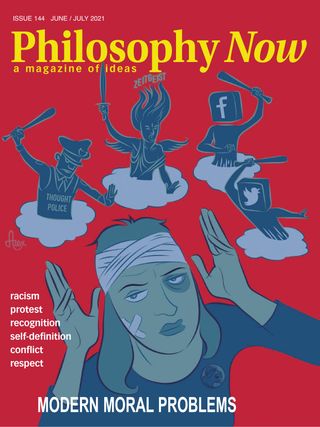
Recognition & Protest
Philosophy Now
|June/July 2021
Andrew Hyams recognises what fuels protest movements.

Throughout the last decade, social protest movements have filled our TV screens and newsfeeds. From Occupy and the Arab Spring to the Yellow Vests, Extinction Rebellion, the Women’s Marches and Black Lives Matter, people's power is as alive as ever.
Sadly, it also remains as controversial as ever, as the media furore over the toppling of statues in the US and UK has shown. This highlights the poor appreciation by many commentators of what drives social protest. If we want mature responses to social movements, we must first consider the points of view of those doing the protesting.
A philosophical account of social movements that does just this is Axel Honneth’s ‘recognition theory’, originally developed in the 1990s. Honneth (b.1949), a German social philosopher, was reacting against a previously academically dominant Marxist explanation for social conflict, which reduced the agency of protestors by claiming that their activism was predetermined by economic and social factors. Honneth sought a new theory that gave proper agency to individuals, recognizing their feelings and hopes. To do this, he turned to an eighteenth-century concept from GWF Hegel (who had in turn been inspired by Fichte) known as ‘mutual recognition. Fichte and Hegel held that a condition of increasing human self-consciousness is that we mutually recognise each other as free. The theory says that we can only truly become free ourselves if we recognise others as free, and have them so recognise us back.

Esta historia es de la edición June/July 2021 de Philosophy Now.
Suscríbete a Magzter GOLD para acceder a miles de historias premium seleccionadas y a más de 9000 revistas y periódicos.
¿Ya eres suscriptor? Iniciar sesión
MÁS HISTORIAS DE Philosophy Now

Philosophy Now
Bilbo Theorizes About Wellbeing
Eric Comerford overhears Bilbo and Gandalf discussing happiness.

9 mins
December 2025 / January 2026

Philosophy Now
What Women?
Marcia Yudkin remembers almost choking at Cornell
11 mins
December 2025 / January 2026

Philosophy Now
Islamic Philosophers On Tyranny
Amir Ali Maleki looks at tyranny from an Islamic perspective.
4 mins
December 2025 / January 2026

Philosophy Now
Peter Singer
The controversial Australian philosopher defends the right to choose to die on utilitarian grounds
5 mins
December 2025 / January 2026

Philosophy Now
Another Conversation with Martin Heidegger?
Raymond Tallis talks about communication problems.
7 mins
December 2025 / January 2026

Philosophy Now
Letters
When inspiration strikes, don't bottle it up. Email me at rick.lewis@philosophynow.org Keep them short and keep them coming!
17 mins
December 2025 / January 2026

Philosophy Now
The Philosophy of William Blake
Mark Vernon looks at the imaginative thinking of an imaginative artist.
9 mins
December 2025 / January 2026

Philosophy Now
Philosophical Haiku
Peering through life’s lens God in nature is deduced: The joy of being.
1 mins
December 2025 / January 2026

Philosophy Now
Philosophy Shorts
More songs about Buildings and Food' was the title of a 1978 album by the rock band Talking Heads. It was about all the things rock stars normally don't sing about. Pop songs are usually about variations on the theme of love; tracks like Rose Royce's 1976 hit 'Car Wash' are the exception. Philosophers, likewise, tend to have a narrow focus on epistemology, metaphysics and trifles like the meaning of life. But occasionally great minds stray from their turf and write about other matters, for example buildings (Martin Heidegger), food (Hobbes), tomato juice (Robert Nozick), and the weather (Lucretius and Aristotle). This series of Shorts is about these unfamiliar themes; about the things philosophers also write about.
2 mins
December 2025 / January 2026

Philosophy Now
Hedonic Treadmills in the Vale of Tears
Michael Gracey looks at how philosophers have pursued happiness.
8 mins
December 2025 / January 2026
Translate
Change font size