
Vuélvete ilimitado con Magzter GOLD
Obtenga acceso ilimitado a más de 9000 revistas, periódicos e historias Premium por solo
“ TOUCH THE MOON ” WITHOUT LEAVING EARTH
Rock&Gem Magazine
|June 2021
Discovering Similarites Between Space and the Upper Midwestern U.S.

The next time you glance up at the Moon (if more than just a narrow crescent is visible), take an extended look at what you see. Even with the unaided eye, or better still, with a pair of binoculars, you’ll note that there are two different types of landforms visible on its surface.
One of these is the lighter-colored, more rugged lunar highlands, while the other consists of the darker-colored, relatively smooth lava plains or lunar maria (plural of mare – the Latin word for “sea”). The older (and heavily cratered) highlands resulted from the cooling of a “magma ocean” that once blanketed the Moon’s surface. By contrast, the younger and roughly circular maria are remnants of former giant impact basins that afterward became filled with flood basalts from the Moon’s interior.
Six pairs of Apollo astronauts visited the Moon’s surface from 1969 to 1972 and returned with more than eight hundred pounds of lunar rocks (see Steve Voynick’s article, “Minerals of the Moon,” January 2020 Rock & Gem). Scientific analysis of these samples (which remains an ongoing endeavor) has told us a great deal about the makeup of our nearest neighbor in space. In turn, radioactive dating of these rocks has enabled us to reconstruct an accurate chronology of the Moon’s leading geological events –– a history stretching back roughly 4.5 billion years before the present. At the same time, these lunar rocks provided evidence for a dramatic new theory of the Moon’s origin (see ahead), one that likewise explains the cause of its former magma ocean.
ANORTHOSITE
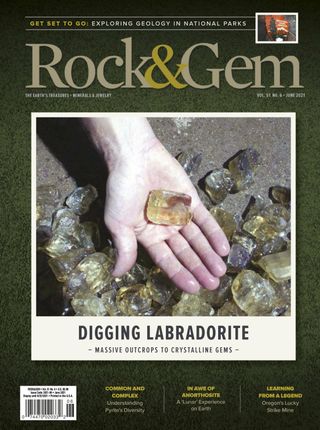

Esta historia es de la edición June 2021 de Rock&Gem Magazine.
Suscríbete a Magzter GOLD para acceder a miles de historias premium seleccionadas y a más de 9000 revistas y periódicos.
¿Ya eres suscriptor? Iniciar sesión
MÁS HISTORIAS DE Rock&Gem Magazine
Rock&Gem Magazine
A New Amber Locality Fills a Gap
A sandstone quarry in central Ecuador has yielded the first significant deposit of Mesozoic amber from South America.

1 min
January / February 2026
Rock&Gem Magazine
Did "Left-Handed" Fish Leave Water Earlier than Thought?
Fossil evidence suggests that fish (or \"fishapods\") dragged themselves onto land during the middle Devonian Period.
1 min
January / February 2026

Rock&Gem Magazine
"Lab Quakes” Produce Surprising Results
When faults let loose and earthquakes result, the main effect we mortals experience is the violent shaking.
1 min
January / February 2026
Rock&Gem Magazine
This Egg is No Spring Chicken
How to date a dino egg
1 min
January / February 2026
Rock&Gem Magazine
Have we Already Mined the Critical Minerals We Need
Then why are we throwing them away?!
1 min
January / February 2026
Rock&Gem Magazine
One Toxic Worm
A critter that creates & tolerates orpiment!
1 min
January / February 2026
Rock&Gem Magazine
ROCK & GEM FIELD GUIDE: Silver
Silver (Ag) is a native element and one of Earth's most prized precious metals.
2 mins
January / February 2026
Rock&Gem Magazine
DINOSAURS OF THE HELL CREEK MUSEUM
In the Badlands of South Dakota, just outside the small town of Belle Fourche—pronounced “Bell Foosh”—a new attraction has taken shape that every dinosaur enthusiast should see. The Dinosaurs of the Hell Creek Museum is part hands-on exhibit, part science center and part active research lab.
3 mins
January / February 2026
Rock&Gem Magazine
The Lost Twins of Kongsberg
A Silver Story Resurfaced
3 mins
January / February 2026
Rock&Gem Magazine
Switzerland's ICE PALACE
Walk Inside a Glacier at The Top of Europe
7 mins
January / February 2026
Translate
Change font size