
Vuélvete ilimitado con Magzter GOLD
Obtenga acceso ilimitado a más de 9000 revistas, periódicos e historias Premium por solo
Intentar ORO - Gratis
"Henrietta Maria has been looked at far too much through the male gaze - it's time for another perspective"
BBC History UK
|September 2022
Leanda De Lisle speaks to Emily Briffett about her new study of Charles I's reviled queen and reveals why she doesn't deserve her rotten reputation

Emily Briffett: Your new book tells the fascinating story of Henrietta Maria, challenging the myths surrounding her life. To begin with, can you please introduce her to us?
Leanda de Lisle: Henrietta Maria was a Bourbon princess. She was the daughter of King Henry IV ("the Great"), a warrior king assassinated by a Catholic fanatic when she was just a baby. Her mother, Marie de Medici, ruled France as regent for many years. At the age of 15, Henrietta Maria married Charles I of England, Scotland and Ireland, later becoming the mother of Charles II and James II.
An important aspect of Henrietta Maria to address is her legacy. How has the Stuart queen been seen through history?
She is probably the most reviled consort to have ever worn the crown of the three kingdoms, but she was ultimately a victim of parliamentary propaganda of the period. In her lifetime she was described as the "popish brat of France" and a whore, and was said to have worn the britches in her marriage. Ever since, she's been perceived as the original "bad woman": Eve, the corrupter who seduced her husband into evil.
How did she come to be so hated?
As the old adage goes, history is written by the victors - those who overthrew the house of Stuart in 1688. A myth then grew up that English Protestantism played a pivotal role in the creation of our democracy, and indeed our sense of nationhood. Therefore, being a Catholic, Henrietta Maria was associated with Charles's authoritarianism and is wrongly assumed to have been, in part, responsible for it.
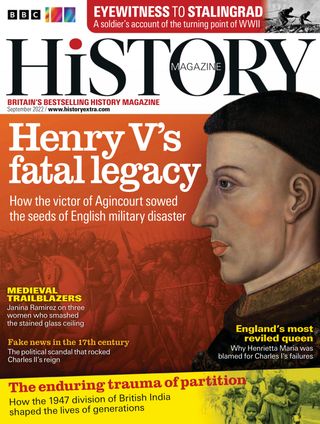

Esta historia es de la edición September 2022 de BBC History UK.
Suscríbete a Magzter GOLD para acceder a miles de historias premium seleccionadas y a más de 9000 revistas y periódicos.
¿Ya eres suscriptor? Iniciar sesión
MÁS HISTORIAS DE BBC History UK

History Extra
Personal stories
Few shows have enjoyed the longevity of Who Do You Think You Are? and it's easy to understand why it has endured.

1 min
June 2026

History Extra
Tidal change
Southern mythos notwithstanding, there exists no static, exceptional American South.
1 mins
June 2026

History Extra
Marriage story
Emily Howes on her novel about Catherine Dickens' relationship with her famous husband
1 mins
June 2026
History Extra
Sexual her-story
A witty, wide-ranging account of the myths and power structures behind female sexuality impresses SARAH JONES
2 mins
June 2026

History Extra
History man
According to Tom Hanks, during his childhood 'The War' was a recurring topic in the conversations of the adults around him.
1 min
June 2026
History Extra
How to be a master of disguise
10 do's and don'ts when attending a masquerade
2 mins
June 2026
History Extra
Age of indulgence
Our content producer Charlotte Vosper picks episodes of the HistoryExtra podcast about Georgian Britain
1 min
June 2026
History Extra
Gaffer tape
While Bobby Robson and Gareth Southgate both led England to World Cup semi-finals, Alf Ramsey remains the only manager to actually win the trophy.
1 mins
June 2026

History Extra
What's the origin of the Fosbury Flop?
Like the Salchow in ice skating, the Fosbury Flop is a sport technique that immortalises the name of its creator.
1 min
June 2026

History Extra
EXHIBITIONS
In 1776, the United States of America was born - heralded by the Declaration of Independence.
1 min
June 2026
Translate
Change font size