
Vuélvete ilimitado con Magzter GOLD
Obtenga acceso ilimitado a más de 9000 revistas, periódicos e historias Premium por solo
Intentar ORO - Gratis
Critical Supplier
Mining Weekly
|November 03, 2017
Battery boom relies on DRC avoiding chaos of past

The cars of the future will depend increasingly on supplies of an obscure metal from a country in the African tropics where there has never been a peaceful transition of power and child labour is still used in parts of the mining industry.
Most major automakers are pledging to build millions of electric vehicles as the world’s governments crack down on climate-damaging emissions from traditional-fuel engines. As a result, demand is surging for lithium-ion batteries, and the materials needed to make them include cobalt, a relatively rare substance found mostly in the Democratic Republic of Congo (DRC).
The country, formerly known as Zaire, supplies 63% of the world’s cobalt. Its market share may increase to 73% by 2025 as producers like Glencore expand mines, according to Wood Mackenzie. By 2030, global demand could be 47 times more than it was last year, Bloomberg New Energy Finance estimates.
“There are a lot of grand plans being put in place by automotive manufacturers, but not many of them seem to have considered the cobalt supply chain,” says Wood Mackenzie director of cross-commodity analytics, in London, Gavin Montgomery.
Few commodity markets are so dominated by one supplier, and that presents a problem for the world’s automakers.
Cobalt is a by-product of copper and nickel mining. Until recently, there were often surplus supplies, as it was used mostly to harden steel. But the metal’s ability to efficiently conduct electricity has made it essential for high-end rechargeable batteries. A typical power unit in an electric car contains about 15 kg of cobalt, though some varieties use less than 5 kg.
Over the next two decades, the global fleet of electric vehicles may reach 282-million, or about 16% of all cars on the road, BNEF analysts estimate.
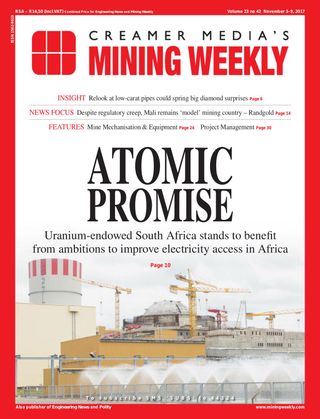

Esta historia es de la edición November 03, 2017 de Mining Weekly.
Suscríbete a Magzter GOLD para acceder a miles de historias premium seleccionadas y a más de 9000 revistas y periódicos.
¿Ya eres suscriptor? Iniciar sesión
MÁS HISTORIAS DE Mining Weekly

Mining Weekly
Supply Cliff?
Commodities supply shortfall looming following years of underinvestment

3 mins
Mining Weekly 17 March 2017

Mining Weekly
Strikes Threaten Coal Sector
If an agreement cannot be reached on the future structure and form of wage nego­tiations in the coal sector, unions have threatened to strike, says Solidarity mining industry deputy general secretary Connie Prinsloo.
3 mins
Mining Weekly 17 March 2017

Mining Weekly
Continued Focus On Downstream Development
Continued Focus On Downstream Development
2 mins
December 08, 2017

Mining Weekly
Unrelenting Scourge
Mining fatalities in South Africa rise for first time in decade
2 mins
December 15, 2017

Mining Weekly
Plea For Open Discussion
Diamonds body calls for ‘productive dialogue’ on Kimberley Process reform
3 mins
December 15, 2017

Mining Weekly
Deep Potential
Stillwater deal seen positioning Sibanye as globally competitive mining champion.
5 mins
January 20 - 26, 2017

Mining Weekly
Explosive Advantage
Explosives reloading system helping Gold One to reduce mining costs.
2 mins
January 20 - 26, 2017

Mining Weekly
Critical Juncture
South Africa’s mining sector at a crossroads, collaborative effort required.
7 mins
January 20 - 26, 2017

Mining Weekly
Consulting Engineering's Viability Proportional to Mining's Growth
The consulting engineer-ing industry’s sustain-ability and growth are largely dependent on and proportional to the mining industry’s sustainability and growth respectively, says industry body Consulting Engineers South Africa (Cesa).
3 mins
Mining Weekly 28 April 2017

Mining Weekly
Greater Emphasis On Ensuring Sustainability
Engineering expertise can be used to generate socio-economic gains for mining companies, particularly in jurisdictions that are dependent on the finite business of mineral extraction, states global engineering and infrastructure advisory firm Aurecon, an adviser to the African mining sector.
2 mins
Mining Weekly 28 April 2017
Translate
Change font size