
Vuélvete ilimitado con Magzter GOLD
Obtenga acceso ilimitado a más de 9000 revistas, periódicos e historias Premium por solo
Intentar ORO - Gratis
Choosing Afrikaners For Extensive Beef Production
Farmer's Weekly
|June 5 & 12, 2020
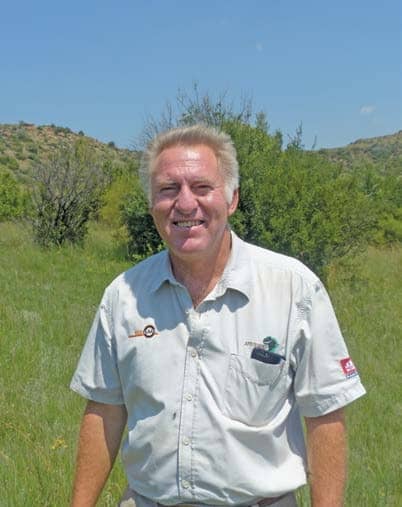
Jacquies Steenkamp produced the 2019 Agricultural Research Council (ARC) Afrikaner National Performance Test Class bull. Mike Burgess visited him on his farm near Rouxville to see why he believes this indigenous breed is so well suited to extensive beef production in demanding areas.

“The Afrikaner is a low-input animal with good-quality beef. Herein lies the real value of the breed,” says Jacquies Steenkamp, who registered his Derus Afrikaner Stud in 1996.
Today, he runs 240 Afrikaner female animals, half of which are registered, in the Rouxville district in the southern Free State, where they produce weaners almost entirely off the veld.
Steenkamp is highly committed to the breed and enthuses about its potential. A council member of the Afrikaner Cattle Breeders’ Society of South Africa, he says the breed offers superb business opportunities for the extensive beef farmer.
For example, the society registered Afri Beef as a quality free-range brand with the then Department of Agriculture, Forestry and Fisheries in 2016, and the brand won the People’s Choice Award at the 2019 African Livestock Trade Fair in Parys, Free State.
Steenkamp’s late father, Piet, ran a commercial Afrikaner herd near Vredefort in the Free State, and Steenkamp completed his BSc Agriculture, majoring in animal husbandry and genetics, at the University of the Free State in 1993. He, too, had become drawn to the breed by then, so after a few years in a mixed cropping/ livestock operation with his brother, André, in the Klerksdorp district of North West, he registered the Derus Afrikaner stud.
The foundation animals were from proven dam lines used by his father, while a process of genetic infusion using Bonsmaras helped him broaden diversity. Over the years, he sourced more Afrikaner bloodlines, including from the Cronjé and Ras families in Theunissen/Winburg and Hoopstad respectively.


Esta historia es de la edición June 5 & 12, 2020 de Farmer's Weekly.
Suscríbete a Magzter GOLD para acceder a miles de historias premium seleccionadas y a más de 9000 revistas y periódicos.
¿Ya eres suscriptor? Iniciar sesión
MÁS HISTORIAS DE Farmer's Weekly
Farmer's Weekly
Cash flow budgets: keeping farmers in control of liquidity, risk, and their survival
Profit doesn't guarantee a farm's survival - cash does. Cobus du Plessis explains why cash flow budgets are one of the most important yet underused financial tools on South African farms.

5 mins
February 27 - March 06, 2026

Farmer's Weekly
The toast of the Navy
The incredible story of the World War II-era Great Dane dog Nuisance being enlisted in the Royal Navy is well documented. Graham Jooste shared some entertaining anecdotes involving the canine shipmate.
6 mins
February 27 - March 06, 2026
Farmer's Weekly
Healthier soils deter destructive locusts
Locust swarms remain a serious global threat, capable of devastating crops, livelihoods and local economies across vast regions.
1 min
February 27 - March 06, 2026
Farmer's Weekly
Wheat crisis dominates Grain SA regional meetings
As the ongoing wheat crisis continues to erode producers' margins, emotions ran high at Grain SA's regional meeting in Moorreesburg in the Western Cape.
2 mins
February 27 - March 06, 2026

Farmer's Weekly
A FARMER'S EXPERIENCE
Street Wallet has been a game-changer for Mario Athanasopoulos, hydroponic production consultant and owner of Green City Farms.
1 mins
February 27 - March 06, 2026
Farmer's Weekly
Kesieberg Merino Stud Production Sale
The Kesieberg Merino Stud Production Sale was held on the farm Leeuwfontein on 4 February on behalf of Willie and Herman Henning.
1 min
February 27 - March 06, 2026
Farmer's Weekly
Not cheaper, just different: what you should know about farming in Mozambique
Although Mozambique is often viewed as a cheaper, easier farming location than South Africa, cost comparisons tell a more complex story. But while cross-border production presents real challenges, it also offers opportunities for complementary trade, diversification and regional food security, particularly when it comes to subtropical crops such as bananas.
10 mins
February 27 - March 06, 2026
Farmer's Weekly
The all-rounder anchoring South Africa's beef value chain
Louis Steyl, CEO of the Bonsmara Cattle Breeders' Society of South Africa, spoke to Octavia Avesca Spandiel about how the versatile Bonsmara breed anchors the country's beef value chain, delivering balanced performance, reproductive and feed efficiency, and carcass traits across extensive and intensive systems.
6 mins
February 27 - March 06, 2026

Farmer's Weekly
THE HITCHING POST
I'm a 60-year-old white woman who loves camping, animals, the outdoors, and watching sport.
2 mins
February 27 - March 06, 2026
Farmer's Weekly
Foot-and-mouth disease in pigs
Recently, the radio news mentioned an outbreak of foot-and-mouth disease (FMD) in pigs in South Africa.
2 mins
February 27 - March 06, 2026
Translate
Change font size