Intentar ORO - Gratis
Breeding Thoroughbreds Takes A Lifetime
Farmer's Weekly
|Farmer's Weekly 28 September 2018
39 YEARS AGOBreeding top-class Thoroughbreds can be a lucrative business, with The Green Monkey fetching a record-high price for a colt of $16 million [about R239 million] in 2004. However, breeding these animals takes precision, good management and patience.
-

“To realise prices at the Germiston yearling sales of R34 000 [R1,02 million] for Havanna Kid (Jamaico-Shamrock) and R20 000 [R602 777] for the Hammerman (Field Master-Killala), and to realise R108 000 [R3,26 million] for nine yearlings, does not happen overnight. So far it has taken the third Elley generation lots of hard scientific work and a great deal of capital to achieve this. Mr Eric Elley of West Bank Stud at Oudtshoorn is the third generation of the family who started the stud in 1922.
“About four brood mares are at present kept on the 90ha of irrigated lucerne and 35ha of river ground in this 200mm rainfall area. About 75% of the lucerne is used for the horses, either in the form of grazing or hay, which is made with a mower conditioner, and the rest is used for cattle and seed production.
RESIDENT STALLIONS
“At present two resident stallions are kept at West Bank. Windsor Lad was imported from New Zealand and won 15 races in South Africa. American Bold Pirate who was raced in England and France with great success, proves to be a great sire. Brood mares are from local and imported stock, most of them having an imposing record.
“Because all Thoroughbreds born before 1 August are automatically registered as a year old at that date, the mating season is arranged so that the mares will foal soon after 1 August. With a gestation period of 11 months and 6 days, mating takes place from September to mid-December.
“Experience tells Mr Elley when a mare is in season, and after teasing the mare she is brought into a paddock with the stallion, after being hobbled and fitted with boots to prevent injury to the stallion.
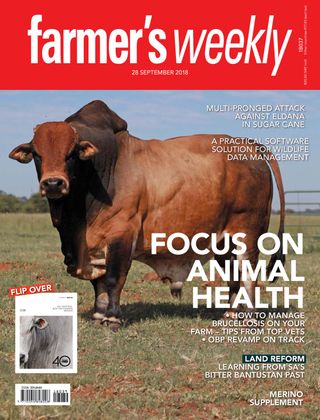

Esta historia es de la edición Farmer's Weekly 28 September 2018 de Farmer's Weekly.
Suscríbete a Magzter GOLD para acceder a miles de historias premium seleccionadas y a más de 9000 revistas y periódicos.
¿Ya eres suscriptor? Iniciar sesión
MÁS HISTORIAS DE Farmer's Weekly
Farmer's Weekly
How AFGRI uses technology to unlock farm finance from asset to market
As modern farming becomes more capital-intensive and digitally driven, AFGRI is reinventing agricultural finance by linking technology directly to lending decisions.

5 mins
January 16-23, 2026

Farmer's Weekly
Adele's Mohair: a living tapestry of craft, colour and rural heritage
Octavia Avesca Spandiel spoke to Adele Cutten, founder of Adele's Mohair, to explore how a small spinning experiment grew into a thriving rural craft enterprise rooted in South Africa's rich mohair heritage.
6 mins
January 16-23, 2026
Farmer's Weekly
Cannabis and marketing in South Africa
The path from cultivation to commercial success remains complicated by regulatory ambiguity. Cultivators who master compliant marketing while delivering verifiable quality will build sustainable businesses, says Thomas Walker.
2 mins
January 16-23, 2026
Farmer's Weekly
Foot-and-mouth disease project targets waste reduction and regulatory reform
A groundbreaking research collaboration between Red Meat Industry Services, the University of Pretoria, and global animal health leader Zoetis is aiming to transform South Africa's approach to foot-and-mouth disease.
3 mins
January 16-23, 2026
Farmer's Weekly
What to expect in 2026
The world faces a complex interplay of economic, geopolitical, environmental, technological, and social pressures.
3 mins
January 16-23, 2026

Farmer's Weekly
How drones are revolutionising pest and disease detection in agriculture
Drones are reshaping modern crop protection by giving farmers a powerful new vantage point: the sky. With advanced sensors, high-resolution imaging, and artificial intelligence-driven analytics, these unmanned aerial vehicles can detect early signs of disease, water stress, and pest damage long before the human eye can. Jedrie Harmse spoke to agricultural drone specialist Monique Heydenrych.
7 mins
January 16-23, 2026
Farmer's Weekly
Generic advertising in perspective
Dr Koos Coetzee explains how industry organisations and the agriculture sector actually have the ability to prudently manage the negative perceptions surrounding generic advertising campaigns.
2 mins
January 16-23, 2026
Farmer's Weekly
The modern Merino: the benchmark breed
The Merino breed has transformed dramatically over the past seven decades-from the skin-folded wool specialists of the 1950s to today's plain-bodied, fertile, well-balanced sheep prized for their dual-purpose productivity. Yet, despite its versatility, myths persist. Willie van Heerden, manager at Merino South Africa, dispels some of these myths.
2 mins
January 16-23, 2026

Farmer's Weekly
Elsenburg Agricultural Training Institute celebrates excellence
The Elsenburg Agricultural Training Institute marked a major milestone in December 2025, conferring over 200 agricultural qualifications, including bachelor's degrees and various national certificates.
2 mins
January 16-23, 2026
Farmer's Weekly
Grain SA issues guidelines as poor-quality agri inputs threaten farmers livelihoods
Grain SA has urged South African grain and oilseed farmers to act fast when seeds, fertilisers, or agrochemicals underperform, providing clear guidelines to protect crops.
2 mins
January 16-23, 2026
Translate
Change font size