
Go Unlimited with Magzter GOLD
Get unlimited access to 10,000+ magazines, newspapers and Premium stories for just
Switching Regulator Efficiency - Minimize Power Consumption in Battery-Operated Systems
Circuit Cellar
|February 2025
A switching voltage regulator converts input DC voltage into a desired output DC voltage. This month, Stuart delves into the factors that influence the efficiency of switching regulators, and why they are crucial for embedded applications. From understanding the role of inductors and transistors to exploring practical examples, this article offers valuable knowledge for anyone interested in optimizing power supply designs.

In a lot of embedded applications, you will use a single power supply, either from the AC line or from batteries. But in some cases, you will have an application that needs more than one voltage. For example, you might have a battery-operated system that needs a 9V or 12V supply voltage for an op amp that is sensing something from a sensor. Or you might need to illuminate an LCD backlight using a voltage that is higher than the supply voltage. You might have a device that operates from a 6V battery (such as four AAA cells), but that has to power a 3.3V MCU.
In all these cases, you need a voltage regulator—a device that produces a constant output voltage to power an electronic circuit. In each instance, you can use a switching power supply to generate the needed voltage. A switching regulator, whether step-down or step-up, uses switching techniques to produce a regulated output voltage. But, especially in battery-operated equipment, you want the power supply to be as efficient as possible, so as to minimize the power it uses.
In my column on “Voltage Regulators” (Circuit Cellar #387, October 2022) [1], I looked at voltage regulators, power, and efficiency, and I touched on switching regulators. This month, I want to narrow specifically to the things that affect the efficiency of switching regulators.
SWITCHING SUPPLY TYPES
Switching supplies come in three basic configurations:
• AC-to-DC converters change AC input to a DC output. An example is the power supply in a desktop computer. I won't be covering those here.
• Step-up or boost converters change a DC input voltage to a higher output voltage. An example would be the aforementioned switcher that converts the 3.3V MCU supply voltage to 6V to power an LCD backlight.

This story is from the February 2025 edition of Circuit Cellar.
Subscribe to Magzter GOLD to access thousands of curated premium stories, and 10,000+ magazines and newspapers.
Already a subscriber? Sign In
MORE STORIES FROM Circuit Cellar
Circuit Cellar
The Future of Sensors in Safety Systems Sensing the Stop
How Magnetic Sensors Are Enabling the Next Generation of Braking Systems

5 mins
December 2025
Circuit Cellar
Alif Semiconductor Elevates Generative AI at the Edge with New Support for ExecuTorch Runtime in Its Ensemble MCUs
Alif Semiconductor, the leading global supplier of secure, connected, power efficient Artificial Intelligence and Machine Learning (AI/ML) microcontrollers (MCUs) and fusion processors, announced that developers can now use the ExecuTorch Runtime, a quantization extension of the popular PyTorch ML framework, for AI applications built to run on its Ensemble E4/E6/E8 series of MCUs and fusion processors.
1 min
December 2025

Circuit Cellar
Encrypted MQTT Protocol for Critical Sectors
Mechanisms, Challenges, and Best Practices
3 mins
December 2025
Circuit Cellar
Datasheet: Small Size, Big Power
Smaller Microcontrollers Bring New Possibilities
9 mins
December 2025

Circuit Cellar
Analog Devices Launches ADI Power Studio and New Web-Based Tools
Analog Devices, Inc. (ADI), a global semiconductor leader, announced the launch of ADI Power Studio, a comprehensive family of products that offers advanced modeling, component recommendations, and efficiency analysis with simulation.
1 mins
December 2025
Circuit Cellar
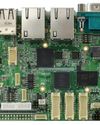
Compact IBR300 2.5" SBC Powered by NXP i.MX 93 from IBASE
IBASE Technology, Inc., a leading provider of rugged embedded computing platforms, announced the release of the IBR300, a 2.5\" RISC-based single board computer (SBC) powered by the NXP i.MX 93 processor with dualcore ARM Cortex-A55 (up to 1.7GHz) and a Cortex-M33 MCU.
1 min
December 2025
Circuit Cellar
Sensors in the Spotlight
The Next Decade of Embedded Sensor Systems
12 mins
December 2025

Circuit Cellar
Bob's Wrap Up
In Bob's last article with Circuit Cellar, he attempts to wrap up a career of more than 50 years as an embedded systems engineer and 14 years with Circuit Cellar. He looks at each of his 58 articles by category and provides some recommendations for his fellow engineers.
7 mins
December 2025

Circuit Cellar
Designing Embedded Software Architectures That Last
I've reviewed hundreds of firmware projects over the years, and one thing always stands out: the most successful projects have a clear, deliberate architecture.
10 mins
December 2025

Circuit Cellar
Broadcom Introduces Industry's First Wi-Fi 8 Silicon Ecosystem Powering the AI Era
Broadcom, Inc. unveiled the first Wi-Fi 8 silicon solutions for broadband wireless, targeting residential gateways, enterprise access points, and smart mobile clients.
1 mins
December 2025
Listen
Translate
Change font size